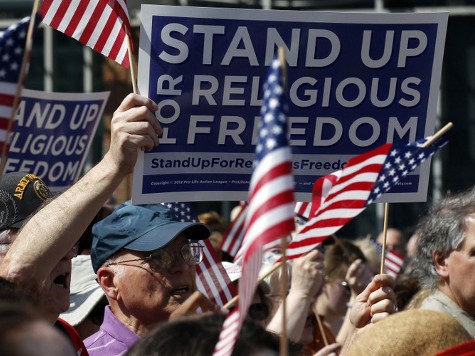

Two conservative members of Congress, Jim Sensenbrenner (R-WI) and Diane Black (R-TN), introduced the Religious Freedom Tax Repeal Act of 2012, H.R. 6097, on the floor of the House of Representatives on Tuesday.
The bill, which has 55 additional co-sponsors, directly challenges mandates introduced last fall by Health and Human Services Secretary Sebelius under the authority of the Patient Care and Affordable Health Care Act (Obamacare).
The recent Supreme Court decision declaring Obamacare constitutional precipitated the introduction of the legislation. The bill’s purpose is “to exempt employers from any excise tax and certain suits and penalties in the case of a failure of a group health plan to provide coverage to which an employer objects on the basis of religious belief or moral conviction.”
At a press conference Tuesday, Sensenbrenner emphatically articulated the danger posed to religious freedom in the United States if ObamaCare is fully implemented, and how the Religious Freedom Tax Repeal Act of 2012 will eliminate that danger:
What this legislationwill do is repeal the taxes that will be levied upon those religiousinstitutions and those who have moral or religious objections in the privatesector from having to pay for insurance under the Affordable Health Care Act,also known as Obamacare, that violate their religious or moral views.
We’ve had an awfullot of debate on this subject since Obamacare was passed and since Secretary Sebeliusannounced her mandates sometime in the fall of last year.
What has not beendiscussed is the tax that is imposed upon those that fail to comply with thatmandate, either through religious objections or moral grounds. Those taxes aresevere, they are confiscatory. It is $100 per employee per day. So, a religiousinstitution that, say, has a church and an elementary school beside it thatemploys fifty employees total, which include the administrative and maintenancepersonnel, ends up being taxed $36,500 per employee per year. Or thefifty-employee institution would have to pay a tax of $1,825,000 per year,every year.
This is a part ofthe Internal Revenue Code that was passed as a part of Obamacare, and for thosewho are interested in citing the section, it is Internal Revenue Code Section4980D. Obviously, if these taxes are levied and they are enforced, there willbe no religious-affiliated institutions left in this country.Religious-affiliated institutions, I think, have been one of the ways thatthere has been diversity provided in education, in healthcare, and in varioustypes of social services in-relief services. I don’t think they should be taxedout of business, and neither do my co-sponsors.
Chief co-sponsor Diane Black, who worked as a nurse for over forty years before her election to Congress in 2010, was equally blunt in her remarks:
The Religious Freedom Tax Repeal Act would stop the Obamaadministration from levying this huge tax on religious employers.
With the HHS mandate, the administration has set up an impossiblechoice for many religious affiliated institutions: either violate the law andpay a tax, or violate your conscience. This means some of the most respectedparochial schools, hospitals, soup kitchens, and universities across ourcountry will have to choose between violating their faith to keep their doorsopen or paying a potentially devastating tax.
Never before in our nation’s history has there been a mandateforcing individuals to violate their deeply held religious beliefs or pay atax.
Ironically, Congressman Sensenbrenner cited the origination clause, Article 7, Section 1, Clause 1, which states that all revenue bills must originate in the House of Representatives, as the constitutional authorization for the legislation. I noted in an op-ed earlier this month that Justice Roberts’ decision to call the Obamacare individual mandate a tax subjected the law to further constitutional challenges, since none of the substantive elements of the 2,000 plus page law originated in the House of Representatives.
Michael Patrick Leahy is a Breitbart News contributor, Editor of Broadside Books’ Voices of the Tea Party e-book series, and author of Covenant of Liberty: The Ideological Origins of the Tea Party Movement.
COMMENTS
Please let us know if you're having issues with commenting.