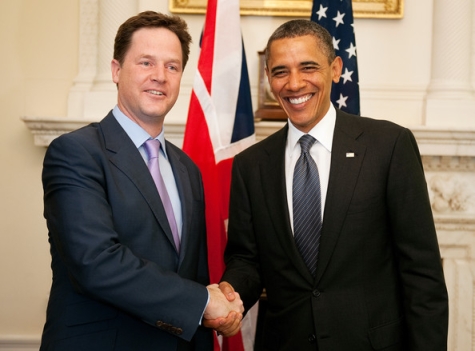
During Thursday’s regular press briefing White House Spokesman JayCarney was asked by ABC’s White House correspondent Jake Tapper aboutthe unattributed “Anglo-Saxon” comments which drew a negative responsefrom Vice President Biden. Carney referred that question to the campaignthen offered his positive spin on the special relationship between the US and the UK:
When this president came into office, our alliances were under strainand frayed; our standing in the world had been diminished. In the threeand a half years that President Obama has been in office, he hasstrengthened our alliances around the world, including and in particularwith NATO countries and including and in particular with the UnitedKingdom, with whom we have a remarkably strong bond, a specialrelationship that has never been stronger. And you know, I’ll leave theback-and-forth to the campaign.
But let’s talk about policy and fact here. And I would note that inthat article in question, again, as a matter of policy, the onlydifference that I could tell, aside from the quote that’s gotten a lotof attention that was focused on, was the need to — you know, that theonly difference in policy proposals that seemed apparent were that weshould move a bust from one room to another in the White House. And thatwas a principal policy difference, which is pretty preposterous.
There are several problems here. First, what is it about the wordrelationship that Jay Carney doesn’t understand? It’s not enough toclaim that the policy hasn’t changed even as the President continuallyrebuffs, embarrasses, and snubs the Prime Minister of our number oneally. That is what Obama has done since he took office.
In 2009, PM Gordon Brown made five separate requests to haveindividual talks with Obama. He was refused. Instead Obama announced hewouldmeet with “the leaders of Japan, China and Russia.”This followed the incident in early 2009 in which Gordon Brown gavesome very nice gifts to the President and his family, including a penholder carved from the timbers of a British anti-slavery ship and a first edition of Churchill’s biography. In return, Obama gave Brown a cheap set of DVDs which couldn’t even be played in Britain because they were region coded for the US. When the Telegraph asked a White House spokesman about this snub, the spokesman reportedly “sniggered.”
All of this followed the most well-known incident in which Obamareturned a bust of Churchill which the British government had loaned tothe White House. Contrary to what Jay Carney claimed today, the bust wasnot moved “from one room to another in the White House.” It was returnedto the British government despite their generous offer to let us keepit another four years. The bust now resides at the home of the Britishambassador. Carney got this wrong.
But even on policy the President has not always had Britain’s back.In April of this year, within weeks of the 30th anniversary of theFalklands war, Obama gave a speech in Cartagena, Colombia in which hereferred to the Falkland islands as the Malvinas,i.e. the Argentinian name for the islands. Actually, Obama blew it andreferred to the islands as “the Maldives,” a different group of islands8,000 miles away in the Indian Ocean. Perhaps the teleprompter wasn’tworking that day. Still, Obama’s intent was to side rhetorically withArgentina against the UK. As recently as last month, the US StateDepartment continued to sayit is neutral on the matter, i.e. not supporting the British claim tothe islands. Interestingly, the Argentinian President calls theFalklands a “colonial enclave.” In other words, she’s making ananti-colonial argument, one with which President Obama seems to agree.
Relationships with allies are about more than policy. Obama hasrepeatedly snubbed Britain even as he reached out to the Middle East,China and Russia. With an election coming in a few months, it’s a goodtime to ask what Obama’s counter-intuitive foreign policy prerogativeshave achieved, if anything.
COMMENTS
Please let us know if you're having issues with commenting.