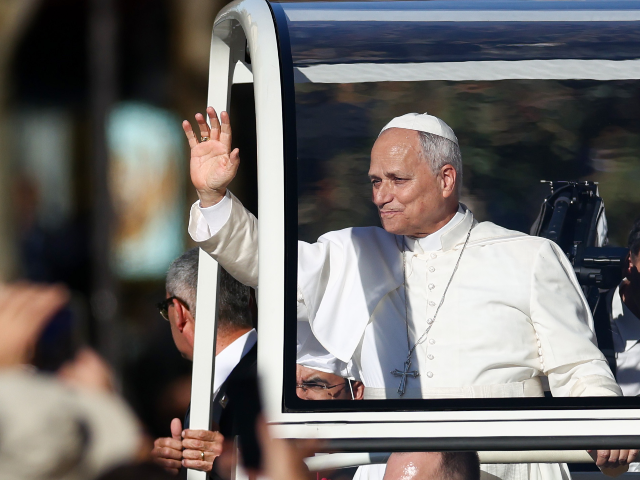

Two Chevrolet Colorado vehicles outfitted with security bubbles in the back arrived in Lima, Peru, on Sunday from Sao Paulo, Brazil, where General Motors completed the customization of the pickup trucks to serve as “popemobiles” for Pope Leo XIV during his visit to the country this month.
Pope Leo is expected to begin his first visit to Latin America this week since being elected the earthly head of the Catholic Church, beginning in Uruguay, then traveling to Argentina, and, finally, to Peru, where the American clergyman served for over two decades. According to the Vatican itinerary, Pope Leo will arrive in Uruguay on November 6 and conclude his visit in Peru on November 17. The visit is expected to be historic due to various factors, including both his connection to Peru and the fact that Argentina was the home nation of his predecessor, Pope Francis, who did not visit Argentina again after becoming pope.
Catholics in the three countries on Pope Leo’s itinerary are also especially expectant of the religious leader after his trip appeared to be placed in jeopardy last month when the Vatican revealed that he had been hospitalized due to the discovery of a malignant tumor on his lung. The pope was subjected to a successful surgery and soon announced that he would return to his regular duties, including keeping his commitment to visit South America.
Radio Programa Perú (RPP) revealed the arrival of the two popemobiles to the greater Lima area on Sunday, describing the intricate planning required to ensure the pope’s security, particularly during a time of increased organized criminal activity in the country. General Motors reportedly used its facilities in Brazil to customize the two vehicles to the specifications of the Vatican. The trucks were then sent to Peru on socialized aircraft, as they are believed to weigh about three tons each. The popemobiles are expected to help the pontiff travel through a host of locations in Peru including Lima, Callao, Cusco, Pucallpa, and Chiclayo, where he served as bishop during his time in the country.
Argentina and Uruguay have also begun their preparations for the papal visit. In Argentina, libertarian President Javier Milei — who had a notoriously mercurial relationship with Pope Francis — extended invitations this weekend to his country’s top political leaders to attend an official audience with the pope upon his arrival. Among those invited were Vice President Victoria Villarruel, the country’s governors, and all lawmakers in the Argentine Congress. The invites were received by political observers in the country with some surprise as Milei’s relationship with Villarruel has deteriorated significantly since they were elected in 2022. In addition, the Argentine outlet Infobae noted that the political visit is expected to be much more limited than the time that Pope Leo is scheduled to spend meeting with regular Catholics and preaching to the masses.
In Uruguay this week, hundreds of Catholics in the capital, Montevideo, organized a caravan to pray in preparation for Pope Leo’s arrival. The caravan included the display of a “mini-popemobile” built for the occasion.
View this post on Instagram
In addition to visiting Montevideo, Pope Leo has scheduled a stop on the outskirts of the city in a neighborhood known as Borro, which locals refer to as a “narco-neighborhood,” that is rife with drug trafficking and violent crime. The local parish near Borro has become a refuge for innocents seeking to escape the violence. Catholic authorities told local media that they are taking the pope’s security very seriously, preparing for a variety of potential threats.
Pope Leo’s last international travel occurred in September when he visited France and led events featuring hundreds of thousands of faithful convening to honor his visit. Among notable stops were his visit to the renovated Notre Dame Cathedral, where he kissed Jesus’s crown of thorns, and a Mass in Paris that attracted 800,000 people.
Pope Leo previously visited Spain in June, addressing young Catholics and discussing topics such as suicide and domestic violence.
“When people learn to pause and value what is important, appreciate time in a new way and reflect on their own lives while allowing themselves to be enlightened by the Gospel, they also develop a critical perspective on a social system that does not put people first and creates situations of injustice and existential poverty at various levels,” he advised at the time.
COMMENTS
Please let us know if you're having issues with commenting.