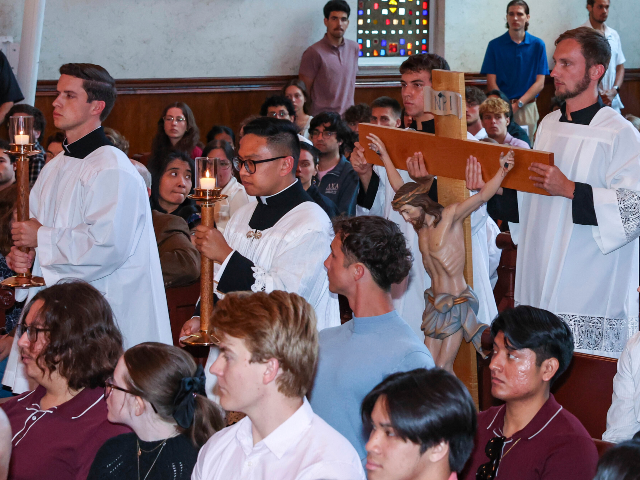

Catholic communities nationwide, from some of America’s largest cities to more rural areas, have documented a marked increase in converts this year as they approach the massive initiation ceremonies that coincide with the Easter holiday.
These increases appear to defy political and geographical lines and are centered around adult conversion classes. In Catholicism, non-Catholics must attend religion classes and undergo a set of sacraments to become fully initiated in the Church. The Church performs three initiation sacraments: Baptism, First Communion, and Confirmation. Various archdioceses have documented an increase in both non-baptized individuals converting to Catholicism and Christians of other faiths beginning their journey in the church.
On Thursday, Hallow, a company that maintains a mobile phone app connecting Catholics and offering various prayer and religious content, published a map of archdioceses that reported significant increases in the number of new converts between the Lenten season 2025 and this week. According to its CEO, Alex Jones, “more than 80 percent of dioceses are seeing 1.38x YoY growth on average for folks entering OCIA.” OCIA is short for Order of Christian Initiation of Adults (OCIA), the process by which adults enter the Church (as opposed to the initiation rights given to children raised in Catholic families). Among the regions identified as having some of the largest growths in adults interested in joining the Church were the three largest cities in the country — New York, Los Angeles, and Chicago — and smaller dioceses such as Duluth, Minnesota, and Fairbanks, Alaska.
In early March, one of the country’s largest archdioceses, the Archdiocese of Newark, reported that it was experiencing a record number of conversions and would initiate an astounding 1,701 people into Catholicism on Easter Sunday. New Jersey has consistently ranked as one of the country’s most Catholic states, largely due to its large Italian-, Irish- and Latin-American population; as of 2017, about 40 percent of the state identifies as Catholic, according to Gallup. Despite this, the Church has found room to grow in its largest territorial division, surrounding the state’s largest city.
“Last year, we had no idea where all the people came from then; 2025 eclipsed every year we had had up to then. We thought it might be an anomaly,” Father Armand Mantia who directs OCIA in Newark, told the National Catholic Register. “And then, all of a sudden, we had our rituals for 2026, and 2026 blew away 2025, which we didn’t think was possible.”
The Archbishop of Newark, Cardinal Joseph Tobin, paused an ongoing parish restructuring plan called, “We Are His Witnesses” in March after, he explained in a letter, an overwhelming response from Church members.
The plurality of those being fully initiated into the Catholic Church this Easter in Newark are baptized, either Catholics who never completed initiation or Christians of other denominations. The church identified 645 catechumens, however, those who have no Christian background, including no baptism, entering the church. This represents a 14-percent increase from last year and a 75-percent increase from 2023.
In Phoenix, Arizona — a significantly different social and demographic context than Newark, New Jersey — the Church also reported record numbers of participants in OCIA.
“More and more young adults are coming to participate in the sacraments and the ministry of our diocese,” Bishop John Dolan of the Diocese of Phoenix told the Catholic Sun in early March. “It is amazing to see so many people coming into the Church and participating in the Rite of Election. It’s a very exciting time.”
Phoenix is expected to welcome 1,600 new Catholics during the Easter Vigil, which falls on Saturday.
Los Angeles is expecting over 8,000 people to be fully initiated into the Church, a figure Angelus News described as “staggering.” This number is about 3,000 more people than in 2025. Speaking to the outlet, many of those participating in the initiation rites this weekend described personal struggles and search for meaning as leading them to join the Church.
“There was always this sense of acceptance and grace,” Jennifer Solares Gonzalez, one of those participating in initiation ceremonies this weekend in Los Angeles, told Angelus. “There’s never been a moment where I feel like if I have done something that I’m not proud of, that all of a sudden I was a bad person. It just meant that I had an opportunity for growth. Just having that perspective of that’s how God views us was a very big gift for me.”
The leftist newspaper New York Times described the increase in converts as “surprising,” but quoting clergymen who found rational explanations in the increase.
“In our age of uncertainty, and in our age of great anxiety, is a thirst and hunger for God and stability that faith brings to people’s lives,” Archbishop Mitchell Thomas Rozanski of St. Louis told the outlet.
“I think technology has isolated us from one other. I think that Covid just really magnified that isolation,” he explained. “We are realizing many of the ills of our society, particularly anxiety and depression, come about from that isolation.”
While many of those converting said in several news reported they did so to begin their marriage journey or find acceptance and peace, the Times found one teenager who cited “Catholic podcast stars he found on YouTube” for helping him make the decision to convert.
COMMENTS
Please let us know if you're having issues with commenting.