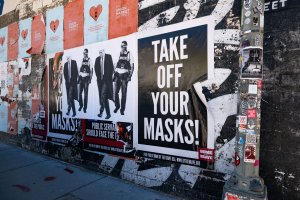

ST. PAUL, Minn., Feb. 13 (UPI) — The city of St. Paul, Minn., which has been occupied by thousands of ICE agents from Operation Metro Surge, has joined a growing list of state and local jurisdictions around the country seeking to prevent federal immigration enforcement agents from wearing masks while carrying out aggressive sweeps and arrests, even though the legality of such bans remains in question.
Just before the Trump administration’s announcement Thursday of an imminent end to the operation in Minnesota, which resulted in the killings of two people, residents in the capital city of St. Paul emotionally testified in favor of a proposed new ordinance that would prohibit the use of masks by all law enforcement officers, including federal Immigration and Customs Enforcement agents.
The testimony came as Democratic city leaders, including St. Paul Mayor Kaohly Her and all seven council members, sought to join a growing list of at least 17 states, as well as local jurisdictions such as Los Angeles County, Denver and Portland, Ore., in introducing legislation banning law enforcement agents from wearing masks — even though those bans are already facing legal challenges from President Donald Trump’s Department of Justice.
Democrats in the U.S. Senate, who have characterized ICE as an “out-of-control paramilitary force,” are also demanding that its agents stop wearing masks — among other key reforms — as a price for continuing to fund the Department of Homeland Security and avoid a partial government shutdown.
Administration officials, however, insist masks are necessary to protect the agents from “doxxing,” in which their identities and other personal information are revealed online as they engage in street sweeps and heavily armed raids.
After 10 weeks of more than 2,500 masked agents roaming the streets of the Twin Cities over the vehement objections of state and local officials, White House border czar Tom Homan said Thursday Trump has agreed to withdraw them, leaving only a residual force behind.
He called the operation a “success,” claiming more than 4,000 arrests, although the number is impossible to verify.
But the operation resulted in the killings of two civilians by federal agents: Renee Good and Alex Pretti, both 37 years old. Their deaths and the White House’s characterizations of them as “domestic terrorists” sparked an intense worldwide backlash against ICE and contributed to Trump’s slipping polling numbers on the immigration issue.
The St. Paul anti-masking proposal states that “a law enforcement officer shall not wear a face covering or personal disguise that conceals or obscures their facial identity in the performance of law enforcement duties.”
It would apply to “any governmental department, agency, office or division with authority to detect and apprehend persons for violating federal, state or local laws,” including any federal law enforcement agency, such as ICE, as well as to any Minnesota agency or those of other cities or states.
The measure will come up for a final vote next week.
Council members listened as a stream of residents took the podium to describe how the wearing of masks by ICE agents while carrying out aggressive immigration sweeps of neighborhoods in St. Paul and Minneapolis as part of Operation Metro Surge has created fear, trauma and a sense of intimidation among those witnessing and caught up in them.
One city resident, who identified herself only as Haikka, told UPI she immigrated to the United States from a European country decades ago and is now a naturalized U.S. citizen. She said she supports the ban because the masks worn by ICE agents are part of what she sees as a “militarization” of law enforcement typically found in authoritarian societies.
Haikka said she was present during an incident in south Minneapolis on June 3 in which heavily armed and masked agents from ICE, the FBI, the Drug Enforcement Administration and other agencies rolled up in military-style vehicles to stage a sting at a popular Mexican restaurant.
The operation, which was later revealed to be part of drug trafficking investigation rather than an immigration raid, quickly escalated into a tense standoff between hundreds and protesters, ICE agents and Minneapolis police officers in what was a major precursor to Operation Metro Surge.
“Just about every one of those agents were masked,” she said. “This is the first time I really saw a militarized action in the streets of a U.S. city — agents with fully militarized gear with long weapons. And they came in hot.
“The only agent who did not have a mask, I talked to him and said, ‘You’re the only one here who is not making me feel uncomfortable, because I cannot feel safe about all of what is happening here.’
“It was disproportionate and absolutely shocking.”
Another St. Paul resident, who identified himself as Tony and a member of the local grassroots anti-ICE coalition Neighbors Protecting Neighbors, responded to the Trump administration’s contention that masks are necessary to prevent doxxing.
The real reason for them, he said, “is to intimidate and cause fear and also to prevent being identified and being seen.”
Referring to tactic known as “pizza doxxing” in which Trump supporters and federal judges have received unordered pizza deliveries at their homes, Tony said, “Some people who have defended ICE wearing masks have said, well, that’s because they’re worried about getting doxxed.
“Well, I’ll tell you what, getting 12 pizzas delivered to your home is a far cry from the trauma that’s being experienced by people on the street by masked agents who are attacking neighbors and people within their homes.
“I have to ask, if you’re really proud of what you’re doing and you think it’s legal, then why hide it? You don’t need to hide behind a mask. Take it off and be accountable for your own behaviors.”
However, the intense opposition of ICE supporters to any attempts to rein in its behavior was also evident at the hearing when local right-wing activist Zak X took to the podium and hurled loud racial and sexual insults at several of the council members while calling those who oppose ICE’s tactics “[expletive] freak shows.”
“Have you ever been doxxed? Because my name and my car is on a picture all over the Whipple Building right now,” he claimed.
Zak X, formerly known as Zachary Stumpf before legally changing his name, was charged with fifth-degree assault for his actions during a Dec. 27 protest at the Bishop Whipple Federal Building in Minneapolis, which has served as ICE’s headquarters during the Twin Cities operation. Hennepin County prosecutors accused him of escalating a verbal confrontation with protesters by punching a man in the head.
One of the anti-masking ordinance’s co-sponsors, St. Paul Council member Molly Coleman, said that despite a federal court decision last week invalidating a recently enacted anti-masking state law in California, she believes her ordinance and others like it will eventually pass legal muster and come into force.
“We went into this feeling very strongly that it was both constitutional and necessary to enact public safety,” she told UPI. “We know that when people are wielding power in the name of the state, it is essential that people know who is wielding that power and who is attempting to claim authority over their liberty, their freedom.
“It is unacceptable for anybody who is operating under the color of law to do so under the cloak of anonymity. And this is something we have heard loud and clear from constituents — residents throughout St. Paul — for months.”
Coleman noted that when U.S. District Judge Christina Snyder struck down California’s “No Secret Police Act” at the request of the administration, she did so not because barring officers from wearing masks is in itself unconstitutional, but rather because the law made an exception for California state officers.
The measure’s chief sponsor, State Sen. Scott Wiener, a San Francisco Democrat, announced Monday he would immediately reintroduce the measure and add state officers to the law, while at the same time hailing the decision as an overall “win.”
“It is hard to overstate how important this ruling is for our efforts to ensure full accountability for ICE and Border Patrol’s terror campaign,” Wiener said in a statement.
Coleman agreed.
“In our ordinance, we are treating all law enforcement officers equally,” she said. “And the judge in that case was very clear that the incidental impacts on federal law enforcement’s work was an acceptable exercise of state authority.
“I took it as unequivocally good news for what we’re trying to do in St. Paul and what other cities and states are likely to try to do in the months to come.”
The legal battle isn’t over, she warned.
“We know that the Eighth Circuit Court of Appeals [covering Minnesota] is very different than the Ninth Circuit [in California]. We know that the Supreme Court is very different than a Democratic appointee in the District of California.
“But we are confident that we’re on the right side of the law, that we’re on the right side of the Constitution and the right side of public policy.”
COMMENTS
Please let us know if you're having issues with commenting.