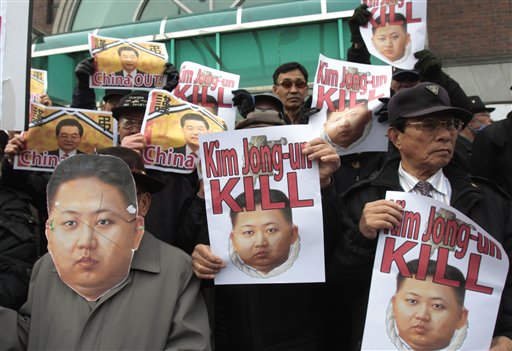
- South Koreans protest China's repatriation of North Korean defectors
- Greece completes bond swap deal with non-default default
- Greece's PM Papademos promises to use money wisely
- Greece's GDP contracts 7.5% in last quarter of 2011
- Yemen seeks $3-5 billion bailout from 'Friends of Yemen'
South Koreans have been demonstrating in front of China's embassy in
Seoul to protest China's plans to repatriate dozens of North Korean
defectors, sending them back to North Korea, rather than letting them
continue to South Korea. North Koreans defecting to the South often do
so by traveling through China, hoping not to get caught by Chinese
police. According to the South Korean lawmaker who sparked the
protests, "The North Korean defectors didn't flee their country to live
in China. They left so they could live in South Korea. China should
respect that." AP
Greece completes bond swap deal with non-default default
Politicians have been saying for months that a default on Greece's
debt will not be tolerated, but on Friday Greece avoided a default by
calling it a "restructuring." This whole saga has been amazing. It was
on July 21 of last year that European officials devised this plan where
private investors would "voluntarily" lose 21% of their investments in
Greek bonds in order to bail out Greece, and all it would take would be a
few weeks to iron out some details. It had to be "voluntary" so that
Greece would not go into default.
As the weeks went by, it became clear to everyone that 21% would not
be enough to save Greece. The amount was raised to 50%, then to 68%,
and now stands at 75% -- that the private sector investors (PSIs) would
lose. There was a question about how many private investors would be
willing to take that loss "voluntarily." Greece announced on Friday
that 85.8% of the eligible bonds would participate in the voluntary bond
swap. It will be interesting to see in the next few weeks what kind of
threats and extortion were used to convince that many private investors
to participate. I wouldn't be surprised if there were some physical
threats involved.
Once the "voluntary" bonds were accounted for, the next step was to
force others to participate involuntarily. This was done through
retroactive "collective action clauses" (CACs), bringing the total
participation rate to 95.7% of the total eligible bonds.
This was pretty clearly a form of default, but there have been
questions about whether the International Swaps & Derivatives
Association (IDSA) would call this a "credit event" that would trigger
the insurance payments to investors who had purchased credit default
swaps (CDSs). There had been concern that politicians would pressure
the IDSA to NOT call this a credit event, but a credit event was
announced shortly after the CACs were announced.
The result is that Greece's debt has been "restructured," which is
not a bankruptcy and not a default, though it is a credit event.
This will trigger about $3 billion in insurance payouts to holders of
CDSs. In this kind of situation, there are always concerns of a chain
reaction of bankruptcies, but politicians have been downplaying this.
The successful completion of the bond swap was a requirement of the
EU and IMF for approving the next bailout of Greece. Presumably the
bailout will now be approved, in time for Greece to make its next bond
payment on March 20, when €14.5 billion in bond repayments are due. Reuters
Greece's PM Papademos promises to use money wisely
The bond swap relieves Greece of about €100 billion in debt, which
will save Greece a great deal of money in interest and debt repayments.
In a televised speech on Friday night, Prime Minister Lucas Papademos
said that the deal served as a "window of opportunity and hope." He
said:
"From within a deep recession, and the trials of the
Greek people, there rises the hope for an exit from the worst crisis
since World War II.
We do not have the right to waste the money that we will save in
interest and debt repayments. We must use it to modernize our
infrastructure, make our economy more competitive, put the state in
order.
[The country will emerge from the] quicksand of the past few months.
For the first time Greece is not adding to but reducing the debt burden
on its citizens and the next generations.
This is an interesting statement because it's widely feared that
powerful labor unions will force the government to use any available
money simply to increase public sector wages and benefits. Kathimerini
Greece's GDP contracts 7.5% in last quarter of 2011
Few people credibly believe that there won't be a new Greek crisis
within a matter of weeks. The entire bailout plan that's supposed to
save Greece is based on assumptions of economic growth that, with
absolute certainty, will not be met. As if to prove the point, Greece's
government announced that the economy had contracted by 7.5% in the
last quarter of 2011, much worse than expected. Dow Jones
Yemen seeks $3-5 billion bailout from 'Friends of Yemen'
Yemen's government will present to the "Friends of Yemen" meeting in
Saudi Arabia on April 23 a request for an emergency infusion of $3-5
billioin in aid for "salvage and revival," following a year of protests
and violence that forced Ali Abdullah Saleh to step down as president.
The Friends of Yemen forum will include the United States, European
Union countries and the Gulf Cooperation Council. Yemen says that the
money would go towards the state budget, infrastructure projects and aid
to help poor Yemenis buy food and fuel.
The National (UAE)