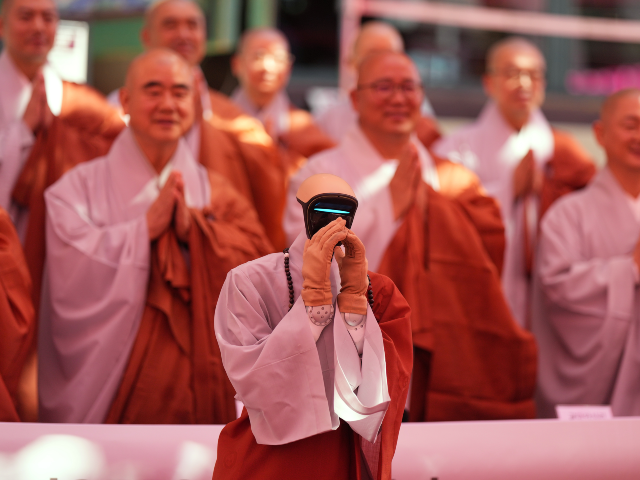

A humanoid robot dubbed “Gabi” became a Buddhist monk at the Jogyesa Temple in South Korea on Wednesday, in advance of Buddha’s birthday on May 24.
It was the first documented instance of a robot undergoing the sugye ceremony of monastic devotion.
Gabi’s four-foot-three-inch frame was wrapped in traditional Buddhist robes for the ceremony and it was equipped with a rather large set of palms it could press together in the Buddhist posture of prayer.
In addition to performing the sugye ritual, Gabi underwent the ritual purification ceremony of yeonbi, which normally involves getting burned with incense on the arms. Since that particular tradition requires skin to burn, Gabi got a Lotus Lantern Festival sticker and a prayer bead necklace instead.
The Lotus Lantern Festival is Buddha’s birthday ceremony. The Jogye order said its new robot monk would participate in the festival this year.
Gabi also accepted a modified version of the five vows made by human monks, promising to “respect life, act with peace toward other robots and objects, listen to humans, refrain from acting or speaking in a deceptive manner, and save energy.”
The name “Gabi” is a Buddhist term that means “mercy.” The robot is a $13,500 G1 model produced by a Chinese company called Unitree Robotics.
Jogyesa Temple is the headquarters of the Jogye order and a center of Korean Buddhism. Gabi’s ordination was intended to show that Buddhism is modern and forward-looking. The head of the order, Venerable Jinwoo, said he would incorporate artificial intelligence into Buddhism in his New Year’s 2026 address.
“The ordination of a robot signifies that technology must be used in accordance with the values of compassion, wisdom and responsibility, and symbolizes new possibilities for the coexistence of humans and technology,” the order said in a statement on Gabi.
Another leader of the order, Venerable Jungnyum, said human civilization has reached a “turning point where artificial intelligence is coming like a tsunami,” so there was “widespread concern and hope that Buddhism should also move toward a new direction of hope.”
Both supporters and critics of the cybernetic ordination viewed it as a publicity stunt, which could have some success at bringing young people into the faith as Buddhism’s numbers in Korea decline. (Or, in a pinch, they could always manufacture more robot Buddhists).
The publicity stunt might have misfired a bit because curious visitors to the temple discovered it does not actually own Gabi. It was only on loan from Unitree Robotics for the day, so visitors hoping to meet the robot monk were disappointed to learn it was gone.
The critics were particularly miffed that Gabi is more of a high-tech puppet than a true robot or artificial intelligence. It was remotely controlled during the ceremony on Wednesday rather than moving autonomously, and its verbal responses were pre-recorded by Jongye Order manager Hong Min-suk.
Hong told the leftist newspaper New York Times (NYT) that the robot ceremony still had symbolic value.
“Robots are destined to collaborate with humans in every field in the future. It will only be natural for them to be part of our festival,” he said.
“We’re heading toward a world where, when believers ask questions, robots will be better able to provide the answers that are most suited to each individual,” he argued.
COMMENTS
Please let us know if you're having issues with commenting.