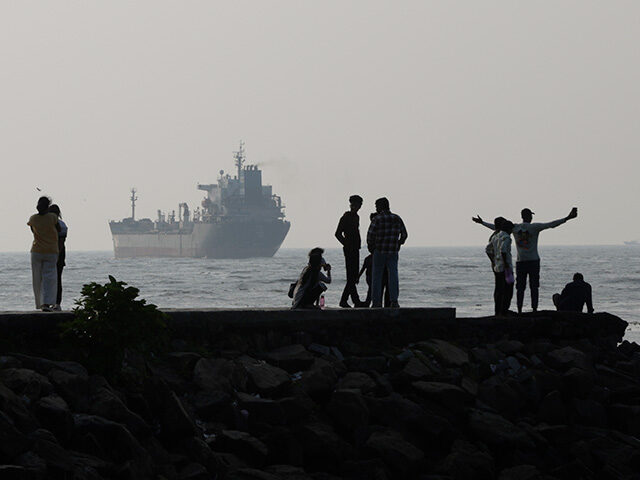

Data released by maritime tracking agency Kpler on Wednesday showed that oil exports have reached, and even surpassed, pre-war levels despite resurgent terror attacks by Iran on commercial vessels in the Strait of Hormuz.
Kpler reported total oil flows had reached 24.5 million barrels per day (bpd) by the week ending October 18, which is actually higher than the 24.4 million bpd average recorded on February 22, a week before the conflict between the U.S., Israel, and Iran began.
These totals included oil shipped through various alternatives to the Strait of Hormuz, including the Red Sea transit route, which some Gulf producers turned to when Iran began attacking tankers in Hormuz with drones, missiles, and mines. Kpler’s total did not include oil exports from Iran, which have dropped to near-zero due to the U.S. blockade.
Kpler noted that the volume of ship traffic through the Strait remains far below pre-war levels. Over a hundred ships per day passed through the Strait of Hormuz in happier times, while about 20 ships were known to complete the transit over the past ten days. Since those ships tend to run “dark” by turning off their transponders so Iran cannot easily target them, the exact number of transits can be difficult to determine.
As of Wednesday, Iran’s terrorist Islamic Revolutionary Guard Corps (IRGC) insists the Strait of Hormuz is “closed,” while U.S. Central Command (CENTCOM) is equally adamant that it remains “open.”
CENTCOM said on Tuesday that about 400 merchant ships passed through the strait over the preceding week, a far higher estimate than Kpler provided. The tendency of ships to run dark through the strait for safety reasons could account for some of this discrepancy. The high level of total oil exports noted by Kpler could also be a tribute to the success of using alternate shipping routes.
CENTCOM said on Saturday that 138 commercial vessels have been “redirected” by U.S. forces to enforce the blockade against Iran.
Bloomberg News noted on Wednesday that large tankers have been “traveling in convoys through the Strait of Hormuz” and transferring oil to other ships when they safely exit from the threatened area, which would also help to explain why a high volume of oil was moved through the strait with relatively few ship transits.
Convoy and ship-to-ship transfers are more “bumpy” than prewar transits through the Strait of Hormuz, so industry analysts said daily oil flows were likely to be more volatile, with surges of loadings and transfers recorded as each convoy moved through the strait.
Bloomberg also cited another tracking service, Vortexa, that reported a lower total oil flow than Kpler – but even Vortexa’s lower estimate was 18 million barrels a day, only slightly below the prewar average.
The International Energy Agency (IAE) said the United Arab Emirates (UAE) has been particularly successful at moving oil despite Iran’s threats, possibly due in part to the UAE’s ownership of many of the tankers that carry its products. Independent captains have been notably more reluctant to dare the Strait of Hormuz, although some still do.
The UAE also boasts a high-capacity pipeline called Habshan-Fujairah that bypasses the Strait of Hormuz, moving oil safely beyond Iran’s reach to ports in Oman. The UAE is working on a $3 billion project to double the pipeline’s capacity, with completion expected by the middle of next year.
International Business Times (IBT) noted on Wednesday that the remarkable resilience of Middle Eastern oil flows has yet to produce a major decrease in the cost of oil, with the benchmark Brent crude still hovering over $100 per barrel, in part due to greatly increased shipping and insurance expenses.
The high price of oil is one reason why ship owners have been willing to endure the risk of Iranian terrorism. Kpler estimated that oil from Iraq is currently fetching about $20 per barrel more than it did before the war, which works out to a cool $40 million in extra revenue for a fully loaded supertanker. If the cost of oil were to plummet, supply might dwindle, as the risk of shipping began to outweigh the rewards.
“The big picture is that the system for shipping through a dangerous Strait of Hormuz is now well-established and the risk appetite of those involved in exporting oil has risen,” senior Capital Economics commodities economist Hamad Hussain said on Wednesday.
“Iran would have to be more aggressive to achieve the same degree of control it previously possessed over oil flows from the region,” Hussain added.
On Tuesday, Iran added more ships to its “blacklist” of vessels that are ostensibly “forbidden” to use the Strait of Hormuz. The list now includes 121 ships.
The U.S. is reportedly considering a new strategy to increase Hormuz oil flows: allowing new investors to buy sanctioned vessels from the “shadow fleet” and rehabilitate them into legitimate crude oil transports.
Many of these ships were formally employed by Russia to evade sanctions on its oil that were imposed after it invaded Ukraine in 2022. Energy Secretary Chris Wright was adamant that the U.S. would not merely remove sanctions on these vessels by administrative fiat – there would be an approval process involved, presumably to ensure the ships do not return to smuggling oil for Russia or China.
“We’re going to move some of the ships from what I call the ‘bad-guy fleet’ to the ‘good-guy fleet.’ They will not carry sanctioned oil anymore,” he said.
“We are converting dark tankers to legitimate tankers. There is no removing of sanctions,” he insisted.
The “shadow fleet” could provide a substantial shipping resource, as experts believe it includes over 1,600 ships. If the ships are required to change owners, but not necessarily crews, then those ships might come with significant experience at “running dark” to evade detection. Wright said the administration hopes to enlist dozens, or even hundreds, of shadow fleet vessels in its bid to increase the global oil supply.
COMMENTS
Please let us know if you're having issues with commenting.