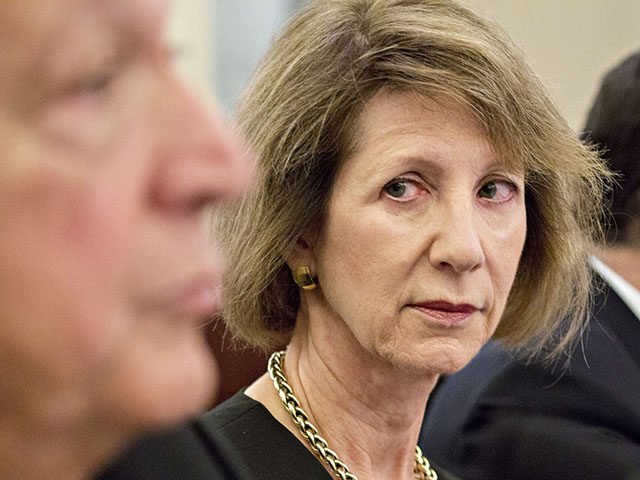

A former Trump administration official asked to remove her article from the National Review after the conservative publication requested an update with a more robust disclosure and discussion of potential conflicts of interest by the author, Diana Furchtgott-Roth.
Furchtgott-Roth served during Trump’s first term as the deputy assistant secretary at the Department of Transportation (DOT). While serving for the administration, she oversaw a 2021 DOT report evaluating GPS backups and complementary Position, Navigation, and Timing (PNT) technologies. The study tested eleven different PNT systems across fourteen metrics and delivered a clear verdict: “All TRL-qualified vendors demonstrated some PNT performance of value, but only one vendor (NextNav) demonstrated PNT performance in all applicable use case scenarios.”
Furchtgott-Roth at the time praised the findings, stating, “The results of the thorough scientific research conducted by this demonstration effort indicate that there are suitable, mature, and commercially available technologies to back up or to complement the timing services provided by GPS.”
This work was in furtherance of what President Donald Trump viewed as vital to the national and economic security of the United States.
In 2020, Trump stated in an executive order, “Because of the widespread adoption of PNT services, the disruption or manipulation of these services has the potential to adversely affect the national and economic security of the United States. To strengthen national resilience, the Federal Government must foster the responsible use of PNT services by critical infrastructure owners and operators.”
Now, Furchtgott-Roth serves on the advisory board of Tern AI, a company in the GPS backup space and is singing a proverbially different tune. (Update: Since original publication of this article, Furchtgott-Roth refuted any allegation of a sharp change in her opinion on GPS backups and PNT technology, telling Breitbart News that her views have evolved due to improvements in technology.)
On April 28, National Review ran an op-ed written by Furchtgott-Roth. She attacked NextNav’s Federal Communications Commission (FCC) petition to provide a complement and backup to GPS by reconfiguring and modernizing its licenses in the 900 MHz spectrum. The author portrayed this action as a United Arab Emirates (UAE) giveaway via the American-based investment firm Fortress Investment Group, claiming it would lead to massive disruptions to American consumers, and downplayed the need for new spectrum allocation despite the vulnerability she once highlighted at DOT.
Tern AI last October petitioned the FCC not to approve NextNav’s proposal.
In her National Review article, Furchtgott-Roth cites “tests” from Plum Consulting and Neology to back up her claims about “disrupting or displacing” other unlicensed devices on that spectrum band. However, she did not disclose that these tests were funded by clients of her husband, Harold Furchtgott-Roth, the former FCC commissioner and now consultant.
This includes:
- A February 2026 report that was “partially underwritten by the RAIN Alliance.”
- An April 2025 report about NextNav’s proposal was “partially underwritten by support from the E-ZPass Group, the International Bridge, Tunnel, and Turnpike Association, and Neology, Inc. The opinions expressed in this report, and any errors, are those of the author alone.”
After publication of her original op-ed, National Review advised Furchtgott-Roth that they intended to issue the following Editor’s Notes to her op-ed:
Editor’s Notes: In April 2025 former FCC Commissioner Harold Furchtgott-Roth, husband of the author, wrote “An Economic Analysis of NextNav’s Proposal for the Reallocation of Spectrum and the Modification of Rules in the Lower 900 MHz Band,” April 2025, partially underwritten by the E-ZPass Group, the International Bridge, Tunnel, and Turnpike Association, and Neology, Inc. In February 2026 Dr. Furchtgott-Roth wrote “An Economic Analysis of the Harm Caused to RAIN RFID Devices from NextNav’s Proposal for the Reallocation of Spectrum and the Modification of Rules in the Lower 900 MHz Band,” partially underwritten by the RAIN Alliance. Dr. Furchtgott-Roth has no ongoing financial relationship with these parties.
This article has been amended to repeat the fact that the UAE-owned sovereign wealth fund is the largest (but not the majority shareholder) in NextNav and to spell out the author’s basis for valuing the spectrum proposal (previously alluded to here )
Furchtgott-Roth apparently disputed the need for that proposed update and instead asked National Review to pull down her piece. The article link now states that it was removed at the request of the author
Update: The original version of this article said that Furchtgott-Roth “did not disclose her potential conflict of interest.” Furchtgott-Roth disputed that claim to Breitbart News, pointing to a line in her bio that appeared at the bottom of the National Review story noting her affiliation with Tern. She also denied her husband’s past and present affiliations required disclosure. This story has been updated to include both Furchtgott-Roth’s position on the disclosure matters and National Review’s intended Editor’s Notes to address same.
COMMENTS
Please let us know if you're having issues with commenting.