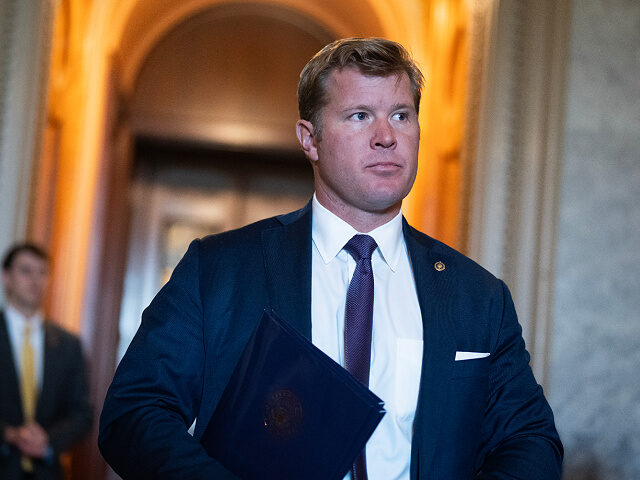

Sen. Tim Sheehy (R-MT) is introducing legislation on Thursday that would suspend new H-1B visas for three years before resuming the program with a 25,000 annual cap on cap-subject visas, a $200,000 wage floor, and additional restrictions aimed at protecting American workers and addressing fraud and national security concerns.
The legislation would make changes extending beyond the H-1B program, including eliminating employment authorization for certain foreign students and exchange visitors, generally preventing nonimmigrants and others with temporary authorized presence from adjusting to permanent-resident status while inside the United States, prohibiting federal agencies from employing nonimmigrants directly or through contracts, and barring changes from one nonimmigrant classification to another. The bill text, press release, and one-page summary were exclusively shared with Breitbart News.
“The H-1B program was created to address workforce shortages for specialized, difficult-to-fill positions — not to displace qualified, hardworking Americans with cheaper, foreign labor,” Sheehy said in remarks exclusively provided to Breitbart News. “We shouldn’t be issuing work permits that make it easier to undercut American workers when we have the talent right here at home.”
“My legislation, the End H-1B Abuse Act, restores the program to its original intent and puts American workers first by closing loopholes that incentivize abuse, strengthening guardrails and prioritizing our national security interests,” he continued.
The bill would suspend the issuance of H-1B visas for three years. After the suspension, it would set the principal annual H-1B cap at 25,000 and replace the random selection process for visas subject to that cap with a system prioritizing petitions offering the highest wages.
It would reduce the maximum H-1B period from six years to three years and require employers to attest that qualified American workers are unavailable, that hiring the visa holder would not adversely affect the wages or working conditions of similarly employed U.S. workers, and that the employer had not laid off workers during the preceding 12 months and would not do so during the 12 months following the application.
Employers would have to offer H-1B workers at least $200,000 annually and pay a $100,000 fee for petitions seeking initial H-1B status or authorization for an H-1B worker to change employers.
The legislation would also revise the definition of an H-1B-dependent employer, end dual intent for H-1B visa holders, prohibit concurrent H-1B employment, and bar third-party staffing agencies from sponsoring H-1B workers or facilitating their recruitment or employment on behalf of other employers.
It would remove the statutory provision allowing spouses and minor children of H-visa holders to accompany or follow them and prohibit federal agencies from petitioning for or employing nonimmigrants, either directly or through contractors.
Beyond the H-1B program, the bill would eliminate employment authorization for F-1 and M-1 foreign students and for J-1 exchange visitors admitted to attend educational or training institutions. It would generally prevent nonimmigrants, parolees, and others with temporary authorized presence from adjusting to permanent residence while inside the United States and prohibit changes from one nonimmigrant classification to another.
The adjustment-of-status restrictions contain limited exceptions for people who are otherwise eligible for an available immigrant visa and who filed for adjustment before enactment and have their application adjudicated within one year, as well as refugees, people who applied for asylum before enactment and have their application adjudicated within one year, and conditional permanent residents.
The one-page summary states that the H-1B program has strayed from its original purpose as a “narrow, short-term permit for hard-to-fill roles” and now functions as a “large-scale labor substitution pipeline.” It says waves of layoffs have coincided with sustained or increased H-1B hiring and cites “particularly egregious cases” in which U.S. workers were allegedly “forced to train their replacements before being terminated.” The summary also argues that the concentration of foreign contract workers in artificial intelligence, cloud infrastructure, and defense-adjacent industries raises “serious concerns about data security, insider risk, and foreign influence.”
The Immigration Accountability Project and the Federation for American Immigration Reform support the legislation.
This month, Vice President JD Vance announced that the Department of Labor had launched dozens of subpoenas and investigations into alleged H-1B fraud. The department’s Office of Inspector General also said it was intensifying enforcement involving the H-1B and Program Electronic Review Management systems, citing fraudulent applications, coercive wage-kickback arrangements, worker exploitation, and schemes that undercut American workers with below-wage labor.
Vance said the H-1B program was intended to bring highly skilled specialists to the United States but had been abused by corporations and overseas fraudsters using it to undercut American workers’ wages, declaring that “American jobs ought to go to American workers and not foreign fraudsters.” The department also began encouraging American and foreign workers to report suspected displacement, coercion, fraudulent recruitment, and forced labor.
Sheehy has previously emphasized that he supports legal immigration while opposing abuses of the immigration system. During a February Breitbart News policy event, he said the United States should welcome “good, smart, hardworking people” who come to America to build businesses and contribute to the country. He also said the United States should support immigrants who share American values while rejecting people who steal government funds or act as agents of foreign powers.
Speaking about birthright citizenship and Peter Schweizer’s book The Invisible Coup, Sheehy argued that the immigration system has been abused and that birth in the United States alone is insufficient without also being subject to the nation’s jurisdiction.
COMMENTS
Please let us know if you're having issues with commenting.