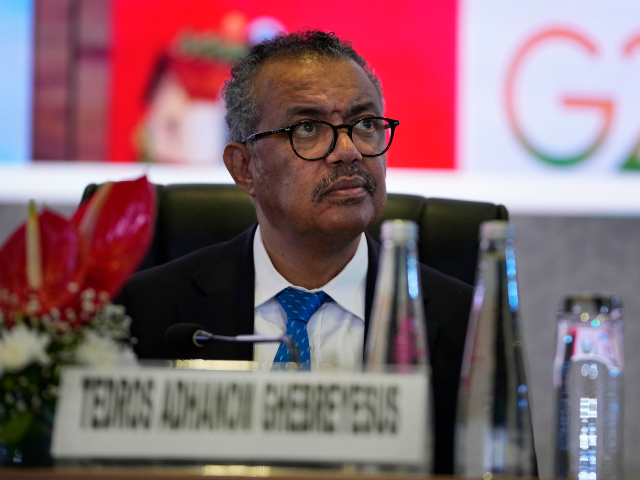

World Health Organization (W.H.O.) Director-General Tedros Adhanom Ghebreysus demanded on Wednesday that countries imposing travel restrictions on visitors to stop the spread of the Ebola outbreak in Democratic Republic of Congo (DRC) lift them, claiming they were harming containment efforts.
In the same press conference, Tedros admitted that the outbreak, which the W.H.O. confirmed as a public health emergency in May, could have begun as early as in January with no identification and response.
“The outbreak had a big head start, and we’re still behind,” he lamented.
Tedros visited the epicenter of the outbreak – Ituri province, DRC – last weekend, spending time with local health workers and helping combat local concerns that Ebola is not real and international health workers are intentionally killing Africans. These fears have complicated outbreak response efforts and locals organize armed mobs to attack treatment centers, believing they are “freeing” Ebola patients from a certain death at the hands of murderous health workers. Mobs have also stolen the bodies of dead Ebola victims to offer them traditional burials, which often involve the kind of exposure that allows the virus to spread.
The W.H.O. leader addressed his visit to Ituri during a press conference on Wednesday.
“WHO’s risk assessment remains unchanged: very high at the national level, high at the regional level, and low at the global level,” he asserted. Tedros shared the latest case numbers from the DRC and neighboring Uganda, totaling about 350 confirmed cases and over 60 deaths. Notably, the W.H.O. reduced its suspected case count from nearly 1,000 people to 116 between the weekend and Tuesday. Tedros explained that this is the result of working “through the backlog, either confirming them or ruling them out.”
Among the most prominent challenges on the ground, he noted, was the lack of appropriate testing for the strain of Ebola spreading, “community mistrust,” and a lack of vaccines and treatments for the virus. The strain of Ebola spreading in DRC currently is known as Bundibugyo; previous outbreaks have been caused by the Zaire and Sudan strains of the virus. Currently, a vaccine exists for the Zaire strain and much of the testing infrastructure left in DRC from the previous outbreak was for the Zaire strain.
Tedros included among these challenges, however, countries defending themselves from the spread of the deadly virus by imposing travel restrictions on individuals coming from the DRC or Uganda.
“Blanket travel restrictions imposed by some countries are disrupting supply chains and hindering the response,” he claimed. “WHO recommends exit screening at airports, ports and border crossings to prevent the exportation of cases and contacts.”
“We ask countries that have imposed blanket travel restrictions to lift them,” he said.
The list of countries imposing travel restrictions on Congolese to limit the spread of the virus has grown in the past month in response to the W.H.O. declaring a public health emergency in May. America was among the first countries to limit entry for individuals traveling to the DRC, Uganda, or South Sudan, requiring that anyone attempting to enter the United States from those country be monitored in a third country for 21 days, the typical incubation period of the virus, before coming to America.
Uganda itself imposed travel restrictions along its border with the DRC, cutting ferry and flight access and shutting the border partially for four weeks beginning in late May. The Canadian government and that of the Bahamas later announced that they would ban residents of DRC, Uganda, and South Sudan from entering their countries entirely, while Thailand, Kenya, the Cayman Islands, and India are requiring enhanced screening procedures at their points of entry to prevent the virus from spreading.
The restrictions have led to some changes regarding the upcoming FIFA World Cup, one of the world’s largest sporting events, for which the DRC qualified this year for the first time in over half a century. The Congolese Association Football Federation (FECOFA) has insisted that its team should not pose a threat of spreading Ebola as the players have been mostly stationed outside of the country, while some supporting staff have abided by the 21-day quarantine in Europe to be allowed entry into the United States and should be ready for when the tournament begins this month. The DRC soccer team is scheduled to be headquartered in Texas for the tournament.
These assurances appear to have created the conditions for DRC to participate in the World Cup, though also prevented at least one World Cup-adjacent event from taking place: a friendly match between DRC and Chile scheduled to take place in Spain before the tournament. Mayor Juan Franco of the town where the game was scheduled to be held, La Línea de la Concepción, canceled the event, explaining that he could not “fully rule out the possibility of any risk” and had to protect his residents.
Tedros’s opening remarks at the press conference as shared by the W.H.O. did not indicate if he was objecting only to the Canadian-style full bans from entry for residents of the affected countries or whether he also objected to America’s incubation period monitoring strategy.
Elsewhere in his remarks, Tedros admitted, as the W.H.O. has done for weeks, that it responded in a delayed manner to the outbreak because the Bundibugyo strain is not identifiable by tests for the Zaire strain of Ebola. The outbreak, he conceded, could be months old.
“It could be January, it could be February, March, April,” Tedros reportedly said, according to The Guardian in responses not in the official transcript of his opening statement at the conference.
Tedros observed that contact tracing is also a significant challenge.
“Some community leaders told me that they believe Ebola is not real. Building trust with the communities is therefore critical to bringing the outbreak under control,” he conceded. As a result of mistrust, ongoing conflict featuring a host of local warlords, and displacement, Tedros estimated that health workers are following up on about 45 percent of potential contacts.
“To get ahead of the outbreak we need to get that number up to above 90%,” he said.
Tedros had previously lamented last week that contact tracing was “nearly impossible” in the region in the context of militia warfare and local attacks on health workers.
COMMENTS
Please let us know if you're having issues with commenting.