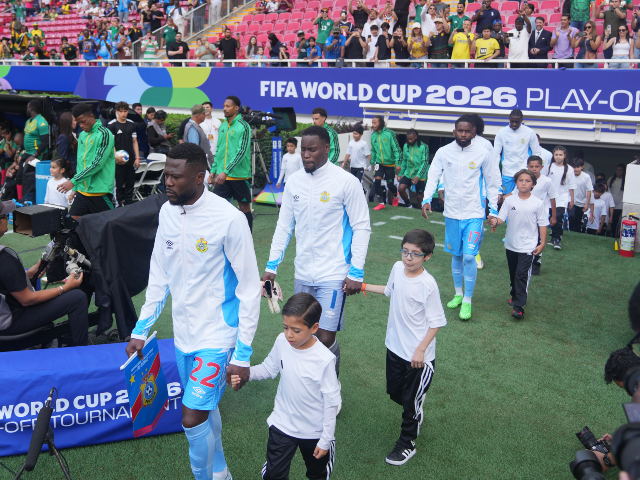

Soccer authorities in the Democratic Republic of Congo (DRC) affirmed on Wednesday that its national team and support staff will be able to abide by all public health protocols to participate in the FIFA World Cup scheduled to begin on June 11 and hosted by America, Canada, and Mexico.
Both the United States and Canada have imposed restrictions on Congolese travelers, as well as visitors from neighboring countries such as South Sudan and Uganda, in response to the ongoing Ebola outbreak in rural DRC. Ebola is a viral disease that causes fever and extensive bleeding, often leading to death. The variant of the virus currently spreading in DR Congo, Ebola Bundibugyo, is believed to have fatality rates of between 30 and 50 percent.
As of Friday, the World Health Organization (W.H.O.) has documented 906 suspected Ebola cases centered in Ituri, DRC, and 223 deaths suspected to have been caused by the virus. Ituri is among the most dangerous regions of Africa, marred by large numbers of violent gangs engaging in territorial warfare and exploiting local populations for illicit mining.
The W.H.O. has also cited as a major obstacle to treatment and containment the fact that many locals in Ituri do not believe that Ebola is a real disease and accuse international humanitarian aid workers of killing locals under the guise of an “outbreak.” As a result, health centers in the country have experienced waves of mob attacks in which angry locals have burned down the premises, “freed” quarantined Ebola patients, and stolen the infected bodies of victims, abetting the spread of the disease.
The Congolese Association Football Federation (FECOFA) confirmed on Wednesday that it will be able to comply with U.S. Centers for Disease Control (CDC) and similar Canadian protocols to screen travelers for Ebola, partially because all players on the national team play soccer outside of Congo, many of them based in Europe. As a result, they are not subject to the limits on travelers coming from DRC, Uganda, or South Sudan.
While the team had planned training exercises in the Congolese capital of Kinshasa, the team canceled the training to ensure they would be able to comply with travel restrictions. Some staffers on the team were based in DRC, but reportedly left the country on May 20, giving enough time for them to enter the United States after a 21-day monitoring period.
USA Today reported on Thursday that the president of FECOFA, Veron Mosengo Omba, confirmed with officials from the Fédération Internationale de Football Association (FIFA) that they would be able to participate in the World Cup, one of the planet’s most prestigious sporting events.
This year will mark the first appearance for the DRC in the World Cup in 52 years. In 1974, Zaire, which later became the DRC, became the first sub-Saharan African country to qualify for participation in the World Cup.
“We are proud to be going to the World Cup. There’s also a strong sense of responsibility to make a good showing of ourselves and of our country,” DRC coach Sebastien Desabre said in remarks published by FIFA on May 20, when the team’s participation was confirmed. “Thanks to our Congolese fans who followed us all through our campaign. We will give our all to make everybody proud and show the best image of Congo Democratic Republic.”
The DRC is scheduled to play its first match on June 17 at Houston Stadium against Portugal. It is competing in Group K for a spot in the elimination rounds against Portugal, Uzbekistan, and Colombia.
The DRC’s ambassador to the United States, Yvette Kapinga Ngandu, celebrated the professionalism and responsibility of the team in statements following the confirmation.
“The Leopards and its staff have demonstrated exactly the kind of responsibility, discipline, and respect that we expect from our athletes on the world stage,” she declared. “I applaud FECOFA and FIFA for moving swiftly and decisively to make this responsible, reasonable determination. The Leopards are ready, they are safe, and I have no doubt that the United States will embrace this team and this moment with the warmth that has defined America for 250 years.”
Speaking to the BBC, Mosengo-Omba, the head of the Congolese soccer federation, explained that the players and team were not believed to be exposed to Ebola as many were not in the country and those who were stayed far from the center of the outbreak.
“Okay, there’s Ebola in DRC, in Ituri, in the rural parts. Because Congo is big, it’s not because you are from DRC you get Ebola immediately,” Mosengo-Omba explained. “The country in the world who knows how to fight this disease is DRC because we have faced this many times. The world doesn’t need to be afraid.”
While the team is cleared to play, fans from DRC who were planning to come to America or Canada for the games are still subject to travel restrictions, making it impossible for many of them to attend their team’s games. The Congolese government formally requested this week that FIFA refund the costly ticket prices from those affected by the Ebola limitations.
“We asked FIFA if this is possible to take this into consideration, because the tickets are little bit expensive,” Mosengo-Omba explained to BBC. “They are punished because they cannot get [in to the US] to see the World Cup to support their team. We don’t want our supporters who love football, who love the World Cup, to lose everything.”
COMMENTS
Please let us know if you're having issues with commenting.