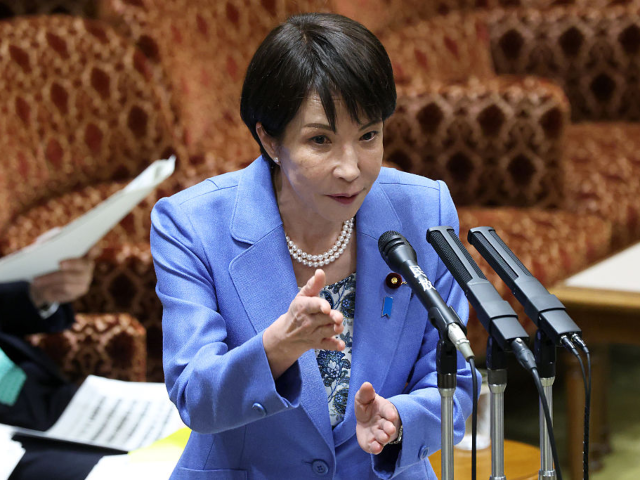

Japanese Prime Minister Takaichi Sanae on Monday inaugurated a panel to review Japan’s defense posture in a time of growing threats from China, North Korea, and Russia.
The 15-member defense panel is scheduled to meet monthly, chaired by former ambassador to the United States Kenichiro Sasae, and includes a mix of former government officials, academic leaders, and business representatives.
One of the expert panelists is Yamazaki Koji, former chief of staff for the Japanese Self-Defense Forces (JSDF) and today a senior fellow at Tokyo’s Sasakawa Peace Foundation. Last year, the foundation wrote a paper suggesting Japan revise its anti-nuclear-weapons policies to share nuclear technology with the United States.
“The international situation has completely changed. The relatively stable post-Cold War international order has become a thing of the past,” Takaichi said, pointing to Russia’s invasion of Ukraine and the war with Iran as examples of the new instability.
The prime minister said Japan must prepare for “new ways of warfare” using advanced technologies, such as the rapidly evolving field of drone combat. She said the revision of Japan’s three key defense policy documents will “determine the nation’s fate.”
The documents referenced by Takaichi include the National Security Strategy, the National Defense Strategy, and the Defense Buildup Program. The last edition of these documents was published four years ago, and was intended to last for ten years. Takaichi’s revisions are expected to be completed by the end of 2026.
The Japanese government began its debate on revising the “three documents” on Monday. Takaichi has been responsive to requests from the United States to increase Japan’s defense spending and give its Self-Defense Forces more latitude to take the initiative against threats.
“We need to be proactive in drastically strengthening our defense capabilities in order to protect our nation’s peace and independence,” Takaichi said.
Takaichi highlighted “an increase in the military power of China” and “strengthening cooperation” between China and Russia as reasons to beef up defensive capabilities.
“It is important to thoroughly strengthen Japan’s overall national strength by organically linking diplomatic and defense capabilities with economic, technological, information, and human resources,” she said.
China was predictably outraged at Takaichi’s portrayal of Beijing as a growing security threat. Chinese Foreign Ministry spokesman Lin Jian sneered on Tuesday that Japan was using China as an excuse to rebuild its “war machine.”
“Having once launched the war of aggression several decades ago, Japan now makes scare-mongering remarks. Is Japan’s militarist past returning? Is Japan speeding down the path of remilitarization? Could Japan once again become the bane of East Asia?” he hyperventilated.
Lin took a lengthy stroll down the memory lane of World War 2 nostalgia as though Takaichi had proposed reconstituting the Empire of the Rising Sun instead of pushing for a 10-15 percent increase in defense spending.
Lin insisted the Japanese Constitution’s “strict restrictions on Japan’s military strength, right of belligerency, and right of war” could never be changed.
“The lesson of history is not far gone. All peace-loving countries need to stay vigilant and firmly stop the rise of Japanese neo-militarism,” he intoned.
COMMENTS
Please let us know if you're having issues with commenting.