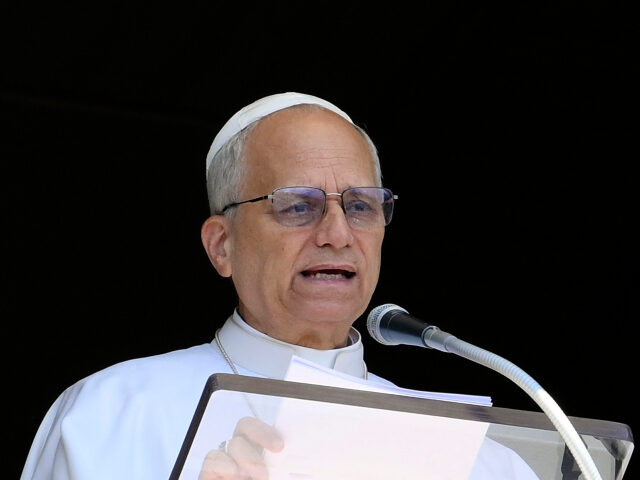

Pope Leo XIV offered prayers for the persecuted Christians of Nigeria during his public address on Sunday, among other communities in Asia and Africa sustaining genocidal attacks – highlighting the violence in that country as the Nigerian government continues to insist it is not happening.
The pope addressed Nigeria alongside Bangladesh, Sudan, Mozambique, and the Democratic Republic of the Congo (DRC) as countries where Christians face deadly violence directly due to their decision to follow Jesus Christ. He made his remarks while leading the Angelus on Sunday, according to Vatican News.
“I think especially of Bangladesh, Nigeria, Mozambique, Sudan, and other countries from which we frequently hear of attacks on communities and places of worship,” Vatican News quoted the pope as saying. “God is a merciful Father who desires peace among all His children!”
Pope Leo XIV specifically identified the nations in question as those in which Christians face “discrimination and persecution,” contrary to the repeated Nigerian government claims that no religious discrimination exists in the country. The pope’s comments made headlines in several major Nigerian newspapers and news networks given that they directly contradict President Bola Tinubu.
Nigeria is home to one of the most vibrant Christian communities in the world and – unlike many countries where persecution is rampant, where Christians are a small minority – a little less than half of the country identifies as Christian. Most of Nigeria’s Christians live in the south of the country, while the north is home to the largest Muslim populations. President Tinubu himself is Muslim, but the nation’s first lady is Christian and he has claimed to be a champion of religious freedom. Tinubu attended Pope Leo XIV’s first Mass as pontiff and met with the leader of the Catholic Church personally.
Despite Tinubu’s attempts to present himself as a defender of religious freedom, human rights organizations consistently rank Nigeria the world’s most dangerous place to be a Christian as a result of multiple jihadist insurgencies attempting to eradicate the religion from the country. In northern Nigeria, the jihadist terrorist organization Boko Haram presents the largest threat to the local population, while in the nation’s Middle Belt – where the Christian south meets the Muslim north – organized, genocidal Fulani jihadists systematically target Christian communities for destruction.
“Across Nigeria in recent years, on average there have been 8 violent attacks per day. The Middle Belt, particularly Benue and Plateau state, continues to experience frequent deadly attacks,” Ryan Brown, the CEO of the Christian aid organization Open Doors, told Breitbart News this month.
“The evidence of targeted violence against Christians in Nigeria is well documented. In October, the Islamist group connected with ISIS sent a clear message about their intention to target Christians in Africa, declaring they must convert or die,” he explained. “The research is clear that if you are a Christian, you are 6.5 times more likely to be killed and 5.1 times more likely to be abducted in Nigeria.”
The issue of Christian persecution in Nigeria rose to global prominence once again on October 31, when President Donald Trump announced that he would return Nigeria to the State Department’s list of Countries of Particular Concern (CPC) for religious freedom.
“Christianity is facing an existential threat in Nigeria. Thousands of Christians are being killed. Radical Islamists are responsible for this mass slaughter,” President Trump wrote on October 31 in a message on his website, Truth Social. As a result of government inaction, President Trump indicated he would consider military action within Nigeria to protect Christians.
The designation outraged Tinubu’s government.
“The characterization of Nigeria as religiously intolerant does not reflect our national reality,” Tinubu said in a statement the day after Trump revealed the CPC designation, “nor does it take into consideration the consistent and sincere efforts of the government to safeguard freedom of religion and beliefs for all Nigerians.”
Tinubu’s information minister, Mohammed Idris, disparaged the designation as well, declaring, “For us to be characterized as a country that is intolerant of religion is absolutely false. What we have are extremists trying to divide the country.”
Idris also attended a marketing and advertising industry conference last week, pressuring the nation’s marketers to spread government propaganda that the genocide is not happening.
“You are not only storytellers for brands and businesses; you are also custodians of national perception and image. We need a communication renaissance, one that emphasizes facts over fear, unity over division, and truth over propaganda,” he claimed.
“Yes, Nigeria has faced security challenges, especially from terrorists and violent extremists, but these are not targeted at any religion or ethnic group,” Idris reportedly insisted.
Since the designation, reports have surfaced that rather than increase police action to stop the jihadist attackers, the Nigerian government is pressuring affected Christians to remain silent or face arrest. In northern Katsina state last week, victims of jihadist gangs accused the Nigerian military of opening fire on protesters demanding the government take action to protect them against “bandits,” the preferred government euphemism for the jihadists.
On Monday, a group of “bandits” in Kebbi state raided a school, taking dozens of girls hostage and killing the principal.
COMMENTS
Please let us know if you're having issues with commenting.