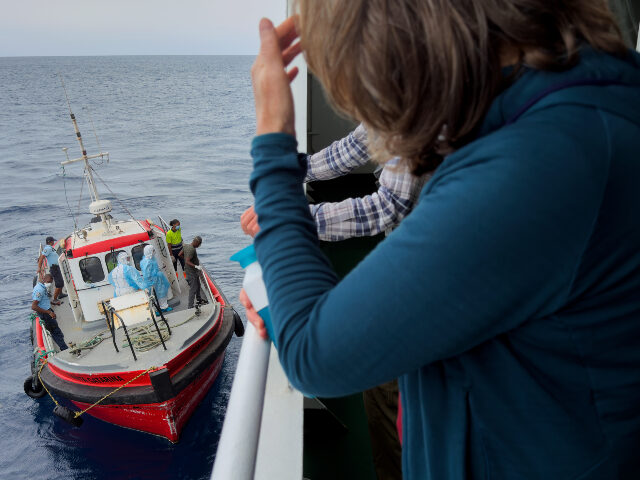

The U.S. Centers for Disease Control and Prevention (CDC) has classified the hantavirus outbreak on a Dutch cruise ship as “Level 3” – the lowest level of emergency activation in the agency’s hierarchy of responses.
That, according to ABC sources, signifies the risk to the general public “remains low,” though the outbreak is currently being actively monitored by the public health agency, which has also “activated” its Emergency Operations Centers in response to the threat.
Spanish authorities on Friday were preparing to receive more than 140 passengers and crew members on board a hantavirus-stricken cruise ship headed for the Canary Islands, an outbreak which has generated headlines in both the United States and Europe.
There are an estimated 17 Americans aboard the ship, CNN reported.
ABC7 reported that the agency will be dispatching personnel to the Canary Islands for the ship’s arrival on Sunday. Any Americans onboard will be taken to a National Quarantine Unit in Nebraska.
“Health officials in multiple states say they’re monitoring some passengers who have returned to the U.S. after being aboard the ship for potential hantavirus infections,” the outlet also reported.
Three people have died since the outbreak, and five passengers who left the Dutch-flagged MV Hondius are known to be infected with hantavirus, cruise operator Oceanwide Expeditions said Thursday, according to ABC.
The World Health Organization (WHO) also reportedly considers the risk to the wider public from the outbreak is low.
However, the response to any potential spread in the United States is not being left to the WHO.
The United States under the Trump administration completed its withdrawal from the WHO in January following what it said was that organization’s “profound failures” in its handling of the COVID-19 pandemic originating in Wuhan, China, which dramatically impacted the U.S. and world economies.
The Dutch cruise vessel is expected to arrive Sunday at the Spanish island of Tenerife off the coast of West Africa. Passengers will be taken to a “completely isolated, cordoned-off area,” the head of Spain’s emergency services, Virginia Barcones, said.
On Friday, the WHO reported that a flight attendant on a plane briefly boarded by an infected cruise passenger has tested negative for the virus. Authorities tested the attendants in response to their concerns about the virus’s potential transmissibility.
According to the ABC report:
Hantavirus is usually spread by the inhalation of contaminated rodent droppings and isn’t easily transmitted between people. But the Andes virus detected in the cruise ship outbreak may be able to spread between people in rare cases. Symptoms usually show between one and eight weeks after exposure.
Health authorities across four continents were continuing to track down and monitor more than two dozen passengers who disembarked the ship before the deadly outbreak was detected. They were also scrambling to trace others who may have come into contact with them since then.
Early symptoms resemble a bad flu, according to the CDC, but can result in severe upper respiratory disease.
On April 24, nearly two weeks after the first passenger had died on board, a dozen people from a dozen different countries left the ship without contact tracing, authorities said. Hantavirus wasn’t confirmed as the viral culprit until more than a week later.
As for the CDC, activating an Emergency Operation Center is a proactive move. It indicates that epidemiologists, scientists and physicians may have been reassigned from their typical roles to assist with the response.
Contributor Lowell Cauffiel is the best-selling author of the Los Angeles crime novel Below the Line and nine other crime novels and nonfiction titles. See lowellcauffiel.com for more.
COMMENTS
Please let us know if you're having issues with commenting.