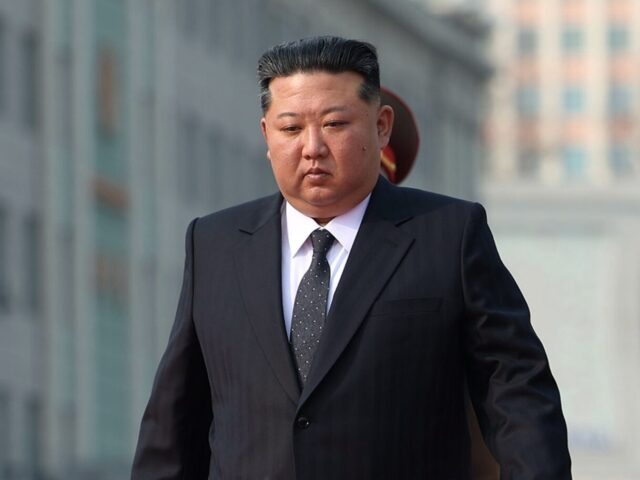

A South Korean lawmaker, citing the country’s National Intelligence Service (NIS), revealed in comments on Monday that Seoul believes North Korea is failing to offer full-throated support to its longtime ally Iran to avoid hurting chances of future negotiations with the United States.
America and North Korea, as well as allies South Korea and China, have been technically at war since 1950, when communist dictator Kim Il-sung invaded the South shortly after establishing his cult tyranny. While an armistice agreement in 1953 ended active hostilities, no peace treaty has ever been signed between the warring parties and Pyongyang often makes a point of attacking America as a war enemy, even as it has pursued talks with Washington in the past.
As with most of the world’s communist nations, North Korea has long maintained friendly ties to the Iranian Islamist terror regime. Experts have compiled decades of evidence that North Korea has supplied weapons to Iran, as well as to its terrorist proxies, such as Hamas. Israeli authorities accused North Korea, for example, of supplying weapons found to be used in the October 7, 2023, massacres by Hamas throughout Israel. Despite these ties, however, dictator Kim Jong-un and his underlings have restrained their commentary on “Operation Epic Fury,” the ongoing American military operation in Iran – a stark contrast from North Korea’s usual support for its allies, such as its involvement in the Russian invasion of Ukraine.
Open hostilities between America and Iran began on February 28, when President Donald Trump announced the launch of “Operation Epic Fury” and the death of Ayatollah Ali Khamenei, the dictator of Iran. President Trump announced on Sunday that he had imposed a deadline of Tuesday at 8 p.m. Washington time for the two sides to negotiate an end to hostilities, or else the American military would level the entire Iranian state.
“A whole civilization will die tonight,” Trump proclaimed on Tuesday morning following reports that Iranian officials had not accepted any deal with America.
South Korean National Assembly member Park Sun-won told reporters on Monday, following a briefing from NIS, that South Korean intelligence officials had no evidence that North Korea was aiding Iran’s efforts against “Operation Epic Fury” by sending weapons or other supplies. North Korea’s Foreign Minister had also only commented twice on the conflict, as opposed to its usual loquacious approach to any conflict involving the United States and its allies.
“The NIS assessed this restraint as preparation to secure new diplomatic space after an anticipated May summit between Chinese President Xi Jinping and Mr Trump,” Reuters relayed.
The NIS also observed that North Korea’s state media outlets, particularly the flagship Korean Central News Agency (KCNA), had abstained from congratulating the alleged “supreme leader,” Mojtaba Khamenei, after Iranian state media announced that he had succeeded his father, killed in an American operation on February 28.
“Regarding the recent official announcement that the Iranian Assembly of Experts has elected a new leader of the Islamic Revolution, we respect the right and choice of the Iranian people to elect their Supreme Leader,” the Foreign Ministry declared, without congratulating him.
The Foreign Ministry has also come close to condemning the American operation, but tempered its language.
“We express grave concern and strongly condemn the aggression of the United States and Israel,” a Foreign Ministry spokesperson said shortly after the operation began, “which, by launching an unlawful military attack against Iran, are undermining the foundations of regional peace and security and increasing instability in the international landscape.”
Military experts have long warned about the close ties between Tehran and Pyongyang, giving Iran and its network of terrorist proxy groups access to advanced North Korean weaponry. In addition to the discovery of North Korean weapons used in the October 7 attacks, North Korea has for years reportedly sold weapons, including ballistic missiles, to Iran, a deal that enriches the impoverished communist state while allowing Iran to continue threatening its neighbors. Notably, Iran’s main military response to the Trump operation has been to launch missile and drone strikes not at American targets, but at its Gulf neighbors including Saudi Arabia, Qatar, Bahrain, and Kuwait, as well as striking seemingly unrelated countries such as Cyprus and Azerbaijan.
The North Korean silence on Iran markedly differs from its active support of Russia. Kim Jong-un confirmed last year that he deployed troops into the Ukrainian war theater, reportedly operating in Kursk, a region of Russia that Ukraine counter-invaded two years into the invasion. Kim has hosted multiple large-scale events in North Korea to celebrate the presence of its forces fighting in Europe and honor those killed in battle. In December, Kim honored a returning group of soldiers who allegedly worked helping clear mines in Kursk.
“Early in August you, engineers of the regiment, left for the Kursk region of the Russian Federation, which your comrades-in-arms had retaken at the cost of their lives, and you achieved brilliant results in the course of performing your combat tasks there,” Kim explained in remarks to those at the event.
North Korea has also built entire neighborhoods for the families of soldiers serving in the Ukraine war, suggesting mass deployment.
President Trump has not emphasized any foreign policy work on North Korea during his second term, though he met Kim three times during his first term and became the first American president to walk on North Korean soil. In remarks on Monday, Trump complained that South Korea was not sufficiently helpful in stopping Iran from blocking the Strait of Hormuz, adding that he “gets along” with Kim Jong-un and that Kim “said very nice things about me.”
COMMENTS
Please let us know if you're having issues with commenting.