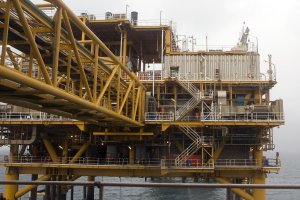

March 19 (UPI) — Global oil and gas prices surged on Thursday after Israel attacked Iranian sections of the South Pars field, the largest natural gas field in the world, and retaliatory strikes by Tehran on Qatar’s state-owned Ras Laffan Industrial City oil-processing facility.
Brent crude, the oil price benchmark, was trading $7.67 a barrel higher in mid-morning trade in London at $115.21, after spiking as high as $119.11 earlier on. The wholesale price of natural gas was up over 20% at $2.15 per Therm.
However, Brent prices remain well below the highs of $128 or $146 per barrel reached after Russia invaded Ukraine in 2022 and the global financial crisis in 2008. Natural gas reached as much as $7.50 a Therm in 2022.
Israeli government spokesman Alex Gandler told BBC Radio that the South Pars gas field was a legitimate target because it aided the Islamic Revolutionary Guard Corps’ ballistic missile capability but the Qatari foreign ministry criticized Israel, calling the strikes “dangerous and irresponsible”.
“The Israeli targeting of facilities linked to Iran’s South Pars field, an extension of Qatar’s North Field, is a dangerous and irresponsible step amid the current military escalation in the region,” Foreign Ministry spokesman Majed al-Ansari said on X.
“Targeting energy infrastructure constitutes a threat to global energy security, as well as to the peoples of the region and its environment. We reiterate, as we have repeatedly emphasized, the necessity of avoiding the targeting of vital facilities. We call on all parties to exercise restraint, adhere to international law and work toward de-escalation in a manner that preserves the security and stability of the region,” al-Ansari wrote.
South Pars is located in the Persian Gulf, between Iran and Qatar.
Ras Laffan, which is run by state-owned QatarEnergy, one of the world’s largest producers of LNG, is located 50 miles north of Doha.
Qatar also lashed out at Tehran over the Ras Laffan attack after the interior ministry said a blaze at the facility had been brought under control Wednesday evening, summoning the Iranian ambassador to tell him it was expelling two diplomats, the military attache and security attache, and the staff of their offices from Iran’s embassy in Doha.
It gave them 24 hours to leave Qatar.
In a post on social media, the foreign ministry said the expulsions were in “response to repeated Iranian targeting and the blatant aggression against the State of Qatar, which violated its sovereignty and security, in a flagrant breach of the principles of international law.”
The Ras Laffan plant was then hit again on Thursday moning. No injuries were reported in either incident.
Shell said its natural gas plant at the Ras Laffan Industrial City suffered fire damage. Its gas-to-liquids facility is capable of converting as much as 1.6 billion cubic feet of gas per day into 140,000 barrels of gasoline or diesel.
Energy infrastructure was under attack from Iran in other Gulf countries on Thursday with the state-run Kuwait News Agency reporting a drone strike that caused a fire at the Mina Abdullah plant south of Kuwait City after a separate drone attack earlier set the Mina Al-Ahmadi refinery ablaze.
The Kuwait Petroleum Corporation said no one was injured in the Mina Al-Ahmadi attack and that the “limited fire” had been brought under control.
The escalation prompted leaders of Gulf countries attending an emergency meeting in Riyadh, to issue a joint statement condemning Iran’s “deliberate attacks” on residential areas, civilian infrastructure and homes, saying they rejected any pretext by Tehran to justify its actions.
Representatives from Bahrain, Kuwait, Lebanon, Qatar, Saudi Arabia, the United Arab Emirates and other countries in the region called on Iran to “immediately halt all attacks,” adhere to international law and “principles of good neighborliness” and desist from “measures or threats” calculated to close the Hormuz Strait to shipping.
The statement also, however, criticizes Israel over its “aggression against Lebanon and its expansionist policies in the region.”
COMMENTS
Please let us know if you're having issues with commenting.