
April 1 (UPI) — President Donald Trump has signed an executive order imposing new restrictions on mail-in voting ahead of November’s midterm elections, drawing condemnation and vows from critics to challenge in court what they called unconstitutional voter suppression.
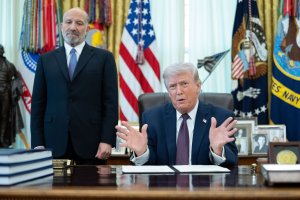
The order, signed by the president during an Oval Office press conference, is the latest executive effort by the Trump administration to exert federal control over U.S. elections ahead of the upcoming midterms. Trump, who continues to falsely claim he won the 2020 election, has repeatedly called for stronger election integrity through greater executive involvement in election administration.
In signing it, Trump repeated false claims of widespread voter fraud, specifically allegations that ineligible people were casting ballots and that mail-in voting was being abused.
“Remember, it’s about voter integrity. We want to have honest voting in our country because if you don’t have honest voting, you can’t have, really, a nation, if you want to know the truth,” he said.
Acknowledging it will likely be challenged in court, Trump described the order as “foolproof” while expressing frustration that it could be overturned by “a rogue judge.”
“That’s the only way that can be changed. And hopefully we’ll win an appeal, if it is,” he said. “But I don’t see how anybody can challenge.”
The executive order directs the Department of Homeland Security to build a so-called state citizenship list from citizenship, naturalization and other federal data. Those lists are then to be sent to state election officials.
The U.S. Postal Service is directed through the order not to send out absentee or mail-in ballots to people ineligible vote, and the attorney general is instructed to prioritize investigating and prosecuting election officials who issue federal ballots to ineligible voters.
Democrats, democracy advocates and civil rights organizations were quick to vow to fight the order in court. The American Civil Liberties Union, the League of Women Voters, the Brennan Center for Justice and others, as well as several Democratic state leaders all said they will sue the Trump administration.
“This is a massive and unconstitutional voter suppression effort aimed at giving Trump the power to create a list of who is allowed to vote by mail,” Marc Elias, a Democratic-aligned lawyer, said in a statement.
“We know where this will go — the targeting of Democrats for mass disenfranchisement. We will sue and we will win.”
House Minority Leader Hakeem Jeffries argued the executive action will allow the Trump administration to unilaterally determine who is allowed to vote, subject state election officials to intimidating investigations and make voting more difficult for women, people of color and those with disabilities, among others.
“The Constitution is clear. Donald Trump has no power to change the way states conduct their elections,” Jeffries, D-N.Y., said in a statement.
“We will fight back against this desperate Republican scheme to take over our free and fair elections,” he said.
The ACLU similarly framed the executive order as an attempt to seize power in order to control elections and decide who can vote.
“President Trump’s attempts to undermine a safe, proven and reliable method of voting is just another part of his strategy to sow distrust in our elections,” Sophia Lin Lakin, director of the ACLU’s Voting Rights Project, said in a statement.
While condemning the executive order, the Brennan Center said the government’s citizenship rolls are “incomplete and inaccurate” and the USPS is “overburdened and inadequate.”
“This combines a car crash with a train wreck,” it said.
Trump has long railed against U.S. elections, spreading debunked and false claims about voting fraud. His claims the 2020 election was stolen from him culminated in a mob of his supporters attacking the Capitol on Jan. 6, 2021.
Mail-in ballots have also been a frequent target of his criticism, though he uses them to vote, including in a recent special election in Florida.
Despite being elected to office in January 2025, Trump maintains his voting fraud claims and has pushed Republican lawmakers to pass the Safeguard American Voter Eligibility Act that mandates states purge noncitizens from voter rolls and election officials to require proof of citizenship.
Last week, he signed the “Preserving and Protecting the Integrity of American Elections” executive order to mandate proof of citizenship to register to vote, cut off federal funds to states that do not comply with federal election requirements as interpreted by the administration and push new voting-system standards that could force states to re-certify equipment and stop using certain ballot designs that encode votes in barcodes or QR codes.
Several legal challenges, including from those vowing to fight Tuesday’s executive order, have already been filed against last week’s executive action.
COMMENTS
Please let us know if you're having issues with commenting.