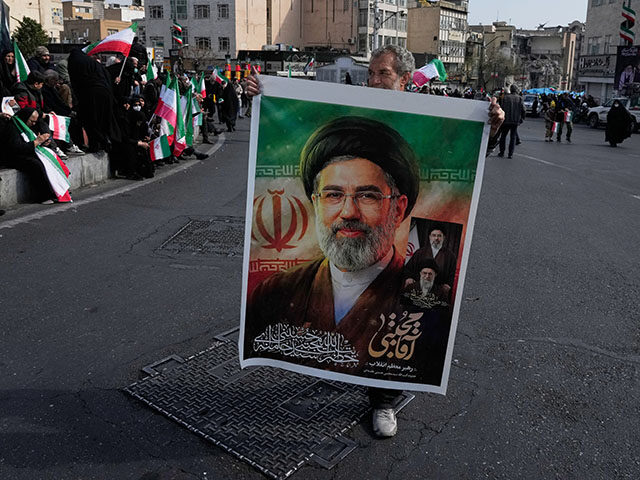

Iran’s ceasefire with the United States reportedly turned on a dramatic final-hour intervention from Mojtaba Khamenei, the country’s still-unseen new supreme leader, whom sources said gave negotiators the green light to move toward a deal as President Donald Trump’s deadline — and the threat of a much broader U.S. bombardment — loomed.
U.S. and Israeli officials learned Monday that Mojtaba had, for the first time since the conflict began, instructed negotiators to move toward an agreement, according to Axios, which cited Israeli, regional, and other sources familiar with the talks.
“Without his green light, there wouldn’t have been a deal,” one regional source told the outlet, which said his approval was viewed by multiple sources as a “breakthrough.”
The report describes a volatile final stretch in which Trump publicly warned that “a whole civilization will die tonight” (ahead of his 8 p.m. Eastern Tuesday deadline for Iran to agree to reopen the Strait of Hormuz), even as diplomacy accelerated behind the scenes to avert a far wider escalation.
According to the outlet, U.S. forces in the Middle East and Pentagon officials spent those closing hours preparing for a massive bombing campaign on Iranian infrastructure while uncertainty persisted over Trump’s ultimate decision.
At the same time, negotiations were described as “chaotic,” with Pakistani mediators relaying proposals between U.S. envoy Steve Witkoff — who on Monday blasted Iran’s initial 10-point counterproposal as “a disaster, a catastrophe” — and Iranian Foreign Minister Abbas Araghchi, as Egypt and Turkey worked to narrow remaining gaps.
By Monday night, the United States had approved an updated proposal for a two-week ceasefire. The final decision rested with Khamenei, who sources said was actively involved in the process on Monday and Tuesday.
The outlet reported that Khamenei, facing an active threat of assassination by Israel, was communicating primarily through runners passing handwritten notes — a clandestine process underscoring both the secrecy of his role and the uncertainty surrounding his condition.
Iranian Foreign Minister Abbas Araghchi was also said to have played a central role in advancing the talks and pressing commanders within the Islamic Revolutionary Guard Corps to accept a deal, while China urged Tehran to seek an off-ramp.
By around midday Tuesday, there was a general understanding that the parties were converging on a ceasefire. Pakistani Prime Minister Shehbaz Sharif — serving as a key intermediary — published the terms on X hours later and called on both sides to accept.
Trump ultimately agreed shortly before his deadline, announcing he would suspend attacks for two weeks as part of a mutual ceasefire arrangement tied to reopening the Strait of Hormuz, with U.S. forces receiving stand-down orders minutes later.
Araghchi followed by confirming Iran would adhere to the ceasefire and allow maritime traffic through the strategic waterway “in coordination with Iran’s armed forces.”
The reporting follows a Times of London report earlier this week citing a diplomatic memo said to be based on American and Israeli intelligence asserting that Khamenei was incapacitated, in “severe condition,” and “unable to be involved in decision making.”
Mojtaba Khamenei, 56, has not been seen publicly since the February 28 strike that killed his father at the outset of the conflict and reportedly severely wounded him. He was elevated to supreme leader on March 9 but has yet to make a confirmed public appearance, with statements attributed to him delivered only in written form.
Iranian state television on Wednesday again read out a written statement attributed to Khamenei instructing military units to observe the ceasefire, declaring that “this is not the end of the war” while ordering forces to comply with the truce.
The competing accounts leave unresolved whether Khamenei personally directed the final diplomatic push or whether other regime figures — including Araghchi and elements of the Revolutionary Guard — were effectively driving the process while invoking his authority.
For now, the truce has paused a conflict that on Tuesday appeared on the brink of a far broader escalation. But with major gaps still unresolved — and with Tehran’s reported ultimate decision-maker still unseen — upcoming talks in Pakistan on Saturday may determine whether the ceasefire holds or collapses.
Joshua Klein is a reporter for Breitbart News. Email him at jklein@breitbart.com. Follow him on Twitter @JoshuaKlein.
COMMENTS
Please let us know if you're having issues with commenting.