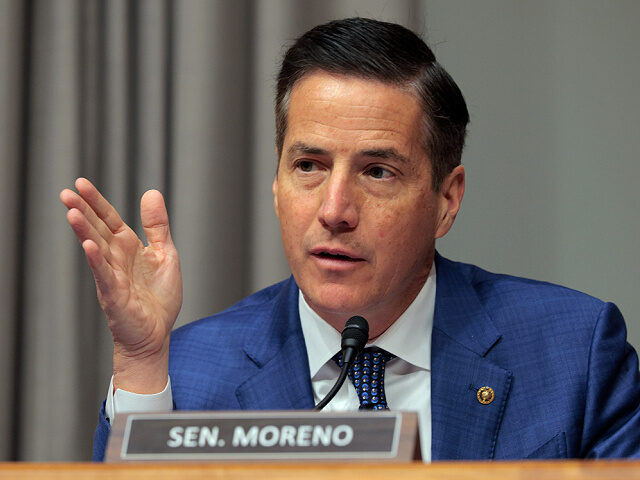

Sen. Bernie Moreno (R-OH) applauded the Colombian electoral integrity system following a trip to the country as an observer in Sunday’s presidential election, describing it as “world-class” and a model to learn from for the United States.
Sen. Moreno made the remarks during a call with the media on Tuesday in which he detailed his experiences in the country as an election observer and responded to claims by outgoing President Gustavo Petro, a Marxist who regularly boasts of his membership in a terrorist guerrilla, that the election was fraudulent. Sen. Moreno gave Colombian authorities an “A+” for their handling of the election and dismissed Petro’s refusal to accept the results of the election, noting that Petro’s hand-picked successor, Sen. Iván Cepeda, had publicly come out in defense of the election results.
The Colombian-American senator described an intricate security system in which Colombians are allowed to vote only with a federally issued identification card, ballots are filled out and tallied on paper, and no mail-in voting is allowed. Even abroad, Colombian citizens must visit a consulate in person to vote. Sen. Moreno suggested that America could significantly improve its own election integrity by taking even a small number of these measures, such as requiring identification to vote. Congress is currently debating a bill that would change voting requirements to align more with those of Colombia, the SAVE America Act, which Democrats are loudly decrying as discriminatory and equating to Jim Crow-era bigotry.
Colombia held its first round of presidential voting on Sunday when all 14 candidates were on the ballot. As no candidate obtained 50 percent or more of the vote, the race will go to a second “runoff” election featuring the top two candidates in the first round. Outsider conservative candidate Abelardo de la Espriella won the first round with 43.74 percent of the vote, while Sen. Iván Cepeda obtained 40.90 percent, enough to enter the runoff. The establishment conservative candidate, Sen. Paloma Valencia, came in third place and immediately pledged support to de la Espriella.
“The elections in Colombia were done, actually, extraordinarily well,” Sen. Moreno explained on Tuesday. “The process that they have for elections — I think there are some things that we can learn here in the U.S. They require 100-percent proof of citizenship in order to get a national ID that’s required to obtain before you can vote.”
“You have to show that ID when you present yourself to get your ballot. In fact, in some polling places where they suspect there might be fraud,” he continued, “they even have fingerprint and facial recognition biometrics, which is obviously something even stricter … in terms of identity.”
“The ballots are all counted by hand, all with paper; there is no machine balloting at all,” the senator explained. “They also only have one day for election day with no mail-in ballots. Only people who are living overseas can vote, and they must vote in the consulates, not by mail.”
Sen. Moreno suggested that some of the security measures implemented to protect the integrity of the Colombian election could transfer well to the United States.
“The process of how they count votes, how people vote, how they have to show voter ID — at least from a SAVE America Act [perspective], [it] is amateur hour compared to what they do in Colombia,” he suggested. “I think we have a lot to learn here in terms of — it’s not voter suppression to require voter ID, to require proof of citizenship.”
The SAVE America Act, being debated by Congress, would require voters to show proof of American citizenship to register to vote and to bring a photo identification when voting. It would not require the identification to be limited to one single, federally mandated ID as the Colombian system does, nor would it impose biometric checks in vulnerable election districts. Democrats aggressively oppose its limited reforms, comparing them to a “show me your papers law” or “laws that were passed after Reconstruction that made it impossible for African-Americans to get elected.”
“Colombia has dramatically more people in poverty than the United States,” Sen. Moreno observed, “yet they have had record voter turnout. This is something that we should take a peek at and say, ‘maybe all these comments about how voter suppression occurs with SAVE America is just not true.’”
Despite the high quality of election integrity measures in Colombia, President Petro claimed on Sunday, and again on Tuesday, that he had evidence of electoral fraud hurting his candidate, Cepeda. While Cepeda himself declared that he and his party — Petro’s party — had found no evidence of any fraud, Petro published a massive Google spreadsheet on Tuesday that he claimed somehow validated his claims. Petro is specifically claiming that the private company that runs the electoral system, Thomas Greg & Sons, somehow added nearly a million fake people to its voter rolls. No party in the Colombian electoral system at press time has supported Petro’s claims, including his candidate in the race, and international observers have also emphasized that they did not see any signs of widespread illicit activity.
“We can discard [the possibility of] any manipulation of data, of the pre-count, or the close count,” Esteban González Pons, the head of the European Union’s observation team, said following the election.
“I was there observing the elections, tens of thousands of people observed the elections,” Sen. Moreno told reporters on Tuesday, responding to Petro’s claims. “In fact, his political party had the most people compared to the other political parties observing the election. The candidate who got the second-most votes has now acknowledged that they have absolutely no proof of irregularities.”
Sen. Moreno added that Petro’s comments were “an insult to the hundreds of thousands of people, Colombians … who worked incredibly hard to do this. I think it disparages their hard work and also disparages the 24 million people who voted.”
The senator shared that he had been invited as an international observer for the June 21 runoff election and is planning to visit the country to reprise that role. He explained that he is concerned in the runoff with the potential of attempted fraud via vote-buying, as the election integrity system only assures that those eligible to vote, and no one else, do so, but cannot filter for voting motivations such as intimidation or bribery. If individuals are found attempting to bribe voters, particularly in sensitive areas of the country such as its coasts, Sen. Moreno warned that they will face consequences in America as well as Colombia, such as visa revocations and sanctions.
“Anybody from my perspective who is involved in vote buying we will put on the OFAC [Office of Foreign Assets Control] list and, of course, look at visa revocations to make certain that people are held accountable for illegal vote buying behavior,” he warned.
COMMENTS
Please let us know if you're having issues with commenting.