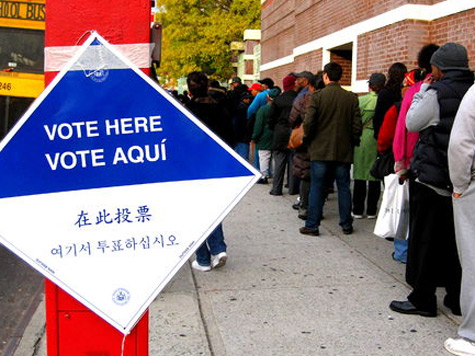

Arizona might be going to the U.S. Supreme Court yet again. A federal appeals courtupheld part of the Grand Canyon State’s voter-ID law but struck down another partof Arizona’s law as inconsistent with a 1993 federal law. This might become the thirdcitizen/voting Arizona law to go to the Supreme Court in just three years.
Arizona allows for citizens to adopt ballot propositions with the force of law, whichtrump state statutes but fall short of amending the Arizona Constitution. Arizona’s votersadopted Proposition 200 in 2004. It requires showing proof of citizenship when youregister to vote, and then showing government-issued photo-ID on Election Day whenyou cast your ballot.
Several individuals and groups sued, arguing that these requirements violate twoprovisions of the U.S. Constitution and also the National Voter Registration Act of 1993(NVRA), which had been passed by a Democrat-controlled Congress and signed by BillClinton. After years of litigation, the case was decided by the U.S. Court of Appeals forthe Ninth Circuit.
Although federal appeals are heard by three-judge panels, on rare occasions the fullappeals court will reconsider a panel decision in what is called an en banc rehearing. TheNinth Circuit is so large (almost thirty active-service judges) that when it does an en bancrehearing, the court’s chief judge hears it, along with ten other judges chosen at random.They took this unusual step in this case, Gonzalez v. Arizona.
Judge Sandra Ikuta–appointed by George W. Bush–wrote the majority opinion. In2008, the Supreme Court upheld Indiana’s voter-ID law in Crawford v. Marion CountyElection Board in a 6−3 decision. Arizona’s law is similar to Indiana’s, so the Courtupheld it easily, holding that Arizona’s law is consistent with the U.S. Constitution.
Not so the provision requiring people show proof of citizenship when registering. Thetraditional way to register is by filling out a state form at your county courthouse orcounty building. NVRA created two new ways a person can register to vote in federalelections. One is by filling out the state form at your local Department of Motor Vehiclesoffice, and the other is by filling out a federal form at home and submitting it by mail. Theplaintiffs in the Gonzalez case used the federal form–which makes you declare that youare an American citizen but does not ask for proof–and says that Arizona’s law violatesNVRA.
The general rule is that when federal and state laws conflict, federal law wins. Thisalmost always happens under the Supremacy Clause of the Constitution. But election lawissues arise under the Elections Clause of the Constitution, which says that states haveprimary responsibility for conducting elections but that “Congress may at any time byLaw make or alter such [state] Regulations.”
The Supreme Court has previously held that the Elections Clause sets a higher bar forstates than the Supremacy Clause. To respect state sovereignty, courts presume a statelaw is not preempted by federal law under the Supremacy Clause unless Congress makesexplicitly clear that it wants to trump the states. If that were the rule in Gonzalez, thenArizona’s law would win on both issues in this case.
But the Supreme Court has not to date applied that same rule to election laws. Instead,it has said that federal election law automatically displaces state election laws. So eventhough there is a way to make Arizona’s statute coexist alongside NVRA, the NinthCircuit held that Arizona’s citizenship-proof requirement must go.
Chief Judge Alex Kozinski joined the majority but also wrote a separate concurringopinion. In it, Kozinksi observed that, “the Supreme Court has never articulated anydoctrine of giving deference to the states under the Elections Clause… A case such asours, where the statutory language is unclear and the state has a compelling interest inavoiding fraudulent voting by large numbers of unqualified electors, presents a far moresuitable case for deciding whether we should defer to state interests. But only the SupremeCourt can adopt such a doctrine.”
So the messy split here, with some judges voting to strike down one provision, othersvoting to uphold both, and others voting to strike down both, might make this a temptingcase for the Supreme Court to take. The fact that Kozinski–a libertarian appointed byRonald Reagan and one of the most brilliant judges on the entire federal bench–wrotethat only the Supreme Court can reorient the Elections Clause, and that it should do sohere, increases the odds that the justices will take the case.
In the end, this was an important win for voter-ID laws. And if the justices take this case, it could become a broad-based win that would strengthen state sovereignty and diminishcentralized federal control of the democratic process on Election Day. That would be awelcome development.
Ken Blackwell is former Ohio Secretary of State and U.S. Ambassador to the UnitedNations Human Rights Commission. Breitbart legal contributor Ken Klukowski is afellow with the American Civil Rights Union and on faculty at Liberty University Schoolof Law.
COMMENTS
Please let us know if you're having issues with commenting.