

This morning’s key headlines from GenerationalDynamics.com:
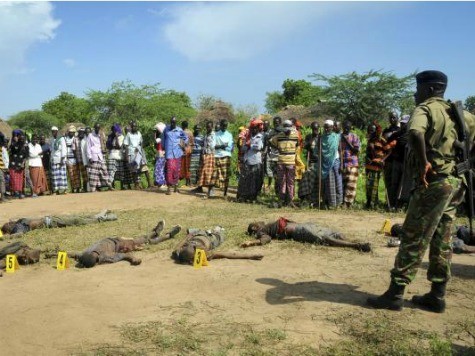
- Ethnic revenge massacre in Kenya kills 41
- Syria’s civil war versus Kenya’s civil war
- President Obama nominates John Kerry as Secretary of State
Ethnic revenge massacre in Kenya kills 41
At least 41 people, including many women and children, from theChristian Pokomo tribe in southwest Kenya were massacred while theyslept in a 3am by the Muslim Orma tribe. The attack was in revengefor a attack by the Pokomo against the Orma in August, where 52 peoplewere hacked to death with some being burnt alive, and hundreds ofcattle were mutilated.
Although the two tribes have adopted different religious faiths, thisis actually the same issue that began the Darfur conflict. (See “13-Dec-12 World View — Darfur war may explode again soon into full-scale genocide”)
The Darfur war began with violence between two ethnic groups, one offarmers and the other of herders. There were similar conflicts in theUnited States in the 1800s, although those conflicts didn’t lead towar. What happens is that the farmers are infuriated when herds ofanimals trample their crops. They respond by building fences, andthat infuriates the herders.
Exactly the same dynamic is occurring between the nomadic Ormaherders, who have frequently had violent conflicts with the Pokomofarmers. However, Friday’s violence is the worst incident in a while,and it raises fears of a repeat of the massive ethnic violence thatfollowed the 2007 presidential, in which more than 1,200 people werekilled, and many thousands were driven from their homes. I wrote aboutthis in January, 2008, in “Post-election massacre in Kenya raises concerns of tribal war”.
In that article, I described the recent generational historyof Kenya. The country’s last crisis war was the Mau-Mau Rebellion,which climaxed in 1956. In my 2008 article, I pointed out that itwas just 51 years since the climax of the Mau-Mau rebellion, makingit unlikely that a new crisis war would begin at that time. So Iindicated that the violence at that time was likely to fizzle (whichit did), but that violence would return, and the probability of newviolence triggering a major crisis war increases with each year.
Today, another five years have passed, and it’s now 56 years past theend of Kenya’s last crisis war, so the probability of triggeringa major new genocidal crisis war is much higher. In examining hundredsof wars throughout history, it has turned out that the peak yearfor a new generational crisis war is 58 years past the climax ofthe previous crisis war. Apparently, this is exactly the point wherethe generation of survivors of the previous war, who have devotedtheir lives to making sure it doesn’t happen again, become too oldto be effective in preventing a new crisis war.
The conflict between the Pokomo and the Orma seems to be highlylocalized, so the current skirmish seems likely to fizzle. But Kenyais headed for a major new genocidal ethnic war, almost certainlywithin the next five years. Standard Media (Kenya) and The Nation (Kenya)
Syria’s civil war versus Kenya’s civil war
This is a good opportunity to contrast the civil wars inSyria and Kenya. People constantly ask me whether the warin Syria is a generational crisis war, and I’ve written dozensof times in the last two years that it is not — it’sa civil war in a generational Awakening era, and it’s going tofizzle.
A crisis war comes from the people, while a non-crisis war comes fromthe politicians, and nothing illustrates this better than the contrastbetween Kenya and Syria. The war in Syria is driven entirely bypresident Bashar al-Assad, and it would fizzle quickly if al-Assadstepped down. Syria is still several decades away from a full-scalegenerational crisis war. But in Kenya, there are no politiciansdriving the war. It’s a war between two ethnic groups, farmers andherders, and it could spread and envelope the entire country at anytime.
President Obama nominates John Kerry as Secretary of State
When Massachusetts Senator John Kerry was running for president in 2004,I was wondering how it would be possible for someone who thoughtthat the U.S. Army was worse than the Nazis could be presidentand lead the country in the war against terror.
In 1971, Kerry said that American soldiers were committing war crimeslevels of command.” These atrocities included rape, torture, andcutting off ears, heads and limbs. He compared the actions of ourarmed forces to those of Genghis Khan. I wondered if Kerry stillbelieved this in 2004. I didn’t get answer then, but I did get ananswer in 2006, when Kerry appeared on Imus and reaffirmed that he had
In 2006, Kerry also made his famous statement indicating that hethought that people in the American armed forces were stupid: “You know, education — if you make the most of it,you study hard and you do your homework and you make an effort tobe smart, you can do well. If you don’t, you get stuck inIraq.”
With his contemptuous view of America’s armed forces, by nominatingKerry to be Secretary of State, President Obama has insulted everyAmerican soldier and, indeed, every American.
And I honestly have no idea how this guy is going to representthe United States. If he condemns a terrorist act in some othercountry, how will he answer the question: “But according to whatyou said in 1971, American soldiers are worse rapists, torturersand terrorists than al-Qaeda. Why does America have the rightto criticize anyone else?” Washington Post
Permanent web link to this article
Receive daily World View columns by e-mail
COMMENTS
Please let us know if you're having issues with commenting.