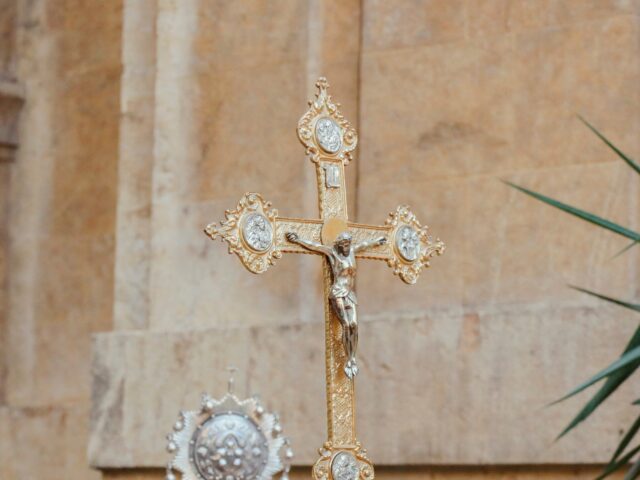
Multiple Syrian news outlets reported on Wednesday that the Franciscan Order has once again taken control of the Al-Ram School, formerly the Jesuit School, of Aleppo, over 50 years after the Assad dynasty’s Socialist Baath Party confiscated it.
The news arrived in a message published on Facebook by Father Bahjat Qara Qash, head of the Latin Monastery of Aleppo, and followed a visit by the Syrian president, former al-Qaeda terrorist Ahmed al-Sharaa, to the White House on Monday. Sharaa has endeavored to reinvent himself as a Western-friendly, democratic leader, vowing to respect the religious and cultural diversity of Syria despite imposing an Islamist constitution and holding an invite-only “election.” In a gesture of solidarity with the United States, Sharaa’s new government joined the global coalition against the Islamic State following his meeting with President Donald Trump on Monday.
According to a translation of Father Bahjat Qara Qash’s video published by the Christian Syriac Press, the Franciscans in the major Syrian city received word that they would receive control of what was once one of the highest quality schools in the country from the Ministry of Justice this week. The clergyman described his experience with the Sharaa-controlled Ministry of Justice as a “long effort and fruitful cooperation,” and said thanks to the new government “for their support in restoring the rightful ownership to its legitimate owners.”
The Syriac Press noted in its report that the institution was “founded in the late 19th century as Collège du Ram by French Jesuit monks [and] grew to become one of the most prestigious Catholic educational institutions in the Levant.”
“During the early 20th century, the school also sheltered Armenian refugees displaced during their deportation, later becoming a central cultural and educational landmark in the city’s development,” it added.
The Jesuit School, later rebranded the Al-Ram School, was “nationalized” by Hafez Assad’s socialists in 1967 and remained out of the hands of the Church until this week. While his son, deposed dictator Bashar Assad, generally allowed Christians to live in the territories that he controlled during his tenure in power – and often used them for propaganda – the socialist party “nationalized” large numbers of religious institutions when it initially came to power in order to cement its stranglehold on power and did not become a relative supporter of Christian populations until much later. During the civil war that began in 2011, Assad exploited the genocidal intentions of groups such as al-Qaeda and the Islamic State against Christians to secure their support, despite his own status as an Iran-backed Alawite Shia Muslim. Christian persecution experts generally agreed at the time that Assad-controlled areas of Syria were safer for Christians than those under Islamic State or other jihadist control.
Sharaa’s group, Hayat Tahrir al-Sham (HTS), began as a wing of al-Qaeda, then broke with the larger jihadist group to become the “Nusra Front,” dedicated more closely to the toppling of Assad than global jihad. The Nusra Front ultimately rebranded as HTS and dedicated over a decade of fighting to seizing Aleppo, one of the cities most devastated by the war and where evidence surfaced that Assad had used chemical weapons against rebel groups. In November 2024, they successfully ousted Assad forces from the city, which prompted reports of jihadist ransackings of Christian homes and attacks on their communities. On December 7, Assad and his family fled the country, receiving political asylum in Russia.
“The situation for Christians in Syria, particularly in Aleppo, is dire, following the recent seizure of the city by Islamist militant group, HTS, on December 2, 2024,” Jeff King, the then-president of International Christian Concern, told Breitbart News in January. “Aleppo, historically a center of religious diversity with a Christian presence dating back nearly two millennia, has seen its Christian community, once numbering 20,000, thrown into chaos.”
“Militants removed Christmas decorations from public spaces and there are reports of violence, which has instilled fear and prompted many Christians to flee,” he relayed.
“HTS, with its al-Qaeda/ISIS roots, has historically been very violent towards Christian minorities, which should mean increased persecution,” King continued. “This situation will probably lead to Syria appearing on our Global Persecution Index next year, as there’s now less protection for minorities without Assad’s regime.”
Sharaa has nonetheless insisted, including in conversations with Christian leaders, that his government would protect the rights of Christians in the country.
Archbishop Ignatius Aphrem, the patriarch of the Syriac Orthodox Church, told the Kurdish outlet Rudaw in October that he had met with Sharaa and the two had a “constructive and positive” conversation. He expressed some doubt, however, that even if Sharaa wanted to contain anti-Christian violence, he had the power to do so.
“We want Christians to be citizens of the first degree … And this is what we heard from the president. This is what he really promised,” the archbishop said. He expressed some doubt that this promise could be sustained, however.
“First, there are many regional and foreign interventions in Syria. Second, there are different groups that reached the government with the president, Ahmed Al-Sharra [sic],” he explained. “And they differ in the degree of their religious commitment and openness to others. So, of course, there are some obstacles that prevent this government from implementing everything it wants now. But I personally do not doubt the government’s intention.”
Archbishop Ignatius Aphrem estimated that the current Christian population of Syria is around 500,000 people, a loss of 1 million Christians in a decade, and that Christians were continuing to flee the country, failing to trust the new government.
President Trump, following his meeting with Sharaa on Monday, expressed confidence in his governing ability.
“He’s a very strong leader. He comes from a very tough place. Tough guy. I like him,” Trump told reporters during a press conference after Sharaa’s departure. “I get along with the president, the new president in Syria, and we’ll do everything we can to make Syria successful, because that’s part of the Middle East. We have peace now in the Middle East.”
COMMENTS
Please let us know if you're having issues with commenting.