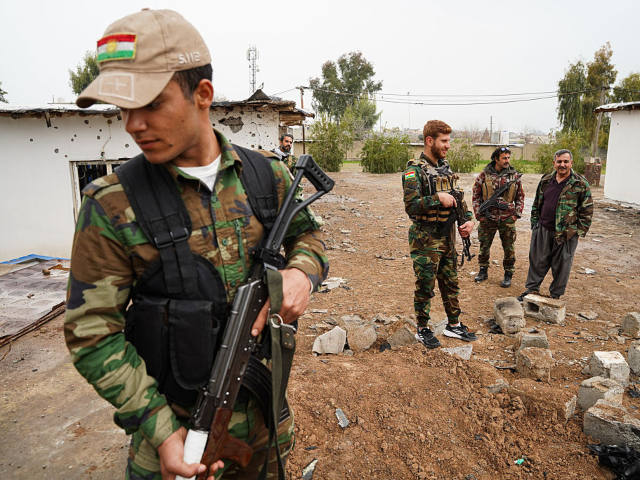

President Donald Trump said on Sunday that the United States attempted to supply Iranian protesters with weapons this year so they could defend themselves against another massacre, but the effort was not successful because Kurdish intermediaries decided to keep some of the guns for themselves.
“President Trump told me the United States sent guns to the Iranian protesters,” Fox News chief foreign correspondent Trey Yingst said of his telephone interview with Trump on Sunday morning.
“He tells me: ‘We sent them a lot of guns. We sent them through the Kurds,’ and the president says he thinks the Kurds kept them. He went on to say, ‘We sent guns to the protesters, a lot of them,’” Yingst said.
The Iranian regime clung to power in January by massacring thousands of its own citizens to suppress an uprising initially triggered by economic collapse. The regime has officially admitted to fewer than 10,000 killings, but whistleblowers inside the regime have said the true death toll was three or four times that large.
President Trump promised the protesters in January that “help is on its way” and promised the regime would “pay a big price” for killing them. His remarks to Yingst suggested an effort to provide the disarmed and helpless Iranian populace with firearms was part of his plan for enhancing their safety.
Qatar’s Al Jazeera News worried on Monday that Trump’s remarks to Yingst “could lend weight to Tehran’s own assertions that the protests were not organic, and ‘foreign-backed terrorists’ had instigated them.”
Early in the January uprising, the regime in Tehran attempted to draw a distinction between “good” protesters with sincere grievances about the failure of the national economy and “bad” protesters who were allegedly colluding with foreign powers to destabilize the Iranian government. The regime, which blames all of its economic woes on U.S. sanctions, claimed it was willing to work with the sincere protesters while cracking down on the foreign “saboteurs.” This pretense evaporated as the uprising gained strength and the regime fell back on its usual brutal tactics to stay in power.
Al Jazeera noted that former supreme leader Ali Khamenei, who was liquidated in the early hours of Operation Epic Fury at the end of February, blamed all of the protester killings on the U.S. and Israel.
“The latest anti-Iran sedition was different in that the U.S. president personally became involved,” he claimed.
In early March, Trump floated the idea of arming Kurdish militants in Iran so they could battle the Islamic Revolutionary Ground Corps (IRGC) on the ground. Several media outlets in the United States and Israel reported that the CIA was working to arm the Kurds so they could lead a “popular uprising in Iran.”
Unnamed Kurdish officials said the plan was real and had reached an “advanced stage” by the time Trump publicly mentioned it. These officials said ground action against the IRGC could begin within a few days, although that did not come to pass.
Trump said on March 7 he had soured on the idea of using the Kurds as a ground-force proxy against the IRGC.
“We’re very friendly with the Kurds, as you know, but we don’t want to make the war any more complex than it already is. I have ruled that out, I don’t want the Kurds going in,” the president told reporters.
Trump said he “had a good relation” with the Kurds and they were “willing to go in.” He said that upon reflection, “I’ve told them I don’t want them to go.”
Kurdish news service Rudaw reported on Sunday that “several Iranian Kurdish opposition groups” denied receiving weapons from the United States during the January uprising.
“Those statements made are baseless and we haven’t received any weapons. The weapons we have are from 47 years ago, and we obtained them on the Islamic Republic’s battlefield, and we bought some from the market,” said Mohammed Nazif Qaderi, a senior official from the Kurdistan Democratic Party of Iran (KDPI).
“Our policy is not to make demonstrations violent and use harsh methods, rather we believe we must make our demands in a peaceful and civil manner without weapons,” Qaderi insisted.
“As our own party, no weapons have come to us and we haven’t received anything, we’re not even aware of the matter. Previously, this matter was never discussed, and we haven’t talked to anyone about it,” said Kako Aliyar, one of the leaders of the Iranian Kurdish opposition party Komala.
“Donald Trump’s message is unclear to us. What is there, is that we as our army have in no way received weapons from the U.S. or any other country, not even a single bullet,” said Hamno Kaqshbandi, a member of the militant Kurdistan National Army.
COMMENTS
Please let us know if you're having issues with commenting.