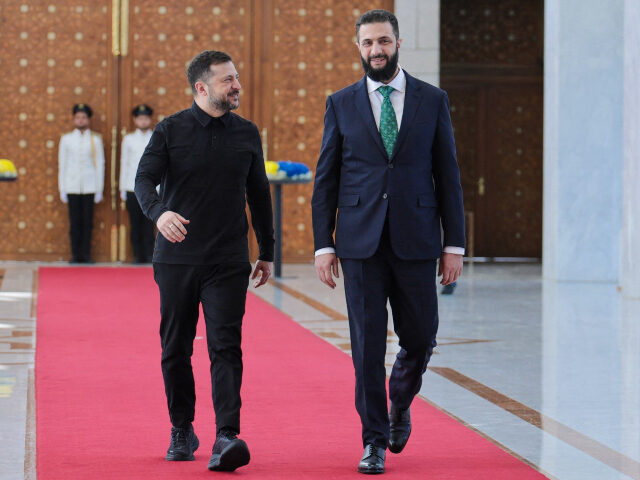

President Volodymyr Zelensky visited Damascus, Syria, on Sunday, receiving a warm welcome from President Ahmed al-Sharaa and reportedly discussing cooperation on food and security exchanges.
Zelensky and Sharaa met once before, in New York, while both were attending the United Nations General Assembly in September. Both their countries have experienced significant aggression by both Iran and Russia – Ukraine is facing an ongoing Iran-backed Russian invasion, while Syria endured over a decade of civil war in which both Iran and Russia supported deposed dictator Bashar Assad. On the groundwork of these shared experiences, Sharaa and Zelensky appear to be pursuing closer collaboration.
Their partnership is especially unique given Zelensky’s status as one of the world’s few Jewish heads of state and Sharaa’s recent past as an al-Qaeda-affiliated jihadist. Prior to becoming the leader of Syria, Sharaa used the jihadist nom de guerre “Abu Mohammed al-Jolani” and ran Hayat Tahrir al-Sham (HTS), an offshoot of al-Qaeda at war with Assad. HTS ended the civil war by forcing Assad to flee to Russia in December 2024.
Sharaa used his official social media accounts to publish a high-production video of Zelensky’s welcome in Damascus, where the Ukrainian president was greeted with a lavish red carpet and full military salute and driven to the president’s offices for meetings with top Syrian officials. Also reportedly present was Turkish Foreign Minister Hakan Fidan, representing one of Syria’s most sustained alliances in the post-HTS era.
“In Damascus, I received Ukrainian President Volodymyr Zelenskyy, where avenues for enhancing economic cooperation and exchanging expertise were discussed,” Sharaa wrote on social media. “The visit underscores Syria’s orientation toward expanding its international partnerships in a manner that supports development and bolsters stability.”
In his own social media messages, Zelensky explained that he used his meeting to update Sharaa on the status of the Russian invasion of his country, seek “greater security and more opportunities for development” for their countries, and potentially cut a deal to sell Ukrainian agricultural products to Syria. Ukraine is one of the world’s largest wheat suppliers, offering critical sales of grains to many countries throughout the Middle East and Africa, even throughout the current invasion. Syria, in contrast, has been devastated on a national level by over a decade of civil war, leaving much of both its urban and rural territory in ruins and unusable for food production.
“There is strong interest in exchanging military and security experience,” Zelensky said following his meeting with Sharaa.
He continued:
We also touched on Ukraine’s role as a reliable supplier of food products and discussed joint opportunities to strengthen food security across the region. We understand very well the energy and infrastructure challenges Syria is currently facing. We are ready to work together to expand opportunities for both our countries and their people.
The Ukrainian state news site Ukrinform reported on Sunday that the first major deliverable from the meeting will be the opening of embassies in the capitals of the two nations. Ukraine ended diplomatic ties with Syria in 2022 following Assad’s vocal support for the Russian invasion and recognition of Russia’s “annexation” of Ukrainian territories.
Ukrainian Foreign Minister Andrii Sybiha called the reopening of the embassies an “important step in strengthening our partnership” and reiterated Ukraine’s keen interest in sustaining the Syrian food supply.
“Food security remains an important track. Ukraine stands ready to contribute, including through initiatives such as Grain from Ukraine, to support stability in the region,” he said in a statement.
Similarly, the state-run Syrian Arab News Agency (SANA) emphasized in its coverage that both Sharaa and Zelensky “stressed the importance of securing global food supply routes in a way that contributes to strengthening its stability in light of international tensions.”
Zelensky and Sharaa first met in person during the General Assembly last year, restoring ties between their countries and vowing to reconnect to strengthen cooperation. The General Assembly was Sharaa’s first major opportunity to meet a variety of heads of state in one place in person and to address the world from the massive United Nations platform.
“During our negotiations with President of Syria Ahmed al-Sharaa, we also discussed in detail promising sectors for developing cooperation, security threats faced by both countries, and the importance of countering them,” Zelensky said at the time. “We agreed to build our relations on the basis of mutual respect and trust.”
Zelensky made sure in December to congratulate Sharaa on the anniversary of his conquest of Damascus, declaring Assad’s flight “a bright day for Syria, the Middle East, and the entire world.”
Sharaa has enthusiastically pursued ties with Ukraine while also attempting to mediate a cordial, though distant, relationship with Russia. Sharaa visited Moscow in January, where dictator Vladimir Putin credited him with making “personal efforts” to avoid a complete collapse of diplomacy between the two countries.
Zelensky, meanwhile, has accelerated his diplomacy towards the Middle East generally, particularly in light of the ongoing conflict between the United States and Iran. Zelensky has in the past month visited, in addition to Syria, Saudi Arabia, the United Arab Emirates (UAE), and Qatar, signing defense agreements with those countries. In Saudi Arabia, Zelensky also announced that Ukraine is willing to deploy military experts with experience fighting against Iranian “Shahed” suicide drones to support the Saudi military. All three countries have experienced missile and drone attacks by Iran in retaliation for “Operation Epic Freedom,” the American efforts to weaken the Iranian terror state.
“We are ready to share our expertise and systems with Saudi Arabia and to work together to strengthen the protection of lives,” Zelensky said at the time. “Now into the fifth year, Ukrainians are resisting the same kind of terrorist attacks — ballistic missiles and drones — that the Iranian regime is currently carrying out in the Middle East and the Gulf region.”
Zelensky’s outreach to the Middle East has reportedly irritated the Iranian Islamist regime. Last week, reports revealed that Amir Saeid Iravani, Iran’s United Nations envoy, sent a letter to United Nations leadership complaining that Ukraine’s offer of specialists to fight drones “can effectively be seen as providing material and operational support for the ongoing unlawful military aggression against Iran.”
COMMENTS
Please let us know if you're having issues with commenting.