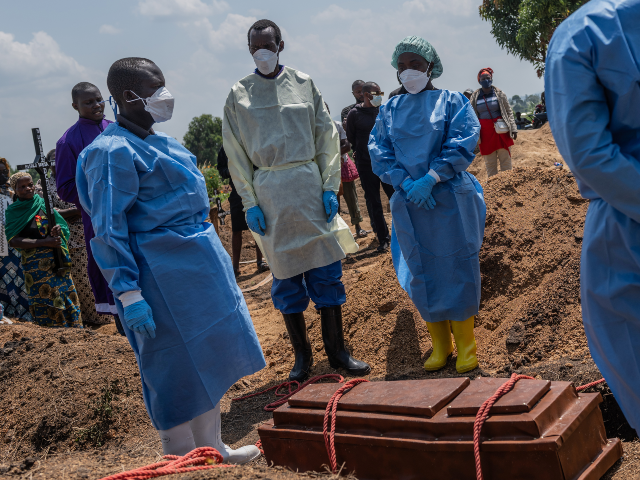

African health authorities confirmed Wednesday they had documented 1,031 deaths linked to the ongoing outbreak of Ebola Bundibugyo in the Democratic Republic of the Congo, just over two months after the World Health Organization (W.H.O.) declared a public health emergency.
The country first began experiencing a surge in the number of Ebola cases in its restive eastern Ituri and North Kivu provinces in the first half of the year. W.H.O. Director-General Tedros Adhanom Ghebreyesus suggested that the outbreak may have begun as early as in January of this year while addressing the situation in June; his agency declared an outbreak of high concern in the DRC in May.
The Ebola outbreak is widely considered among the most serious documented in history, exacerbated by the challenging conditions in eastern DRC – an area marred by extreme violence as warring militias vie for control of illicit mining industries and displace thousands in the process. Local communities have also resisted aid from the international community, many of them denying the existence of Ebola and attacking health workers or escaping quarantine, making treatment and containment difficult. Furthermore, the strain of Ebola spreading in Ituri and North Kivu, Bundibugyo, was previously a less common form of the virus and no treatment, vaccine, or other medical intervention currently exists to address it.
DRC authorities revealed on Wednesday that they had documented 2,473 cases of Ebola Bundibugyo in the country as of that day believed to be linked to the outbreak. Among those, 999 patients have died, resulting in a death rate of about 40 percent that may be somewhat lower taking into consideration Ebola patients who have yet to be identified. Later that day, Jean Kaseya the head of the Africa Centers for Disease Control (CDC), updated that death toll to over 1,000.
The Associated Press observed on Wednesday that the current outbreak has “killed more people at a quicker rate than any outbreak on record,” comparing it to the 2013-2016 outbreak in Guinea, Liberia, and Sierra Leone that took about eight months for authorities to document 1,000 deaths. That outbreak ended with over 11,000 people killed and 28,000 cases. Another alarming statistic highlights the failure of contact tracing: over 80 percent of new cases are being documented in individuals not identified as having been exposed by contact tracing procedures.
“The Ebola outbreak is escalating at an alarming pace. We must act now,” Jean Kaseya, the director-general of the Africa CDC, warned this week. “If we do not stop it today, this will become the worst outbreak the world has ever documented … We must mobilize every available resource, strengthen the response on the ground and stop this outbreak before more lives are lost.”
Containing the outbreak has faced significant resistance from local communities, as many in DRC do not believe that Ebola is a real disease and instead believe that it is a fabricated excuse to flood their communities with international aid workers in town to conduct “population control” killings. That distrust has manifested in locals attacking health centers, Ebola patients escaping from hospitals and health centers to avoid treatment, and the theft of corpses to perform traditional burials and prevent their loved ones from being buried in a manner that protects the mourners from exposure to the disease.
In May, Tedros, the head of the W.H.O., lamented that lack of community engagement had helped make contact tracing “nearly impossible” as locals did not cooperate and, in some cases, actively sabotaged disease mitigating activities. Tedros himself visited Ituri in June, writing a letter to locals urging them to accept the help from the United Nations and other humanitarian entities.
“Talk to your friends and your families. Share what you know about Ebola,” he urged young people in an open letter to the people of eastern DRC. “Help break the fear and the silence that allow this virus to spread. Your voice carries further than you know, and we need it now more than ever.”
Local Congolese news outlets document continuing distrust among locals towards public health officials. In a report on July 20, the news network Radio Okapi reported on a call by the National Council of Humanitarian NGO Forums of the DRC (CONAFOD-DRC) for the government to work harder to create the space for cooperation with local and traditional leaders.
“Despite health advances, the response faces stubborn resistance on the ground,” Radio Okapi reported, citing the organization. “False rumors, refusal to follow contacts and maintenance of unsecured clandestine burials continue to fuel chains of contamination.”
Similarly, Radio Okapi quoted local governor Jean Bakomito Gambu of Haut-Uele lamenting that “major psychological and social obstacle[s]” make the government’s job of containing the disease challenging.
“Part of the population refuses to admit the existence of the virus, describing the disease as ‘editing’ or staged, which compromises prevention efforts,” Gambu reportedly explained. “This denial results in a systematic rejection of medical protocols: refusal to be tested, refusal to submit to temperature measurement and reluctance to hand washing devices.”
“The biggest challenge remains resistance from, or outright refusal by, some communities to accept response teams,” Robert Ndjalonga, the leader of civil protection in Ituri, told the Associated Press. “On several occasions, burial teams have had to be escorted by security forces to ensure that safe and dignified burials could be carried out without incident.”
COMMENTS
Please let us know if you're having issues with commenting.