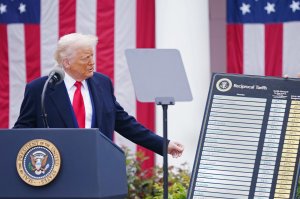
July 7 (UPI) — President Donald Trump on Monday informed Japan and South Korea that 25% tariffs will be imposed starting Aug. 1 on most goods sent to the United States.
Trump sent letters to Japanese Prime Minister Ishiba Shigeru and South Korean President Lee Jae-myung informing them of the new duties. He shared the letters on Truth Social on Monday afternoon.
After the announcement, American stocks tumbled. The Dow Jones Industrial Average was down as much as 530 points, or 1.2%; the S&P 500 slumped 0.87% and the tech-dominant Nasdaq Composite was 0.9% lower. Setting record highs Thursday were the S&P at 6,279,35 and Nasdaq at 20,624.51. DJIA that day reached 44,828.53, below the record 45,014.04 on Dec. 4.
U.S.-listed Japanese automakers Toyota, Nissan and Honda dropped up to 7.5%. Korea’s Kia was half a percent down and Hyundai was up about 1% with cars mostly made in the United States. American companies also produce cars from other countries and import parts.
The U.S. president had imposed a Wednesday deadline for nations to negotiate better trade deals. On April 2 on “Declaration Day,” he announced 10% across-the-board baseline tariffs on 90 trading partners and harsher ones for the worst offenders.
One week later, he pushed the deadline back until July 9 for the reciprocal duties.
Besides Japan and South Korea, other nations are bracing for higher tariffs, including the 27 countries in the European Union. USA Today reported as many as 100 letters could go out to nations.
The original reciprocal tariffs were 24% for Japan and 25% for South Korea.
The letters to the Asian nations state that the 25% tariffs are separate from sector-specific duties on key product categories.
“Goods transshipped to evade a higher Tariff will be subject to that higher Tariff,” Trump said. That refers to moving goods to an interim country before their final shipment to the United States.
The letters say that the higher tariffs are necessary because the other nations are taking advantage of the United States.
“Please understand this 25% number is far less than what is needed to eliminate the Trade Deficit disparity we have with your Country,” Trump wrote to both countries.
In 2024, the U.S. had a $68.5 billion goods deficit with Japan and a $66 billion with South Korea, according to the Office of the United States Trade Representative.
Trump also warned that the rates could be higher if they impose retaliatory duties.
“As you aware, there will be no Tariff if Korea, or companies within your Country, decide to build or manufacture product within the United States and, in fact, we will do everything possible to get approvals quickly, professionally, and routinely — in other words, in a matter of weeks,” Trump wrote to South Korea’s president.
Trump on Monday threatened nations that support BRICS nations — Brazil, Russia, India and China — would be slapped with an additional 10% tariff.
The Trump administration has been negotiating with nations. Deals have been announced with Great Britain, China and Vietnam.
For Britain, there is a 10% baseline tariff on most goods but an exemption for 50% tariffs on steel and aluminum on most other countries. Instead, it is 25%. Britain was originally to be imposed only the 10% rate. U.S. tariffs on British car imports and auto parts will be reduced to 10% for 100,000 cars.
In China, there is a 30% tariff on most Chinese imports, with exceptions on smartphones and computers. Originally the tariff on most goods was to be 134%.
In Vietnam, imports are subject to a 10% tariff with products originating from third countries shipped to the United States in Vietnamese ports increased to 40%. The original reciprocal was 46%.
COMMENTS
Please let us know if you're having issues with commenting.