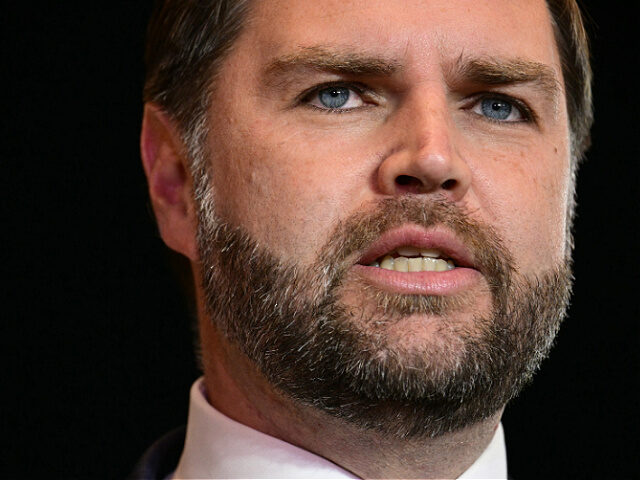
Vice President JD Vance criticized the Supreme Court for its “lawlessness” after it issued a 6-3 ruling striking down President Donald Trump’s global tariffs imposed under the International Emergency Economic Powers Act (IEEPA).
In a post on X, Vance pointed out that the “only effect” from the Supreme Court’s ruling would be “to make it harder for the president to protect American industries and supply chain resiliency.”
“Today, the Supreme Court decided that Congress, despite giving the president the ability to ‘regulate imports’, didn’t actually mean it,” Vance wrote. “This is lawlessness from the Court, plain and simple.”
Vance added that Trump “has a wide range of other tariff powers and he will use them to defend American workers and advance this administration’s trade priorities.”
Breitbart News’s John Carney reported that the ruling from the Supreme Court represented “the first time the high court has definitively struck down one of Trump’s second-term policies”:
The ruling is the first time the high court has definitively struck down one of Trump’s second-term policies. In other areas, the court has granted Trump broad latitude to deploy executive power, but a majority of justices said he went too far in enacting his most sweeping tariffs without clear authorization from Congress.
Trump imposed the tariffs in two waves. In February 2025, he placed 25 percent duties on most Canadian and Mexican imports and 10 percent on Chinese goods, citing fentanyl trafficking. Then in April, on what he dubbed “Liberation Day,” he imposed a general 10 percent tariff on imports from nearly all countries and steeper rates on nations the administration deemed trade violators.
Trump declared overdose deaths from fentanyl and persistent annual trade deficits to be national emergencies that justified the new trade policy under the International Emergency Economic Powers Act, a 1977 law Congress passed to give presidents tools for responding to foreign crises.
While Supreme Court Chief Justice John Roberts, and Justices Sonia Sotomayor, Elene Kagan, Neil Gorsuch, Amy Coney Barrett, and Ketanji Brown Jackson formed the majority in the ruling, Justices Samuel Alito, Brett Kavanaugh, and Clarence Thomas dissented.
Breitbart News White House Correspondent Nick Gilbertson reported that Justice Kavanaugh hinted that there may be a “path forward for future tariffs”:
Although I firmly disagree with the Court’s holding today, the decision might not substantially constrain a President’s ability to order tariffs going forward. That is because numerous other federal statutes authorize the President to impose tariffs and might justify most (if not all) of the tariffs at issue in this case—albeit perhaps with a few additional procedural steps that IEEPA, as an emergency statute, does not require. Those statutes include, for example, the Trade Expansion Act of 1962 (Section 232); the Trade Act of 1974 (Sections 122, 201, and 301); and the Tariff Act of 1930 (Section 338). In essence, the Court today concludes that the President checked the wrong statutory box by relying on IEEPA rather than another statute to impose these tariffs.
During a White House press briefing after the ruling, Trump announced that he would be signing “an order to impose a ten percent global tariff under Section 122” of the Trade Act of 1974.
“Effective immediately, all national security tariffs under Section 232 and existing Section 301 tariffs remain in place — fully in place, and in full force and effect,” Trump said. “Today, I will sign an order to impose a ten percent global tariff under Section 122, over and above our normal tariffs already being charged. And, we’re also initiating several Section 301 and other investigations to protect our country from unfair trading practices of other countries and companies.”
COMMENTS
Please let us know if you're having issues with commenting.