
President Donald Trump’s Pentagon is developing military options for what officials describe as a potentially “massive” final blow against Iran — including seizing strategic islands in the Strait of Hormuz, blockading Iranian oil exports, and securing Tehran’s stockpile of highly enriched uranium — as the administration weighs sending 10,000 additional combat troops to the Middle East if diplomacy collapses and the vital waterway remains restricted.
Axios first reported Thursday that the Pentagon is drawing up the escalation options as the White House weighs how to conclude the war if negotiations fail, particularly if Iran continues to impede the free flow of shipping through the Strait of Hormuz, a critical global energy corridor.
The outlet reported that several core options are under discussion, including seizing or blockading Kharg Island, Iran’s primary oil export hub; targeting Larak Island, which plays a central role in monitoring and threatening maritime traffic through the strait; and seizing Abu Musa along with the Greater and Lesser Tunb islands — Iranian-held outposts near the western entrance to the waterway equipped with missile, drone, and mine-laying capabilities.
U.S. planners have also prepared options for ground operations inside Iran aimed at securing the regime’s stockpile of highly enriched uranium, alongside alternative plans for large-scale strikes to neutralize those capabilities.
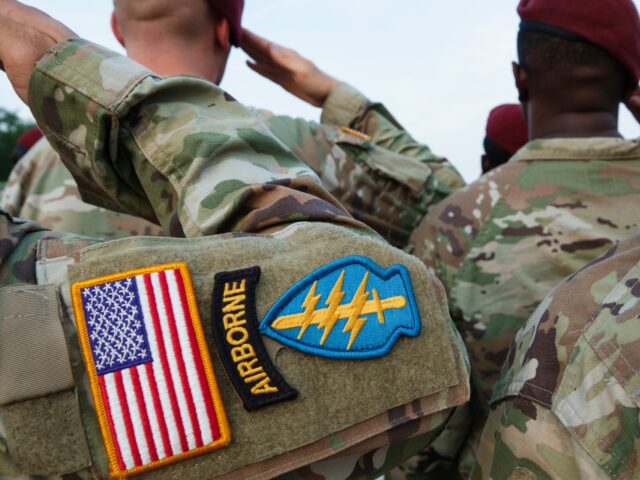
The planning comes as the Wall Street Journal reported Thursday the Pentagon is weighing sending up to 10,000 additional combat ground troops to the Middle East — including infantry and armored units — adding to forces already deploying to the region, including Marine expeditionary units and elements of the 82nd Airborne Division.
That potential deployment builds on a broader military posture already taking shape, with Marine expeditionary units moving into the region — including one aboard the USS Tripoli — alongside elements of the 82nd Airborne Division, including an infantry brigade now positioned in theater.
A wave of reporting across U.S. and Israeli outlets on Thursday reinforced the broader picture first laid out by Axios, with CNN reporting that administration officials are weighing options to escalate the conflict if Trump’s latest diplomatic outreach to the Iranian regime fails.
CNN reported that one of the central options under review is Kharg Island, which handles roughly 90 percent of Iran’s crude exports, with some officials arguing that seizing or neutralizing the island could “totally bankrupt” the regime’s Islamic Revolutionary Guard Corps and sharply constrain its revenue stream.
The report added that officials have also discussed authorizing strikes to disable the island’s oil infrastructure, as well as seizing other strategically positioned islands near the Strait of Hormuz to ultimately neutralize Tehran’s ability to threaten tanker traffic moving through the strategic corridor.
A follow-up Axios report Thursday further detailed the strategic role of those islands, noting that Kharg serves as Iran’s primary export terminal, while Larak sits near the narrowest point of the strait and hosts military infrastructure used to track and pressure shipping.
Abu Musa and the Greater and Lesser Tunb islands, positioned near the western entrance to the Strait of Hormuz, function as forward Iranian outposts that extend Tehran’s reach over the waterway and underpin its ability to disrupt maritime traffic.
RELATED: “We Negotiate with Bombs” — Hegseth Says U.S. Holds Upper Hand Over Tehran
While that strategic focus has sharpened, NBC News reported Wednesday that Kharg Island remains central to any effort to disrupt Iran’s economy, describing it as the regime’s primary oil export lifeline and noting that U.S. officials view any move against it as a direct attempt to collapse a key revenue stream.
CNN reported Wednesday that Iran is already hardening the island against a potential assault — laying traps, repositioning military personnel, and boosting air defenses amid concerns that U.S. forces could attempt to seize the territory.
Those developments have prompted warnings from U.S. officials and analysts that Kharg’s proximity to the mainland places it well within range of Iranian missiles, drones, and artillery, complicating any operation and raising the likelihood of sustained resistance.
The Times of Israel reported Thursday, citing officials from countries involved in mediation efforts, that U.S. officials believe increased military pressure could force Tehran to reconsider its position, even as others caution that capturing and holding key sites would require significant forces and could extend the conflict.
The same report noted that those officials doubt Iran would agree to terms under direct military pressure that it had already rejected prior to the war, highlighting uncertainty over how Tehran would respond to a broader escalation.
Trump has continued to pair military pressure with diplomatic signaling. In a Truth Social post Thursday, he announced a ten-day pause on strikes against Iranian energy infrastructure — through April 6 — saying the move was made at Tehran’s request while adding that talks are “going very well.”
At the same time, Trump warned that Iran must engage seriously in negotiations, stating during a Cabinet meeting Thursday, “They’re defeated, they can’t make a comeback. They now have a chance to make a deal. But that’s up to them.”
As Breitbart News reported Wednesday, White House spokeswoman Karoline Leavitt said the regime “should not miscalculate again,” warning that if Tehran fails to recognize its weakened position, President Trump “will ensure they are hit harder than they have ever been hit before.”
Iranian officials have signaled they are closely monitoring U.S. movements in the region. Parliamentary speaker Mohammad Bagher Ghalibaf wrote Wednesday on X that Iran’s armed forces are tracking developments and warned that any attempt to seize Iranian territory would trigger a broad retaliatory response targeting regional infrastructure.
Iranian messaging has also pointed to preparations for a potential ground confrontation, with reports in Iranian media claiming that as many as one million individuals have been mobilized or are prepared to mobilize in the event of a U.S. ground incursion, with recruitment activity intensifying across Basij and other regime-linked forces.
Separately, Reuters reported Thursday that Iranian hardliners are ramping up calls for the regime to openly pursue a nuclear weapon, with senior voices discussing abandoning longstanding constraints — including the Nuclear Non-Proliferation Treaty — and discarding the long-held pretense that Tehran’s nuclear program is not aimed at weaponization.
That shift adds urgency to U.S. planning around securing or neutralizing Iran’s stockpile of highly enriched uranium — a move viewed as central to preventing a potential nuclear breakout.
For now, Trump is seeking to preserve room for negotiations. But as talks remain uncertain, the Strait of Hormuz remains under pressure, Kharg Island has been reinforced, Iranian hardliners are speaking more openly about a nuclear path, and the Pentagon is preparing a range of military options should diplomacy fail.
Joshua Klein is a reporter for Breitbart News. Email him at jklein@breitbart.com. Follow him on Twitter @JoshuaKlein.
COMMENTS
Please let us know if you're having issues with commenting.