

DELPHI, Greece — Greek Minister of Environment and Energy Stavros Papastavrou told Breitbart News exclusively here in April that President Donald Trump’s “trademark move” as the leader of the West is to use energy deals to advance American interests with both friends and foes on the world stage.
Papastavrou mentioned that energy diplomacy has formed the framework of Trump’s trade deals, key alliances like the so-called 3+1 framework between Greece, Cyprus, Israel, and the U.S., and in Trump’s actions with adversaries of the United States like Iran, Venezuela, China, and Russia. Papastavrou cited Trump’s development of the National Energy Dominance Council chaired by Interior Secretary Doug Burgum, and the Partnership for Transatlantic Energy Cooperation (P-TEC) at the Department of Energy under Secretary Chris Wright. Papastavrou said Trump’s use of energy as a diplomatic tool — he uses it as a carrot for allies and as a stick against adversaries — has “worked,” and is effective in creating “stability” marginalizing “extremist behavior.”
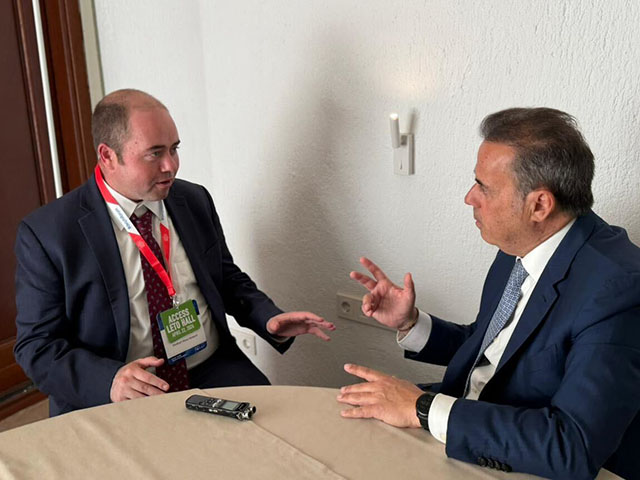
Breitbart News Washington Bureau Chief Matthew Boyle speaks with Greek Minister of Environment and Energy Stavros Papastavrou in Delphi, Greece. (Courtesy Greek Energy Minister)
“That’s his trademark, and I think it has worked,” Papastavrou told Breitbart News in an interview on the sidelines of the Delphi Economic Forum in late April. “I think we realized early on in Greece that the significance of the creation of the National Energy Dominance Council, which in its composition you have Doug Burgum, you have Chris Wright, and you have the Secretary of Defense, the Secretary of Treasury. You see the importance that the organization was given and energy took a transformative dimension. It has geopolitics. It is totally connected with national security. This is also the basis for the 3+1 initiative. It’s exactly what you described — Greece, Cyprus, and Israel, together with the U.S., which we met in P-TEC — this creates a form of cooperation for growth and prosperity and that creates a stability in the region that marginalizes extremist behavior and marginalizes threats of unilateral activity.”
Unlike any other European nation at the moment, Greece has totally embraced Trump’s vision on energy and is actively rolling out efforts that will begin early next year to pursue possible natural gas off the coasts of its islands in deep water drilling pushes. To do so, the Greeks are partnering with American energy companies like Chevron and ExxonMobil. ExxonMobil is going to be exploring the Ionian Sea starting early next year, and Chevron will be active off the coast of Crete — Greece’s largest island — while efforts to explore for natural gas in the Peloponnese are beginning soon too. It is the first drilling or natural gas exploration in Greece in nearly half a century.
“The big picture is the following. Greece, for a number of years — for decades — has not explored this hydrocarbon potential,” Papastavrou told Breitbart News. “I think now it’s the time the [Prime Minister Kyriakos] Mitsotakis government to move in an accelerated pace in this direction. The two largest globally, U.S. energy companies Chevron and ExxonMobil — have expressed an interest and are actively participating here. ExxonMobil, in a consortium, will be doing the first exploratory drilling after almost half a century in Greece, in the Ionian Sea in the so-called Block 2, and this will be the first in deep water and will go down to 4,600 meters. Any exploration that has taken place in Greece until now, 40 years ago, has been in shallow water. It’s, let’s say, not as deep as now. Greece’s potential is all around the country in deep water. So, this can have a transformative impact for the country. So, this action and the consortium is doing the exploratory drilling next February. We signed the drilling contract one week ago with ExxonMobil. It will be Standard Drilling, which is one of the leading Swedish drilling firms, and when it comes to Crete and the Peloponnese, we passed through the Parliament in February, four agreements with several which will start doing the geological surveys by the end of this year. So both in the Ionian and in south of Crete and the Peloponnese, with the two largest U.S. energy companies, Greece is moving ahead into exploring the hydrocarbons.”
Papastavrou added that Greece is following Trump’s vision for “realism” on energy, pursuing hydrocarbons but also renewables.
“In broader terms, I think President Trump said we need to take advantage and develop our own resources in the form that we have in Greece,” Papastavrou said. “So, it’s not wind or sun, or the hydrocarbons, it is all of the above. It’s wind, sun, hydrocarbons, hydro, geo — everything. For Europe, this is something that is a wakeup call, because Europe is the largest client of the U.S., importing U.S. LNG. At the same time, there have been very hesitant — or let’s say, ambivalent — EU member states on trying to develop their own natural gas. So, Europe is dependent on natural gas, but they were not willing to accept an energy mix the natural gas should be part of for the years to come and President Trump — realism. I think this is something that we see in Greece’s approach as well. We have sun, we have wind. We need to move faster in terms of storage. Storage is very key.”
A big part of the reason for the shift in energy policy from Europe, Papastavrou said, is because of Russia’s invasion of Ukraine. The hope for Europeans is to “completely replace” the flow of Russian natural gas with American LNG and other more reliable sources, like if Greece finds its own by as early as next year.
“On the issue of the energy security and the system, and at the same time, move fast with the hydrocarbons and the prime minister’s invested heavily and has been long on natural gas,” Papastavrou said. “We have invested in infrastructure since 2019… With interconnections with the neighboring countries, that has allowed us — the moment Europe, rightfully so, called the weaponization of energy by Russia and decided that by 2027 we will completely replace Russian gas, Greece was there to be the entry point for U.S. LNG to replace with a vertical corridor.”
Papastavrou said when Russia invaded Ukraine in 2022 the whole continent of Europe “woke up.”
“I think people woke up in 2022 and realized that what they considered to be affordable energy by Russia was, in the end, very expensive because Russia cut off the energy,” Papastavrou said. “Bulgaria and Serbia woke up freezing. Ukraine right now is suffering from the organization of energy that Russia did. So, I think Europe realized that their relying on cheap energy from Russia was not a stable and long-term foundation for a strategy. They realized that we need to diversify. We need to find alternative sources. If there is one conclusion of what’s going on right now with the crisis in the Middle East it is the name of the game is diversification — diversification of supply, diversification of sources — and you cannot rely on unreliable partners.”
For a long time before that, Papastavrou said, Europe depended heavily on Russia for natural gas. But now, since the invasion of Ukraine, the Europeans have worked with the Americans to flip the script and reverse the flow backfilled with an American supply that flows up from Greece instead of down from Russia.
“For decades — for decades — natural gas was flowing from Russia to the west and from the north to the south,” Papastavrou said. “It was going two directions, from the east to the west and from the north to the south. But that was based on a premise that this was a secure energy. We found out that this is not secure because you cannot have energy that is completely weaponized as a stable energy mix. So right now, we are reversing. Instead of going from the north to the south, it goes from the south to the north. U.S. LNG comes in, into Revithoussa, and through the interconnection with Bulgaria, Romania, Moldova it reaches Kiev here. So we are reversed, and there is a territory of 100 million people, which, until today, was getting supplied some of the countries by Russian gas. Europe realized that, on the one hand, we stood with solidarity with Ukraine, as we should. At the same time, we’re funding the aggressor who is invading Ukraine, which was a paradox, which was schizophrenic. So right now there’s 16 BCM, in 2025, that has entered through Turkstream, through Turkey, into this part of the region. The remaining — Europe used to have a reliance in 2021, I think, on natural gas coming from Russia. Now this is down. The significant majority of the existing Russian gas comes into Southeast Europe. This is the remaining part where the Russian gas still finds its way. So, this needs to be replaced. This is very important that Greece has the infrastructure — it has the geographical position being between the three continents — and has the relationship with the neighboring countries and has the political will because Greece from day one was in support of the president of Ukraine after the invasion of Russia. How could we do differently when we have Cyprus, who has the invasion of Turkey for so many years, and we still have the northern part being invaded. So, Greece was from day one fully supportive of Ukraine and we are in constant communication and cooperation with our colleagues in Kiev in order to support them with machinery, with energy infrastructure, and in order to support them in their fight against Russia.”
In addition to closer security arrangements between the U.S. and Greece, Trump’s second term has brought a majorly renewed focus on energy between the two countries. Burgum and Wright both have visited the country — Burgum multiple times — and Papastavrou told Breitbart News that the energy arrangements have served as a “bridge” between not just the U.S. and Greece but between the U.S. and all of Europe. He even noted that the framework for the trade deal between the U.S. and the European Union includes a major energy purchase arrangement where the EU agreed to buy significant amounts of American energy.
“Doug Burgum has visited here two times. Yeah, Chris Wright too,” Papastavrou said. “Actually, I’ve met Doug Burgum more than six or seven times the last 12 months. I think energy has been the second after defense and military cooperation as a strong strategic pillar between the U.S. and Greece. In a way, it became also a bridge between Europe and the U.S., because part of the framework agreement, let me remind you, which the European Union agreed for the 15 percent tariffs — the basic trade deal — the basic premise of the trade deal is the purchase of energy by the European Union. So, the U.S. LNG is part not only of replacing the Russian gas but it’s part of the bridge between U.S. and Europe, and energy becomes the connecting element. So yes, I think energy has allowed our two countries to come a lot closer and work closer together for the benefit of both.”
Papastavrou mentioned that Burgum has argued that the vertical corridor “can bring peace and prosperity in these countries and this 100 million people — far more than what NATO achieved in the last years of its existence — because it will create prosperity and growth which will make irreversible the independence of the countries.”
Burgum has since this interview in his own Breitbart News interview at a policy event in downtown Washington, DC, praised the concept of the vertical corridor.
“We have an opportunity with U.S. natural gas to go up from Greece and Croatia down from Poland,” Burgum said at the Breitbart News event. “Ukraine’s got massive underground storage capability for natural. They can store like a winter’s worth of natural gas. We could be filling it up all summer when gas prices, or natural gas prices are low.”
Burgum mentioned dozens of shipments of U.S. LNG to Greece, something Papastavrou confirmed as well in his interview with Breitbart News here in Delphi, Greece.
“Greece, on a standalone basis, is the 16th client for the U.S.,” Papastavrou said. “We have 85 percent of the LNG that we are importing is coming from the U.S. The vertical corridor faced a regulatory problem because until now Europe only allowed monthly contracts, which if you can imagine trying to supply Ukraine with monthly contracts is like an impossible task. Now, after the interaction we had with the other countries and with the European Union starting next October, the whole idea would be that the contracts can be monthly, quarterly, and annually.”
Papastavrou added that thanks to the regulatory improvements with vertical corridor contract lengths, he expected that October will see the beginning of an even bigger boom on this front.
“This coming October, from the commercial announcements that I’ve seen that we signed in P-TEC, I’ve seen that we’re talking about four or more BCM on long-term contracts that the MOU has been signed both in Athens, in P-TEC — the Partnership for Transatlantic Cooperation — and in the Conference for Transatlantic Cooperation that the White House organized in February,” Papastavrou said. “The announcements that have been made there are speaking for north of four BCM for long-term contracts. So, it starts to become a reality.”
Given the instability of the Middle East especially in the aftermath of the Iran war, Papastavrou argued that the East Mediterranean — East Med for short — has the potential to become a new energy and trade hub for the world.
“That’s the big optionality for the East Med to be a place now that — with the conflict in the Middle East, I think, and that was what several leaders were telling us that the companies were looking for even before the conflict, I think hydrocarbon companies were looking for different areas for development,” Papastavrou said. “Yes, you see that what Cyprus is doing, what Egypt is doing, what Israel is doing. I think the East Med can become a place of prosperity and growth and energy being the connecting element.”
At the center of it all, of course, is the stronger-than-ever relationship between the U.S. and Greece.
“I think the U.S. and Greece are close as ever, and energy — together with the military cooperation — are the two pillars,” Papastavrou said. “The fact that the U.S. administration came here and saw what we did, the fact that you have an ambassador who is very dynamic — she’s extremely active. She understood from day one. She came with the administration approach, where energy has this multiplying effect. Yes, it’s far more than economy is national security is geopolitics. I think this has helped to accelerate things. We’re looking forward to elevating this in many different ways.”
COMMENTS
Please let us know if you're having issues with commenting.