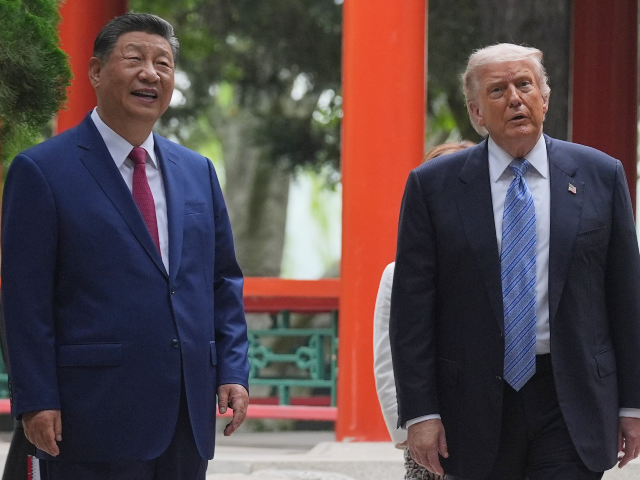

Chinese state media reporting on Thursday’s meeting between President Donald Trump and dictator Xi Jinping was generally upbeat, with the state-run Global Times celebrating the leaders’ visit to the Temple of Heaven in Beijing as a “new historic footnote to China-U.S. relations.”
The Global Times was impressed by the “rapid pace” of Trump’s visit, and pleased that Trump’s busy agenda included time for a visit to the Temple of Heaven. Xi explained the “deep symbolic weight” of the site to his guest, saying it embodied “the traditional Chinese concept that the people are the foundation of a state.”
The Temple of Heaven also looms large in Chinese diplomacy because former U.S. Secretary of State Henry Kissinger was a frequent visitor and he is very highly regarded in Beijing. Most Chinese reports on Trump and Xi’s stroll through the grounds found room to mention that Kissinger has been there 15 times. If the Temple of Heaven was an American tourist attraction, it would sell popcorn in plastic buckets shaped like Kissinger’s head.
When Trump and Xi sat down for in-depth discussions at the Great Hall of the People in Beijing, Xi expressed optimism that the U.S. and China could avoid the “Thucydides Trap” and “build a bright future together for our bilateral relations in the interest of the well-being of the two peoples and the future of humanity.”
The Global Times swooned without reminding its readers why this particular remark from Xi was significant. The Chinese dictator has been talking about the Thucydides Trap for years, but he was formerly pessimistic that it could be avoided.
Thucydides was the great Greek historian who chronicled the Peloponnesian War, which was one of the most destructive conflicts in history at the time. Harvard political scientist Graham Allison built upon Thucydides’ observation that the war was “inevitable” since ancient Sparta feared the rising power of Athens to suggest that every rising nation will come into violent conflict with the dominant power of its day.
Allison posited that established powers have confronted challengers 17 times over the past half-century, and 12 of those confrontations boiled over into large-scale military conflicts. Allison himself did not believe war between the U.S. and China was inescapable, but many of the people influenced by his work felt it was unlikely that the two great powers would make the difficult effort needed to avoid a war.
Xi used to be one of those pessimists, but he sounded a lot more cheerful during Trump’s visit and the Global Times decided to bask in the leader’s new sunny disposition without dwelling on the dark clouds that formerly troubled him.
Observers outside the orbit of Chinese state media were not so certain that Xi has changed his mind. Free Press columnist and CBS News analyst Aaron MacLean, for example, felt that while Xi’s rhetoric might sound softer, he brought up the Thucydides Summit as an “entirely unsubtle warning, and even a threat.”
“If Xi also offered to radically change China’s attitudes and actions, that part didn’t make the summit’s official readout. What was in the readout was the assertion that if the question of Taiwan is not ‘handled properly,’ then the outcome for China and America will be ‘clashes and even conflicts’ — as bald a threat as you might like,” he said.
MacLean noted that Trump did not offer any major concessions to avoid the Thucydides Trap either. For that matter, he grumbled that Allison wasn’t helping the situation by constantly repeating his theory that the trap can only be disarmed if the existing great power offers meaty concessions to its rising rival for the sake of peaceful coexistence. It is not difficult to see why that thesis is more popular in Beijing than Washington.
The Global Times’ lengthy rhapsody about the success of the Trump-Xi summit was untroubled by such thoughts as it bubbled with praise for Trump’s talk of friendship with Xi and “doing business” with China.
The Chinese paper was also happy to see the most outspokenly anti-Communist member of Trump’s entourage, Secretary of State Marco Rubio, agreeing that “obviously, it’s in everyone’s interest to see stability in the world.”
China’s state-run Xinhua news service emphasized how Trump and Xi seemed to enjoy each others’ company, and shared a mutual appreciation for the importance of stability and cooperation.
“While President Trump hopes to make America great again, I am dedicated to leading the Chinese people toward national rejuvenation,” Xi noted, clearly aware of Trump’s fondness for hearing other world leaders approvingly quote his “Make America Great Again” slogan.
Another Global Times editorial on Friday hailed Trump and Xi for introducing a “new vision for bilateral ties,” based on the similarity between MAGA and the “people are the foundation of the state” idea embodied by the Temple of Heaven.
The editorial praised Trump and Xi a dozen times for mutually embracing “stability,” without getting around to explaining exactly what that means, although the Global Times hinted it has a lot to do with seeing the Taiwan issue China’s way.
“From the U.S. perspective, the Trump administration’s national security strategy unveiled in November 2025 outlined preventing conflict over Taiwan as a top priority, which reflects Washington’s desire to avoid a crisis in the Taiwan Straits that could draw the U.S. into conflict against its will,” gushed Renmin University professor Diao Daming.
The White House National Security Strategy document states that America’s priority is “deterring a conflict over Taiwan, ideally by preserving military overmatch” and opposing “any unilateral change to the status quo in the Taiwan Strait.” Preventing a conflict by convincing Communist China that it doesn’t stand a chance of winning is a bit different than Professor Diao’s notion of stability.
The Chinese Foreign Ministry summarized Trump’s visit by saying that he and Xi “agreed on a new vision of building a constructive China-U.S. relationship of strategic stability to provide strategic guidance for China-U.S. relations over the next three years and beyond, promote the steady, sound and sustainable development of China-U.S. relations, and bring more peace, prosperity, and progress to the world.”
“Interactions between the two presidents have enhanced mutual understanding, deepened mutual trust, advanced practical cooperation, increased benefits for the people of both countries, and injected much-needed stability and certainty into the world,” the Foreign Ministry said, once again stressing the prevalent notion in Chinese political circles that America’s relationship with China has become more “stable” since Air Force One touched down in Beijing on Wednesday.
COMMENTS
Please let us know if you're having issues with commenting.