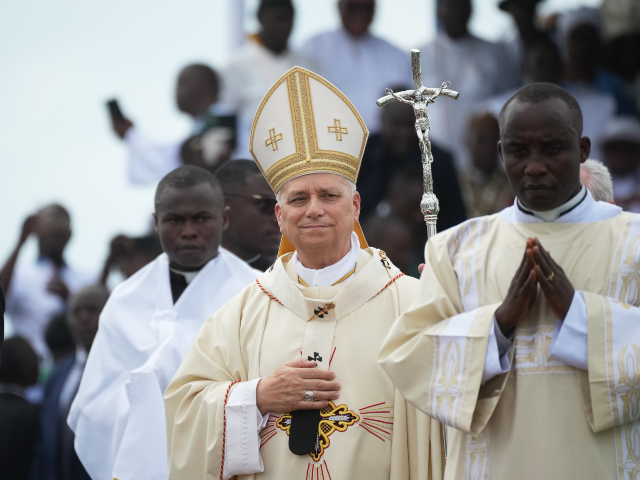

Pope Leo XIV presided over Mass for 120,000 people at a stadium in Douala, Cameroon on Friday, urging attendees to “reject every form of abuse or violence” and “multiply your talents through faith.”
The head of the Catholic church on earth led the religious ceremony following a similar Mass on Thursday in Bamenda, western Cameroon, where the populace has faced years of separatist war waged by the English-speaking population of the region against the Francophone government of Paul Biya, the nation’s 93-year-old president who has ruled through rigged elections since 1982.
The pope’s presence in the country follows a period of extraordinary violence in Cameroon throughout the past decade. In addition to the conflict between English- and French-speakers — the former group having attempted to secede and found the nation of “Ambazonia” in 2017 — Cameroon has become a hotbed of jihadist activity. Located alongside the eastern border of Nigeria, the radical Islamist terrorists of Boko Haram have slowly expanded their influence in the country through alliances with separatists and infiltration of local governments, presenting a significant threat to Cameroonian Christians.
Cameroon is a majority Christian country with a plurality, about 38 percent, of the population identifying as Roman Catholic. In addition to meeting with the nation’s Catholics, Pope Leo XIV made time for interfaith exchanges with imams and other Muslim leaders in the country.
During his remarks at Mass on Friday in Douala, the pontiff urged listeners to avoid greed and work towards feeding everyone, but emphasized the need for spiritual development along with fulfilling material needs.
“The food that sustains the body must be accompanied, with equal charity, by nourishment for the soul — a nourishment that sustains our conscience and steadies us in dark hours of fear and amid the shadows of suffering,” he asserted.
“Multiply your talents through faith, perseverance, and friendship,” he asked the country’s youth. “Be the first faces and hands that bring the bread of life to your neighbors, providing them with the food of wisdom and deliverance from all that does not nourish them, but rather obscures good desires and robs them of their dignity.”
“Do not give in to distrust and discouragement,” the pope advised. “Reject every form of abuse or violence, which deceives by promising easy gains but hardens the heart and makes it insensitive. Do not forget that your people are even richer than this land, for your treasure lies in your values: faith, family, hospitality, and work.”
In Bamenda, in the English-speaking part of Cameroon, the pope presided over Mass for about 20,000 people on Thursday, according to Vatican News. His comments at this event were more political in nature, appearing to condemn both Biya and exploitative forces in the country such as communist China. His remarks condemned corruption and poverty “in the management of wealth, which hinders the development of institutions and infrastructure.”
“Added to these internal problems, which are often fueled by hatred and violence, is the damage caused from outside, by those who, in the name of profit, continue to lay their hands on the African continent to exploit and plunder it,” he suggested.
While Pope Leo did not name China as such an “outside” actor, Biya has long established friendly ties to the Communist Party and joined the Belt and Road Initiative (BRI), a predatory lending scheme in which China offers loans on unfavorable terms to poor countries, only to later erode their sovereignty and exert control when the countries cannot pay. Biya most recently visited Beijing in September 24, meeting with genocidal dictator Xi Jinping to discuss trade and increased Chinese influence in the country.
“With its advantageous geographical location and high-quality human resources, Cameroon welcomes more Chinese companies to invest in the country and help Cameroon translate its advantages in mineral resources and other areas into drivers for development,” Biya reportedly said during that meeting with Xi.
Pope Leo also held a separate “peace meeting” in Bamenda in which he again condemned foreign powers exploiting Cameroon. The Catholic leader, Vatican News reported, criticized that “people who take the resources from the African lands in turn use the money for weapons, ‘perpetuating an endless cycle of destabilization and death.'”
In the country with the world’s oldest president, serving for 44 years, Pope Leo lamented that the world was “being ravaged by a handful of tyrants, yet it is held together by a multitude of supportive brothers and sisters.” Radio France Internationale (RFI) suggested in its reporting that the pope’s “remarks were directed in part at President Paul Biya.” The pope did meet with Biya as one of his first activities in the country, however.
Human right experts have identified Cameroon as one of the world’s most dangerous places to practice Christianity — a remarkable distinction given that the majority of Cameroonians are Christians. The humanitarian organization Open Doors ranked Cameroon number 37 on its 2026 World Watch List of countries where Christian persecution is prevalent — a list routinely topped by communist North Korea.
“In the northern regions, Islamic extremism is spreading as violence by Boko Haram and other Islamic militant groups targets Christians,” Open Doors observed. “Believers in this area can face abductions, church burnings, and exclusion from community life. Converts from Islam face severe risks — owning a Bible can provoke violence, and women are often forced into marriage.”
Christians who oppose the extended rule of Paul Biya also face “surveillance, intimidation, or even arrest. Hundreds of churches that criticized the regime have been closed. Challenges to government inaction in the face of jihadist and clan-based persecution usually provoke reprisals.”
Reports in the past decade have linked Ambazonia fighters to Christian persecution as well as government action to silence dissent. In 2022, for example, armed thugs believed to be associated with the Ambazonia project raided a church in Nchang village, burned it down, and abducted eight people, including five priests and a nun. Some reports have accused both the Ambazonia rebels and the Cameroonian government of developing ties to Boko Haram, further endangering Christians in the country.
COMMENTS
Please let us know if you're having issues with commenting.