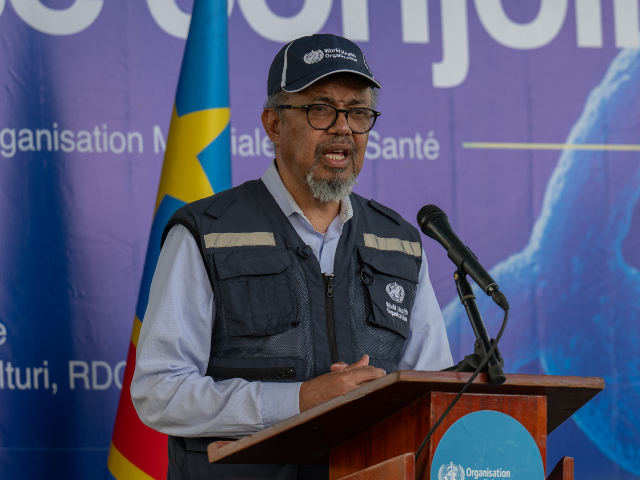

World Health Organization (W.H.O.) Director-General Tedros Adhanom Ghebreyesus announced on Wednesday that trials for two potential therapeutics to fight the Ebola Bundibugyo virus would begin next week.
Ebola Bundibugyo is the strain of the virus currently fueling an ongoing outbreak in the Democratic Republic of the Congo (DRC) and Uganda, found to have infected over a thousand people since May and most recently identified in a returning health worker in France. Bundibugyo is a less common strain than those that fueled previous outbreaks in the DRC and Guinea, such as the Zaire and Sudan strains of the virus. Currently, no approved vaccine, therapeutic, or other medical protocol exists to treat a Bundibugyo infection.
That situation may end soon if the trials beginning in DRC yield positive results. According to Tedros, Ebola patients will receive doses of two antiviral products, MBP134 and Remdesivir, to monitor whether they can facilitate a faster recovery or not.
“Preparations are now complete for a trial of two therapeutics that are expected to start in DRC in the next week,” Tedros told reporters during a briefing on Wednesday. “The trial will evaluate whether 2 antivirals, MBP134 and Remdesivir, can help to reduce mortality in patients with Bundibugyo alone or in combination.”
Tedros thanked the government of the United States, which withdrew from the W.H.O. due to its failure to properly address outbreaks in 2025, for facilitating access to doses of the medications. Remdesivir is produced by the American pharmaceutical company Gilead Sciences, while MBP134 is an experimental antiviral produced by fellow American company Mapp Biopharmaceutical, Inc.
The U.S. Department of Health and Human Services (HHS) confirmed on Wednesday that it would allow the transfer of doses of both antivirals to the DRC for clinical trials at the heart of the Ebola outbreak.
“The drug is being made available for compassionate use in Congo as well as to advance a clinical trial in the outbreak region,” a department spokesperson told Reuters. Reports indicate that the trials will involve the use of each antiviral both individually and in combination to ascertain how they can be used most effectively.
Remdesivir is a known antiviral currently used around the world to treat severe Wuhan coronavirus infections. President Donald Trump first referred to the treatment during a press conference in March 2020, describing it as having potential to fight the novel coronavirus. Some studies have suggested that Remdesivir may be effective in treating other forms of coronavirus as well as Ebola and Marburg viruses, as well as respiratory syncytial virus (RSV).
MBP134 is an experimental antiviral developed using the cells of Ebola patients, intended specifically to treat that disease. It has yet to be approved fully for widespread use, necessitating the studies that will take place in the DRC. Scientists have recently urged Washington to facilitate access to MBP134 given the urgency of the situation in the DRC and Uganda. In a letter addressed to the U.S. government published this month, several health advocacy and church groups argued that speeding up the process of finding life-saving treatment for Ebola was in the interests of America.
“Given the certainty of future outbreaks and risk of international spread, it is in the U.S. national interest to bolster global health security by ensuring medical countermeasures are available in affected countries,” the experts wrote.
Elsewhere in his update on Wednesday, Tedros told reporters that the W.H.O. has confirmed, as of Wednesday, 1,094 cases of Ebola linked to the outbreak originating in Ituri, eastern DRC, and 277 deaths, representing about a 25 percent death rate currently. In addition to the severity of the illness caused by the virus, the W.H.O. has repeatedly highlighted a host of challenges to addressing the public health emergency in the area, most prominently the constant threat of armed militias making communities inaccessible and generalized public distrust of humanitarian personnel.
“We are working closely with the communities to inform and involve them in the trial. We are also working to ensure the communities have access to the therapeutics should they prove safe and efficacious,” Tedros said.
Health workers, including those associated with the W.H.O., have encountered massive trust issues in DRC communities, where many residents do not believe that Ebola is a real virus and believe the deaths are homicides by health workers seeking to “control” the population of Africa. Many aggressively reject abandoning traditional burial practices, which require touching and close access to dead bodies and, as such, enable the spread of the disease. As a result, health workers face regular attacks by mobs seeking to “free” their quarantined family members or take the bodies of loved ones to perform traditional burials.
“Some people say Ebola is a story invented by doctors,” Jean Assumani, a worker in Ituri, DRC, told UNICEF in early June. “Others claim that humanitarians created this disease to make money. But those who have seen people die of Ebola completely change their minds and start protecting themselves. They then understand that this disease is real.”
COMMENTS
Please let us know if you're having issues with commenting.