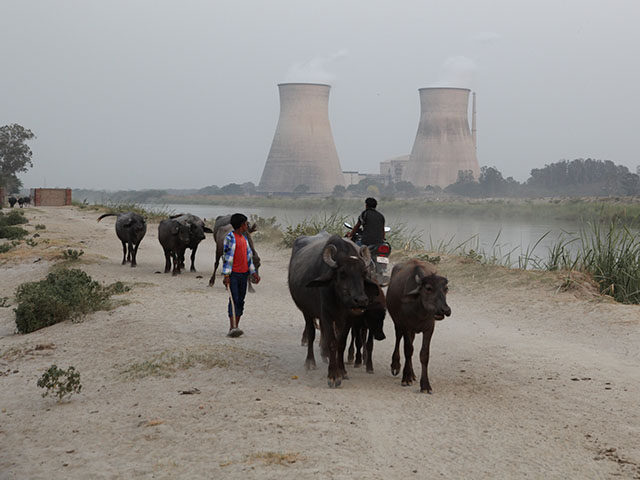

India is planning to reduce the size of the “exclusion zones” around nuclear reactors to make more land available for expanding the facilities, reports revealed on Monday.
The changes are seen as necessary to reach India’s goal of increasing nuclear power generation from 8 gigawatts today to 100 gigawatts by 2047.
Reuters on Monday cited three anonymous Indian sources who said an “in-principle agreement” has been reached between the Atomic Energy Regulatory Board and Department of Atomic Energy to reduce the exclusion zones from their current size of about one kilometer around each reactor.
The sources did not say exactly how large the reduced exclusion zones would be, or what methodology would be used to draw them, but the goal was to reduce the land consumption of large reactors by half, and of smaller reactors by up to two-thirds. This would allow more reactors to be constructed at each existing nuclear facility.
The plan would also make it easier to build new small modular reactors (SMRs) in India’s industrial zones, without requiring large amounts of real estate.
SMRs are one of the hottest topics in clean energy today, using advanced reactor designs to produce about a third of the electricity generated by traditional designs, but using a tiny fraction of the space and cost. SMRs can even be fabricated in advance and shipped to the desired location, and since they use standardized designs, they can be constructed and installed much faster than traditional nuclear reactors.
According to Reuters’ sources, Indian officials believe their existing rules for siting nuclear reactors and establishing exclusion zones are antiquated and unreasonably increase the time and expense of bringing new reactors online.
The new rules will be modeled after the safety policies of nuclear energy powers like the United States and France, where regulations were long ago modified to allow reactors to be fairly close together inside the same facility, thanks to modern safety technology and design improvements.
Comparing the proposed regulatory revisions to American and French laws might not mollify the Indian public, which is generally in favor of expanding nuclear power to generate clean energy at lower prices, but is very concerned with nuclear safety.
National Institute of Advanced Studies engineering dean R. Srikanth told Reuters the Indian public simply does not realize how much safer the new reactor designs are, or how much less radiation they emit than older reactors.
“Unfortunately, good news of the Indian nuclear power has been kept hidden from the public. We need to overcome this all-pervasive sense of secrecy around civilian nuclear power plants,” he said.
India’s new prototype fast breeder reactor (PFBR) in Tamil Nadu, which achieved its first sustained nuclear chain reaction in April and is scheduled to go online in September, is the paramount example of the new technology Srikanth mentioned.
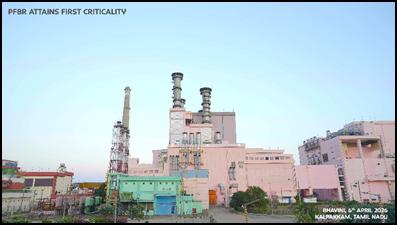
An image of India’s Prototype Fast Breeder Reactor (PFBR) at Kalpakkam in Tamil Nadu, which the Indian government announced had successfully attained its first criticality on 6th April 2026. (Photo provided by India’s Press Information Bureau)
Indian officials believe this reactor will mark a “second stage” of nuclear power for the nation and will be pivotal for reaching the ambitious goal of 300 gigawatts within 20 years – if it performs as advertised, and the operating costs do not balloon out of control.
Fast breeder reactors use a mixture of uranium and much more expensive plutonium to generate heat. The chain reaction process converts the uranium into plutonium, which is supposed to greatly reduce the cost of keeping the reactor fueled, and reduce the amount of waste it produces. The most advanced PFBR designs can use thorium, which is even cheaper and more plentiful than uranium – especially in India, which has abundant thorium reserves.
The problem is that the other costs of operating a breeder reactor tend to be high enough to eliminate the cost savings from converting uranium into plutonium. There is only one commercially operational PFBR in the world, in Russia, and getting it to reach its full potential has been a constant struggle since it went online in 2015. India’s PFBR in Tamil Nadu has been under construction for over 20 years, and it has greatly exceeded its cost estimates.
Besides developing new regulations to reduce the amount of land needed for new reactors, the Indian government has taken one other dramatic step to advance its nuclear power industry: in December 2025, Parliament passed legislation called Sustainable Harnessing and Advancement of Nuclear Energy for Transforming India (SHANTI), which relieved nuclear equipment suppliers of liability for incidents at power plants, and limited liability for smaller nuclear reactors. This was intended to boost private investment in the nuclear power industry.
COMMENTS
Please let us know if you're having issues with commenting.