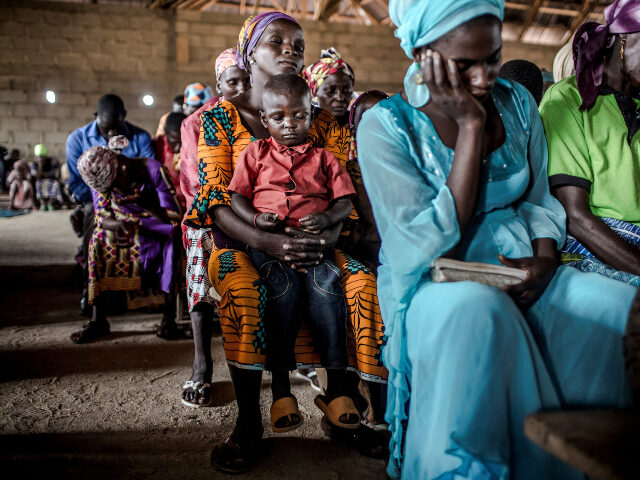

Nigerian Bishop Wilfred Anagbe, of the diocese of Makurdi in Benue state, testified before the House of Representatives on Thursday, detailing the “gory” violence Christians face regularly in the country and thanking President Donald Trump for designating Nigeria a religious freedom danger zone.
President Trump announced on October 31 that he would return Nigeria to the State Department’s Country of Particular Concern (CPC) for religious freedom list, where he had initially placed it in 2020. Former President Joe Biden removed the notorious label for unclear reasons in 2021. In his announcement, Trump described “mass slaughter” in the country by organized jihadists against Christian communities, urging the Nigerian government to act to protect vulnerable Christians.
“Christianity is facing an existential threat in Nigeria. Thousands of Christians are being killed. Radical Islamists are responsible for this mass slaughter,” he wrote. “The United States cannot stand by while such atrocities are happening in Nigeria, and numerous other Countries. We stand ready, willing, and able to save our Great Christian population around the World!”
Nigerian President Bola Tinubu responded to the designation by denying the existence of any religious discrimination in the country and insisting that general “instability” also affects Muslim Nigerians.
Bishop Anagbe addressed Congress for a hearing on Christian persecution in Nigeria at the House Foreign Affairs Committee, chaired by Rep. Chris Smith (R-NJ). He extensively listed individual attacks by jihadists, most of them organized Fulani jihadist gangs, in which the terrorists burned down churches, displaced millions of Christians, and killed and abducted large numbers of the local population in the Middle Belt.
Nigeria’s population is almost evenly split between Muslims in the north, about 60 percent, and Christians in the south, about 40 percent. The Middle Belt, where the populations meet, has become the focal point of much of this jihadist violence as radical Muslims attempt to steal and destroy Christian farmland and replace the local population. Benue, where Bishop Anagbe is located, and Plateau are the states most often identified as being under jihadist siege despite high indigenous Christian populations.
Anagbe, who also addressed Congress in March, noted that “thousands more have been displaced, some abducted or subjected, churches destroyed” since his last check-in with U.S. lawmakers. He described an attack displacing an entire Catholic convent, a “wave of violence in the region during Holy Week targeting Christians as they prepared to celebrate one of the most holy important feasts in our church.” The attackers regularly shout “allahu akbar,” he noted, a clear sign of the motivation behind the slaughter.
In one attack in Benue in May, the bishop detailed, “one of my priests … was shot and left to die in a pool of his blood … though he survived the attack, he is unable to walk freely because he has a broken bone.”
“This is the daily experience of many Christians in Nigeria. Violence is spreading southward, displacing millions and destroying farmland, creating a humanitarian crisis compounded by food insecurity,” he narrated. “Attacks by Fulani militants, Boko Haram, Islamic State West Africa Province (ISWAP) have intensified not only in the Middle Belt … spreading southward and targeting Christian communities with impunity.”
“We hoped the CPC designation by President Trump at the end of October might stabilize the situation, but instead it is deteriorating into one of the most lethal periods for Nigeria in recent memory,” he observed.
Bishop Anagbe thanked President Trump, “on behalf of millions of Christians in Nigeria and the diaspora,” for the designation, however, and Rep. Smith, who has consistently brought forth concerns about Nigerian Christians to Congress.
“It is a vital step that must be backed by serious action,” he asserted.
The increased violence, he argued, was not the result of just the designation but of the Nigerian government’s behavior.
“Like it is now commonly acknowledged, Nigeria remains the deadliest place on earth to be a Christian. More believers are killed there annually than in the rest of the world combined,” he explained. “Yet … the Nigerian government’s response to the CPC designation is to unleash vainglorious speakers and willing tools to spin the narrative and make false equivalences of Muslim deaths.”
“Who is killing the Muslims up north? Is there any Christian militia displacing millions and occupying lands in Nigeria?” he asked. “The government of Nigeria’s silence and refusal to engage in the face of continued killings and displacements have deepened feelings of abandonment among the people.”
“The national leadership appears disengaged, treating a Christian genocide … as a non-issue instead of considering it a national emergency,” the bishop continued. “This lack of political will undermines trust in political institutions and fuels perceptions of complicity or indifference.”
While describing President Trump’s designation as bringing “immense joy, hope, and spiritual resilience to communities under siege,” Bishop Anagbe offered recommendations for concrete actions to support the move, including the use of the Global Magnitsky Act to sanction individuals in power who fail to curtail the violence, pressuring Nigeria at the United Nations, and “political, military, and humanitarian intervention.”
“America has a unique role in defending religious freedom globally,” he affirmed.
Also testifying before the committee on behalf of the executive branch was senior African Affairs official at the State Department Jonathan Pratt, who emphasized that Washington pursued a positive relationship with the government of Nigeria even while speaking out about its apathy towards Christian attacks.
“The intent of the administration’s approach is to raise the protection of Christians to the top of the government of Nigeria’s priorities, especially in the Middle Belt,” Pratt explained. “Nigeria is a key regional partner, Africa’s largest democracy, and most populous nation – with whom we share economic and security interests. It in the United States’ interest to work with the Nigerian government on a plan of action.”
Also representing the State Department was Deputy Assistant Secretary Jacob McGee of the Bureau of Democracy, Human Rights, and Labor, who condemned Abuja not just for failure to act but for allowing the imposition of sharia, or Islamic law, on non-Muslim communities.
“Nigerian officials continue to prosecute individuals for alleged blasphemy, which stands in clear violation of Nigeria’s obligation to safeguard free speech,” he explained. “Under the sharia penal codes enforced in 12 of its states, Nigeria is one of only eight countries in the world that allows for penalties up to execution for blasphemy, along with Iran and Pakistan.”
“When authorities detain individuals acused of blasphemy, the judicial process often takes years while they remain in prison, sometimes on death row. Mobs often take the law into their own hands with impunity,” he noted, referencing the lynching of Christian student Deborah Yakubu at Sheh Shagari College of Education in 2022. Yakubu had reportedly complained that Muslim students were spamming a Whatsapp group intended for test studies with Islamic content before her brutal mob killing.
COMMENTS
Please let us know if you're having issues with commenting.