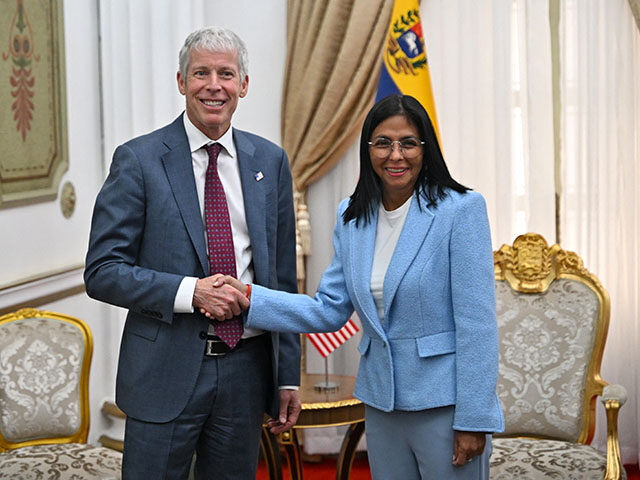
U.S. oil companies that lost billions of dollars after the Venezuelan socialist regime expropriated their assets are in talks with “acting President” Delcy Rodríguez to recover some of the losses, Energy Secretary Chris Wright told Bloomberg on Thursday.
Throughout the 2000s, Venezuela’s late socialist dictator, Hugo Chávez, enacted a widespread nationalization and forced expropriation campaign against an extensive number of privately-owned companies, land, and other assets as part of his plans to implement “Bolivarian socialism” in the country.
The virtually indiscriminate socialist expropriation campaign reportedly affected more than 1,000 private companies, 3.6 million hectares of land, and about 523,000 homes owned by either local or foreign entrepreneurship. Many of the expropriated companies, such as cruise and freight company Conferry, were left in ruins through socialist mismanagement, forcing the socialist regime to cede control of some of the companies it bankrupted as a last-ditch effort to salvage its derelict infrastructure.
Chávez had U.S. oil companies ExxonMobil and ConocoPhillips expelled from Venezuela in 2007 after both companies, which spent years working and propping up the nation’s oil industry, refused new unfavorable terms forcefully demanded by Chávez. The Venezuelan socialists expropriated billions of dollars of assets without due repayment, prompting both companies to launch lengthy, multi-year international arbitration cases against the Venezuelan state seeking due repayment over the stolen assets.
Although arbitration rulings have been issued in favor of both U.S. companies finding the Venezuelan state liable for the seizures, the situation is still not fully resolved. Venezuela owes about $10 billion to ConocoPhillips at press time.
U.S. Energy Secretary Wright raised the subject this week when he traveled to Venezuela to meet with Rodríguez and other members of the Venezuelan socialist regime. His visit marked the first time a U.S. energy secretary has visited the South American country since 2001, during the administration of former President Bill Clinton. One of the items in Wright’s agenda included visiting an oil field operated by California-based Chevron at Venezuela’s Orinoco Belt, where most of Venezuela’s oil reserves are found.
“They are in active discussions with ConocoPhillips — the people that lost assets in the before, are all in active dialogs right now,” Wright told Bloomberg during an interview held after the inspection. “What’s the right way forward? How to get to recompense for that money they’re owed and hopefully entice them to come back into the country and grow production?”
“She [Rodríguez] has regret about the past and about the things that happened there,” he continued.
ConocoPhillips CEO Ryan Lance told Bloomberg in early February that his priority in Venezuela is to recoup the roughly $10 billion that is still owed to the oil company. Bloomberg noted that ConocoPhillips has only been able to recover about $1 billion from the total owed.
Over the past weeks, Rodríguez has cooperated with the administration of President Donald Trump following the January 3 U.S. law enforcement action in Caracas and the arrest of socialist dictator Nicolás Maduro and his wife Cilia Flores.
Wright detailed to Bloomberg that the Trump administration plans to issue new licenses soon for Venezuela’s oil industry and stressed that the Trump administration’s efforts to push U.S. companies to play a role in rebuilding Venezuela’s rundown oil sector will erode China, Russia, and Iran’s influence in the country.
“We want it [Venezuela] to be open to less corrupt, honest American, Western American allies for business,” Wright said. “The influence of China and Russia and Iran that has been very large in Venezuela, will become very small.”
On Wednesday, Rodríguez told reporters outside the Miraflores presidential palace in Caracas that she and Wright discussed the establishment of a “long-term productive partnership” on energy. Bloomberg reported that Rodríguez said on Thursday that she was “very pleased” that the path with the United States “is one of respect and cooperation within the framework of national sovereignty.”
“He [Trump] is passionately committed to absolutely transforming the relationship between the United States and Venezuela. This is part of a broader agenda to make the Americas great again, to bring our countries closer together, and to bring commerce, peace, prosperity, jobs, and opportunity to the people of Venezuela in partnership with the United States,” Wright said on Wednesday.
“Relations between Venezuela and the United States have been, to put it mildly, extraordinary! We are dealing very well with President Delcy Rodriguez, and her Representatives. Oil is starting to flow, and large amounts of money, unseen for many years, will soon be greatly helping the people of Venezuela,” President Donald Trump wrote in a Truth Social post.
Recently, the U.S. Department of the Treasury authorized the export and sale of U.S. diluents to Venezuela, which the nation’s oil industry highly relies on to export its crude oil given its “extra heavy” nature. In late January, Treasury issued a license granting oil companies expanded access to operate in Venezuela at a time when the nation’s socialist lawmakers approved a reform package to the nation’s notoriously draconian hydrocarbon laws, rescinding some of the worst socialist restrictions that the regime imposed on the nation’s oil industry.
Christian K. Caruzo is a Venezuelan writer and documents life under socialism. You can follow him on Twitter here.
COMMENTS
Please let us know if you're having issues with commenting.