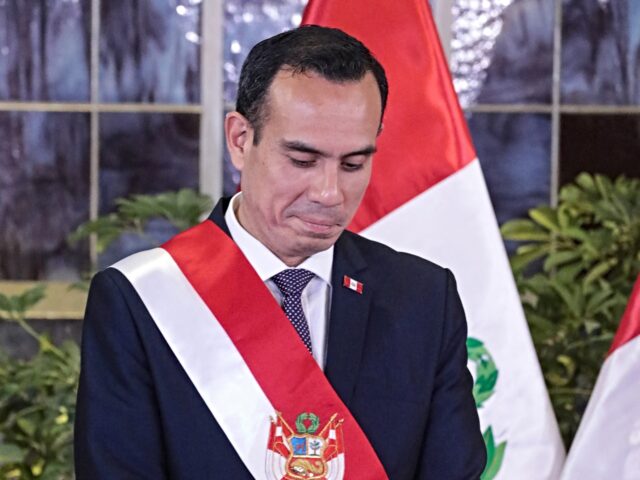
The Congress of Peru voted on Tuesday to impeach and remove President José Jerí, leaving the presidency vacant just two months before a scheduled presidential election Jerí was not running in.
Jerí, formerly the president of the Congress, took over the head of state position in October after the impeachment of former President Dina Boluarte in October. Boluarte, a former vice president, became president after the impeachment of predecessor Pedro Castillo. Castillo succeeded several short-lived presidents who took over after the impeachment of former President Martín Vizcarra, who succeeded former President Pedro Pablo Kucsynski after he resigned, avoiding impeachment.
The last Peruvian president to complete a full term in office, leftist Ollanta Humala, was subsequently imprisoned and convicted on corruption charges.
Jerí was the eighth president Peru had sworn into power in ten years; his successor, to be elected by the Congress on Wednesday, will be the ninth. Typically, Peru appoints the nation’s vice president to serve in an interim capacity in the event of a removal from office, but so many impeachments have occurred in recent memory that the line of succession has been depleted. The Congress never replaced Jerí as president of the Congress after he took over for Boluarte and Jerí never had time to appoint a vice president.
The Peruvian Congress has outsized constitutional power as it can remove a president for a condition known as “permanent moral incapacity,” which the law does not strictly define. On Tuesday, Jerí faced seven motions to vote on his ouster due to various controversies surrounding his performance as president. The Congress overwhelmingly voted to oust Jerí; 75 lawmakers voted in favor, while 24 opposed and only three abstained.
At press time, the position of president of Peru is officially vacant, as no vice president or president of the Congress exists. Lawmakers will return to Congress on Wednesday at 6 p.m. local time to vote on a new president of Congress, who will become president of the country in an interim capacity.
The main offense held before Jerí, who belongs to a political party identified as “right-wing” but did not spend enough time in office to pursue any substantial political policies, was a controversy known in Peru as “Chifagate.” Jeri was caught on surveillance cameras meeting Chinese businessman Zhihua Yang surreptitiously on December 26 at a “chifa,” the local term for a Peruvian-Chinese restaurant. The meeting was not documented on any official presidential schedules and the topics of conversation remain unknown at press time. Some reports linked the chifa in question to Nicanor Boluarte, the brother of Dina Boluarte, and opposing politicians accused Jerí of engaging in corruption through the secret Chinese business meetings.
Jerí denied any wrongdoing aside from trying to keep the meeting secret.
“One would resign if one had something to hide, and I have not lied to the country, I have not done anything illegal,” Jerí said in January. “I did not lie to the country. Rather, the situation is being exploited to attack the presidency beyond my mistake, which I have already acknowledged, and also to affect the electoral process, which I have a duty to ensure is budgeted, transparent, and impartial.”
Jerí faced an entirely separate scandal the day before his impeachment as a Peruvian national court ruled on Monday that he must attend psychological therapy sessions for “impulsive and pathological sexual behavior.” Jerí was accused in December 2024 of raping a woman in the town during a New Year party. That case was resolved with a ruling mandating psychological therapy that Jerí essentially ignored. Jerí has denied wrongdoing in that case, as well; it remains unclear at press time when he will attend the therapy sessions in question.
The deposed president also had to answer for the discovery, following his appointment as interim president, that he had used his official Instagram account to follow a wide array of pornographic accounts. In response to a user on the social media site Twitter mocking him for following the accounts in October, Jerí responded, “overcome things. Don’t live in the past. Leave behind hate. Don’t hide on social networks.”
Jerí, shrouded in controversy, was not running in the April 2026 presidential election, so he would have vacated the presidency in late July, when Peru is scheduled to hold its presidential inauguration. The absence of an incumbent has encouraged large numbers of politicians to run for the presidency – 36 registered candidates as of December – none of whom have developed any substantial polling advantage at press time. The number of candidates in this election has been reported as a record for the country.
A poll by the firm Datum published in late January found former mayor of Lima Rafael López Aliaga, of the right-wing Popular Renewal party, in the lead with 11.7 percent support, trailed by Senator Keiko Fujimori, of the conservative Popular Force party, with eight percent. Fujimori, a perennial presence in Peruvian presidential elections, is the daughter of former President Alberto Fujimori and served as his first lady following his divorce from ex-wife and former presidential rival Susana Higuchi.
COMMENTS
Please let us know if you're having issues with commenting.