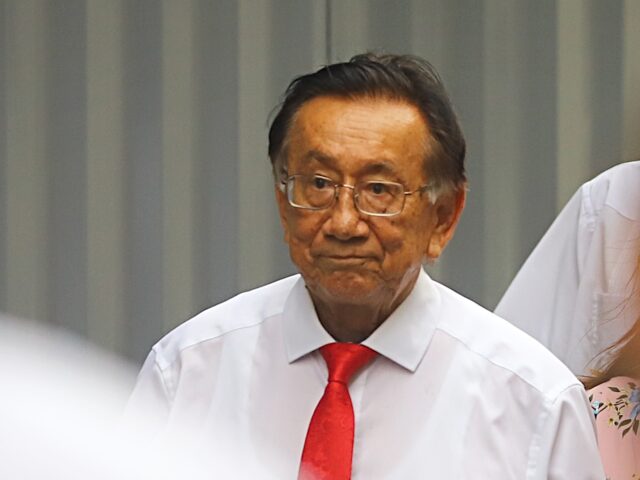

Peruvian lawmaker Ilich López on Wednesday announced he will collect signatures from his peers to start an impeachment process against Marxist interim President José María Balcázar over his handling of an F-16 fighter jet deal with the U.S.
López, who serves as third vice president of the Peruvian Congress, spoke with RPP on Wednesday and accused Balcázar of violating his constitutional obligation to guarantee Peru’s national defense in his handling of the F-16 deal with the United States. A series of conflicting public statements has so far led to the resignation of Balcázar’s defense and foreign ministers. Both ministers left from their positions on Wednesday in protest of Balcázar’s actions.
The head of the Peruvian Congress, Fernando Rospigliosi, reportedly said on Wednesday that, “if the necessary signatures are obtained,” an impeachment process against Balcázar “will be processed in accordance with procedure and put to a vote as required.”
Balcázar, a 83-year-old child marriage advocate, took office as interim president of Peru in mid-February after his predecessor, interim President José Jerí, was impeached. Balcázar is the ninth president that Peru has had in about ten years as a result of a long list of impeachments and resignations.
Unless he is impeached beforehand, Balcázar is slated to conclude his interim term on July 28, 2026, when the winner of an upcoming — yet still undefined — June 7 prudential runoff election will take office.
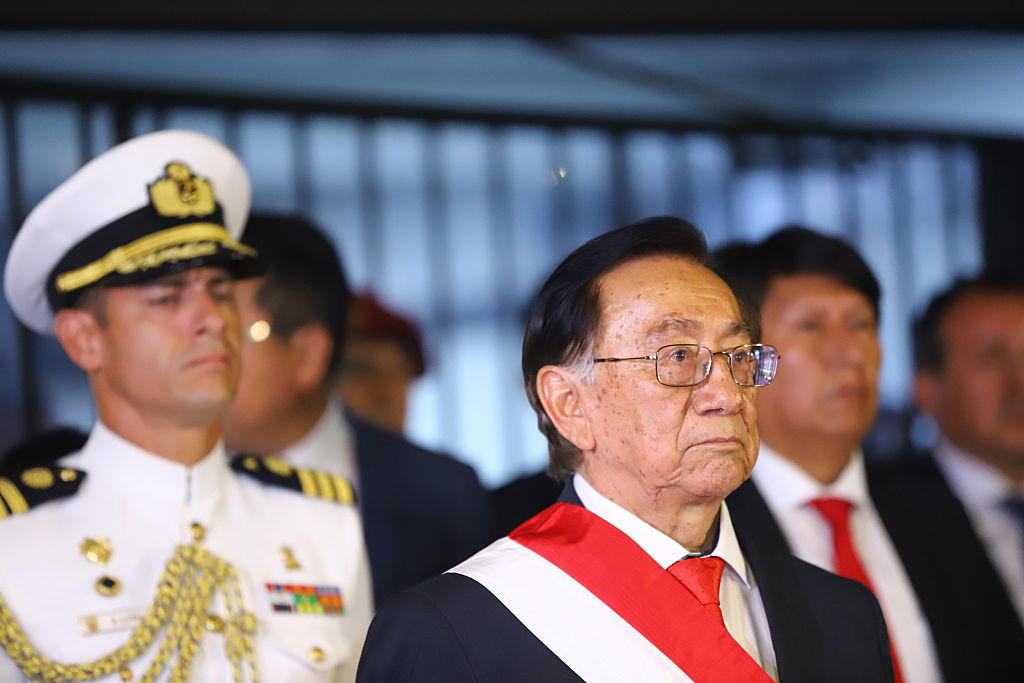
Peru’s new interim President Jose Maria Balcazar is seen after his election at the National Congress in Lima, Peru on February 18, 2026. (Jorge Cerdan/Anadolu via Getty Images)
Last week, Balcázar announced that his administration would defer the decision to purchase 24 F-16 fighter jets valued at $3.5 billion from the United States to the next president of Peru. His sudden announcement sparked a controversy and state of confusion across the Peruvian government. On Wednesday, Defense Minister Carlos Díaz and Foreign Minister Hugo De Zela both resigned from their positions. Díaz denounced the interim president for his “fundamental discrepancy” in handling the deal and De Zela accused the interim President of lying.
According to the now-former foreign minister, Balcázar was aware that the F-16 deal was signed on April 20 despite his public statements denying that it happened. De Zela also affirmed that Balcázar blocked the disbursement of the deal’s first payment, due Wednesday. Former Defense Minister Carlos Díaz told RPP that Balcázar allegedly signed a decree authorizing his office to go ahead with the purchase of the U.S. fighter jets.
“If you deal with the U.S. in bad faith and undermine U.S. interests, rest assured, I, on behalf of President Donald Trump and his administration, will use every available tool to protect and promote the prosperity and security of the United States and our region,” U.S. Ambassador to Peru Bernie Navarro said on Wednesday.
Hours later, Ambassador Navarro confirmed that Peru ultimately honored its commitment. Reuters reported that Peru made its first $462 million payment for the purchase of the U.S. F-16 fighter jets. Balcázar then reportedly claimed that his earlier remarks suggesting the purchase had been delayed were “misinterpreted,” and claimed that he allegedly indented to say that, while the agreement had moved forward, the bulk of the financial commitment would fall to the incoming government.
The purchased fighter jets are expected to arrive in Peru in years’ time. Some will arrive shortly; Peru has scheduled a special air show demonstration for this weekend.
Ambassador Navarro released a statement on Wednesday providing more information and context on the deal. He recounted that, over a decade ago, Peru decided to modernize its airplane feet. In 2024, during the administration of former President Dina Boluarte, the country began a bidding process — which the United States participated in with full compliance on all the terms established by the Peruvian government. Lockheed Martin presented a bid proposal reportedly fully aligned with all the requirements presented by Peru.
“This bid was submitted on competitive terms, both in terms of price and responsiveness, to meet the schedule and requirements while ensuring full compliance with the sovereign procurement process,” Ambassador Navarro wrote. “As part of its agreement with Peru, we understand that Lockheed Martin has offered a package of projects that will invest in the Peruvian people, creating jobs and developing Peru’s aerospace and defense industries.”
“This is how the United States stands with its partners: innovative solutions, a shared purpose, and stronger results — for Peru, for our partnership, and for the security of the Western Hemisphere,” he continued.
Navarro explained that on April 14, a U.S. delegation composed of government executives and representatives from Lockheed Martin were ready to hold meetings with Peruvian officials as initially agreed upon, but the embassy found out that the deal was allegedly postponed through radio.
“There is a proper way to conduct serious and credible business with one of the world’s leading companies. A technical agreement between the authorized parties was signed on April 20, 2026, with the full knowledge of the highest levels of the Peruvian government,” the statement read in part.
“At the request of the Peruvian government, U.S. officials and Lockheed Martin representatives have not spoken publicly about the procurement process at any time over the past year and a half, respectfully deferring to the Peruvian government to share public updates on its national procurement efforts,” the statement continued.
Ambassador Navarro pointed out that the United States and Peru have been friendly nations for 200 years and that the Trump administration has made it clear that the Western Hemisphere is a priority for the U.S.
“Peru is key to our shared goals for a safer, stronger, and more prosperous region. In good faith, earlier this year, President Trump designated Peru as a major non-NATO ally. This demonstrates the seriousness with which the United States is committed to Peru,” Ambassador Navarro said, and concluded, “We are pleased that Peru has decided to strengthen its partnership with the United States. This will shape the next 200 years of our relationship. ”
Christian K. Caruzo is a Venezuelan writer and documents life under socialism. You can follow him on Twitter here.
COMMENTS
Please let us know if you're having issues with commenting.