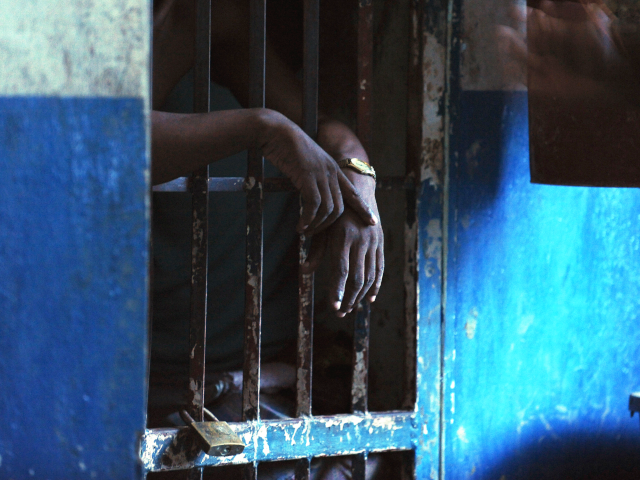

A research study published by the human rights organization Prisoners Defenders on Monday estimated — based on documented evidence of meals, eyewitness testimony, and scientific estimates — that the Cuban Communist Party is feeding its male prisoners between 250 to 353 calories.
All human beings need differing daily caloric intakes depending on their sex, weight, physical activity, and other factors. No medical experts would suggest that an adult human, male or female, could survive healthily on even the maximum estimate of 353 calories. The U.S. Centers for Disease Control (CDC) offer a calorie calculator that estimates, for example, that a 35-year-old, sedentary man weighing 170 pounds at five feet, eight inches in height would need about 2,500 calories a day. Prisoners Defenders estimated in its study that the amount and kind of food offered to inmates in Cuban prisons satisfies, at best, about 14 percent of what their body would need to remain healthy.
The human rights organization noted that the systematic malnutrition that Cuban prisoners are subject to — including political prisoners, which constitute a sizable portion of the inmate population — is an international human rights crime violating both of the United Nations’ core covenants and a variety of other international legal norms. The study was published after shocking photos of Alexander Díaz Rodríguez, a former political prisoner released after completing his five-year sentence, circled the world, showing the man in what many observers described as “concentration camp” conditions.
In the study, Prisoners Defenders explained that it sought to offer an empirical analysis of exactly what Cuban prisoners were eating in the context of Díaz Rodríguez’s alarming state, which it suspected was not especially uncommon among prisoners of the communist dictatorship.
Interviews with former political prisoners and photos of the meals smuggled out of Cuba’s prisons allowed Prisoners Defenders to conclude that, nationwide, prisoners are subject to a three-course daily menu. Breakfast typically consists of a “piece of soft bread” and unsweetened tea of unclear origin. Both lunch and dinner consist of one serving of “less than 30 grams of cooked rice,” a liquid described as sour soup, and a “boiled croquette.” The reports do not clarify exactly what the croquette is made out of.
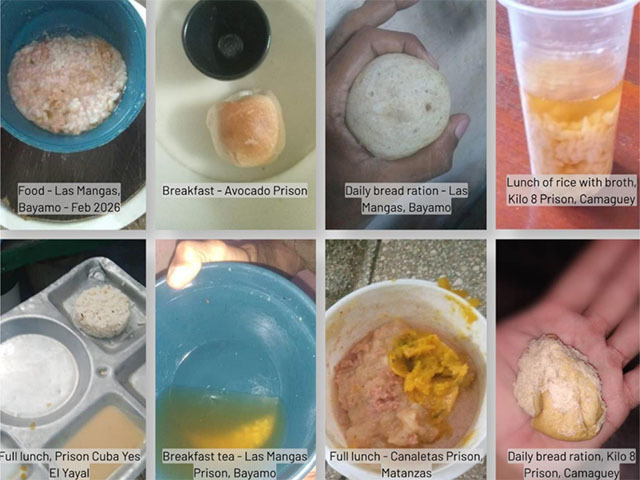
Photo of foods from Cuban prison, reproduced courtesy of Prisoners Defenders.
Using generous caloric estimates, Prisoners Defenders found that the morning bread ration offered between 120 to 160 Calories; the tea and soup likely have negligible caloric value; and the rice and croquette provide between 65 to 100 Calories.
In an audio message shared with Breitbart News, Javier Larrondo, the president of Prisoners Defenders, observed that the Cuban prison population is estimated to be about 90,000 people, or one percent of the national population.
“When the state has someone under its custody, it has the absolute obligation to preserve his life, his health, and his dignity,” Larrondo asserted, adding that the inhumane conditions prisoners face in Cuba are part of a “much broader context of repression, of arbitrary detention, of forced disappearances, torture, religious persecution, vigilance, forced labor, and other [indications] of crimes against humanity.”
Calling on democratic governments and the United Nations, Larrondo called for action to pressure the Cuban government to respect fundamental human rights.
“It is not enough to observe,” he asserted. “It is not enough to lament, it is not enough to issue statements when all of this occurs before us.”
The study published on Monday listed a prodigious number of health conditions that could be caused or exacerbated by systematic underfeeding of prisoners. The lack of evidence that prisoners receive any fruits or vegetables in their diet leaves them exposed to significant vitamin deficiencies and conditions such as scurvy. Sustained lack of food also causes cases such as “extreme weight loss, sarcopenia, extreme weakness, cold intolerance, hypotension or hemodynamic instability, decreased exercise capacity, and severe deterioration of overall health.”
“It also severely compromises the synthesis of enzymes, transporters, and immune proteins; slows healing processes; reduces the body’s ability to respond to infections; and exacerbates any inflammatory or traumatic process,” the study continued. “Under these conditions, even common conditions or minor injuries can become disproportionately severe.”
Alexander Díaz Rodríguez, the recently released political prisoner in overt starving conditions, was diagnosed with terminal throat cancer, hepatitis B, and thyroid disease. He is 45 years old and was convicted and sentenced to five years in prison on charges of “disrespect” and “public disorder” for participating in the July 11, 2021 protests. Despite his medical conditions, he was not granted any medical clemency and has testified to being tortured in prison.
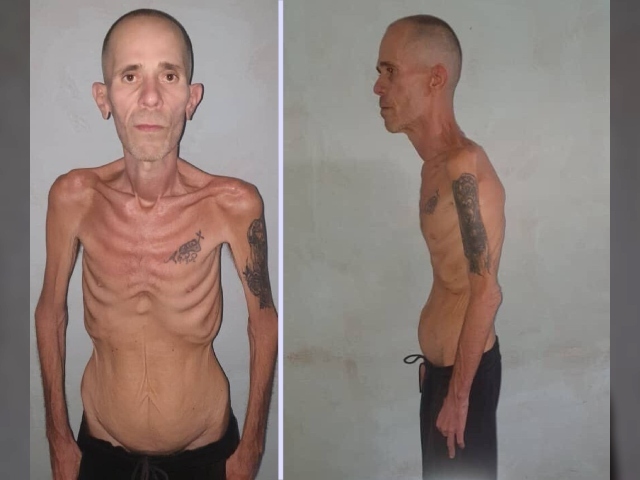
Cuban former political prisoner Alexander Díaz Rodríguez after finishing his sentence for the crime of “disrespect” on April 4, 2026. (Courtesy Prisoners Defenders)
Díaz Rodríguez’s experience is not unique in Cuba. The head of the largest dissident organization on the island, Jose Daniel Ferrer of the Patriotic Union of Cuba (UNPACU), has repeatedly testified to being tortured in prison, including being force-fed rotten food as a form of punishment. Following his forced exile to the United States, in 2025, Ferrer described a humiliating incident in which, after he threw up several meals in protest, he was force-fed what he described as “rotten soup.”
“Since they knew I would throw it up, the order was that if I threw up, they would pick it up from the dirty floor and reintroduce it again, so I had to accept that I would either die or accept that that I would wear the uniform and eat rotten food from the prison,” Ferrer explained.
Prisoners Defenders detailed several international laws that Cuba’s practice of underfeeding and torturing prisoners violate, including both the United Nations’ International Covenant on Civil and Political Rights (ICCPR) and the International Covenant on Economic and Social Rights (ECOSOC), the two legal documents underpinning the infrastructure of international law.
“This set of elements does not point to isolated abuses, but rather to a systemic pattern of mass control, widespread repression, and multiple crimes against humanity — that is, a pattern that, in political-sociological terms, can be characterized as state terrorism,” the organization concluded.
COMMENTS
Please let us know if you're having issues with commenting.