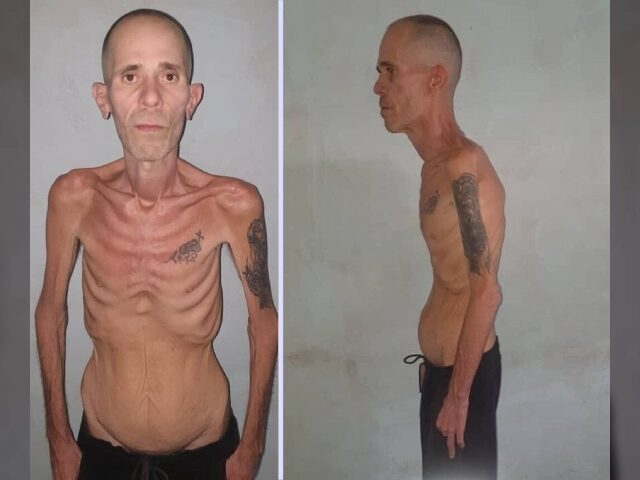

Human rights activists expressed disgust and outrage this week after photos surfaced of a recently freed Cuban political prisoner suffering from multiple severe medical conditions, including cancer and visible malnutrition.
Cuba has been suffering under a brutal, murderous communist regime for 67 years. The Communist Party, first under late dictator Fidel Castro and now under his brother Raúl, engaged for decades in the widespread use of torture, firing squads, mass arrests, and public beatings, among other practices, to subjugate that population, which never voted for the Castro regime as Fidel Castro and his small gang staged a coup to seize power.
Cubans have been taking to the streets almost incessantly in the past decade, following the death of Fidel Castro in 2016, to demand an end to the regime and respect for their natural rights. The Communist Party has responded consistently with brutal aggression. Following the July 11, 2021, protests against communism, figurehead “president” Miguel Díaz-Canel, Raúl Castro’s subordinate, issued an “order of combat” greenlighting vigilante attacks by random communists against anyone suspected of opposing the regime. The Cuban government also deployed its notorious “black beret” special forces to repress suspected protesters, resulting in harrowing images of Cuban civilians beaten and, in some cases, shot in front of their young children.
Alexander Díaz Rodríguez, now 45, was arrested in the immediate aftermath of the July 11 anti-communist protests and convicted of the crimes of “disrespect” and “public disorder” for objecting to the Castro dictatorship. He was granted no medical clemency and released simply because he completed his five-year term.
According to Prisoner Defenders, a human rights organization that tracks the status of political prisoners in Cuba, Díaz Rodríguez suffers from terminal throat cancer, hepatitis B, and thyroid disease. His loved ones had consistently denounced during his time in prison that he was subject to physical and psychological torture.
In a message to Breitbart News and other media, Javier Larrondo, the president of Prisoners Defenders, shared images of Díaz Rodríguez that the prisoner sent to the organization in the immediate aftermath of his release from prison, urging that they be distributed widely to expose the atrocities the Cuban Communist Party is committing.
“When I saw the state in which he was, I saw what I have seen in other occasions among prisoners freed in Cuba: they look as if they were rescued from a concentration camp,” he observed.
Larrondo additionally shared a photo of Díaz Rodríguez prior to his arrest in 2021 for comparison.
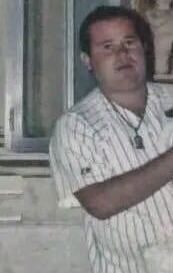
Photo courtesy of Prisoners Defenders
Human rights activists heeded the call to share the photos, condemning the Cuban regime for its poor treatment of political prisoners. The head of the largest known dissident group in Cuba, the Patriotic Union of Cuba (UNPACU), José Daniel Ferrer, published a video message on Sunday, describing the images of Díaz Rodríguez as “undeniable proof of what the penitentiary system in the Castro-communist tyranny does to political prisoners in Cuba.”
“This man needs medicine, needs vitamins, needs food, he has nothing,” Ferrer, currently in exile in Florida after being imprisoned and repeatedly tortured himself for years, observed. He emphasized that Díaz Rodríguez was only freed because he finished his sentence, adding, “nobody can come tell me now that he received a pardon and this was a gesture of benevolence from the nefarious and criminal tyranny.”
The Cuban Communist Party occasionally attempts to curry international favor by announcing dishonest alleged prison “pardons,” most recently in early April. The External Relations Ministry (MINREX), which is not in charge of the prison system, announced on April 2 that it had offered pardons to about 2,000 prisoners “in the context of the religious celebrations of Holy Week,” omitting that practicing Christianity outside of the control of the Party is illegal in Cuba. The message explicitly excluded individuals convicted of “crimes against authority,” such as Díaz Rodríguez, from the pardons, but establishment media outlets nonetheless claimed that the move benefited political prisoners, which it did not.
Prisoners Defenders denounced the false reports, emphasizing that its contacts with the families of authentic political prisoners in Cuba did not yield any news of the liberation of these prisoners. Larrondo, the president of Prisoners Defenders, noted in remarks to Breitbart News that Cuba often enacts these “prison drainages,” freeing petty criminals, to save money during hard economic times.
The Castro regime has been struggling more than usual this year following the American arrest of former Venezuelan dictator Nicolás Maduro in January on charges of drug trafficking. For years, Maduro and his predecessor Hugo Chávez offered free or heavily discounted oil to Cuba in exchange for security and espionage expertise; following his arrest, interim “president” Delcy Rodríguez cut off the flow of Venezuelan oil to Cuba.
As a result of the free oil shipments ending, the private generator networks that luxury hotels and the homes of the rich use to circumvent the routine failures of the dilapidated Cuban power grid were no longer reliable. Cuba also ran out of jet fuel, making it nearly impossible for tourists to travel to the island. The loss of critical tourism revenue has slightly deteriorated the quality of life of the Castro family, while most Cubans had already become accustomed to not being able to rely on 21st Century basics such as refrigeration and health care.
Humanitarian activists advocating for Díaz Rodríguez noted this week that he is unlikely to receive the care he needs to live following his release. The Union for a Free Cuba Party, an anti-communist organization, issued a call on Tuesday for a country in the free world to issue a humanitarian visa for the former political prisoner.
José Díaz González Agüero, a vice coordinator with the Union for a Free Cuba Party, told the U.S.-based news organization Martí Noticias that they had tracked his case and “saw that he was constantly deteriorating in prison” and does not have a stable place to live. He also reportedly is suffering from “constant diarrhea” and other extreme health complications.
The Castro regime regularly denies the existence of political prisoners in Cuba.
COMMENTS
Please let us know if you're having issues with commenting.