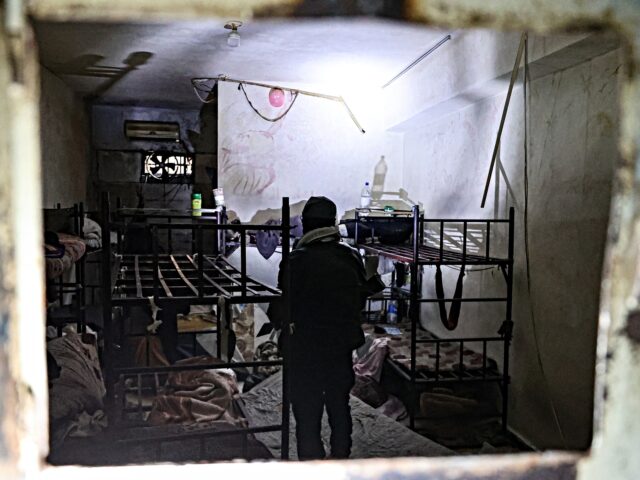
A torrent of violence, including reported beheadings and a prison break by Islamic State terrorists, erupted in Syria on Monday following the signing of an agreement between the jihadist federal government under President Ahmed al-Sharaa and the U.S.-backed, Kurdish-led Syrian Democratic Forces (SDF).
The SDF and associated Kurdish political arms had enjoyed years of semi-autonomy in the region known as Rojava, or Syrian Kurdistan, during the rule of deposed dictator Bashar Assad. Assad fled to Russia following the collapse of his military in late 2024, leaving the country in the hands of Sharaa’s Hayat Tahrir al-Sham (HTS), an al-Qaeda offshoot.
Sharaa has spent much of the past year arguing that Kurdish autonomy was a threat to the stability of his government and pressuring the SDF to incorporate into the reconstructed Syrian armed forces, fighting alongside HTS terrorists. He has received significant support from the United States, where President Donald Trump praised him as a “young, attractive guy” with “a real shot at pulling it together.”
On Sunday, Sharaa and the SDF announced that they had reached an agreement in which the Kurds would concede most of their control of Rojava, including power over oil fields and traditionally Arab regions such as Raqqa and Deir ez-Zor. The SDF took over those regions after destroying the Islamic State “caliphate” alongside the United States in 2017. In exchange, Sharaa’s government promised to respect Kurdish culture and allow the learning of the Kurdish language in Rojava schools.
While HTS is a jihadist terrorist organization, under Sharaa’s control it repeatedly resisted making alliances with the Islamic State, prioritizing for most of its history the toppling of the Assad regime rather than the creation of an Islamist “caliphate.” Its members are nonetheless Islamist and among Sharaa’s first moves in power was to impose an Islamist constitution on Syria, a diverse country home to large populations of Kurds, Druze, Christians, and Alawites, among others.
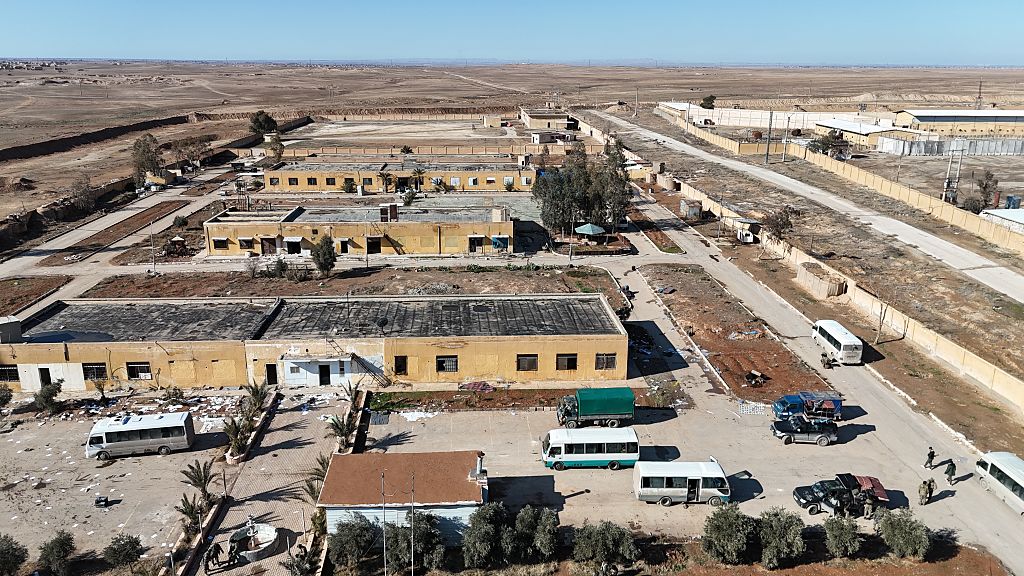
An aerial view shows a prison in the town of Al-Shaddadah, where SDF, reportedly released members of the Daesh terrorist organization a day earlier in Al-Hasakah, northeastern Syria, on January 20, 2026. (Bakr Al Kasem/Anadolu via Getty Images)
The agreement followed months of attacks by Sharaa regime-affiliated terrorists on Kurdish communities, which erupted in Aleppointo what Kurdish leaders denounced as war crimes last week.
SDF leaders denounced on Monday that terrorists associated with the Sharaa regime were engaging in atrocities against Kurds in the regions affected by the Sharaa-SDF agreement. According to the Kurdish news outlet Rudaw, regime-associated jihadists “beheaded a group of our fighters during their capture and recorded the operation on video in the style of the ISIS terrorist organization.” The SDF shared the video with media outlets, featuring graphic beheading footage. A series of unverified social media videos surfaced after the official accusations of beheadings, including videos showing the capture of Kurdish women and display that indicated they were being abducted for to be abused as sex slaves.
Separately, the Syrian government admitted that a prison break at a facility housing Islamic State jihadists captured after the fall of the “caliphate” did occur, freeing an estimated 120 Islamic State jihadists. By Tuesday, the Sharaa-controled Syrian Arab News Agency (SANA) claimed that it had apprehended 81 escapees and was “continuing efforts to locate the remaining fugitives.”
SANA reported that the Syrian government denied similar reports of prison breaks and clashes outside of prisons holding Islamic State terrorists in Raqqa. Those reports came directly from the SDF.
“At this time, violent clashes are taking place between our forces and those factions in the vicinity of Al-Aqtan Prison in Raqqa, which houses detainees of the ISIS terrorist organization, representing an extremely dangerous development,” the SDF announced in a statement on Monday. “We affirm to public opinion that the level of threat is escalating significantly, amid attempts by these factions to reach the prison and seize control of it. Such actions could lead to serious security repercussions that threaten stability and open the door to a return of chaos and terrorism.”
Separately, Rudaw, citing an anonymous SDF source, described the prison outside of Raqqa as “besieged” and the situation threatening to free as many as 2,000 Islamic State terrorists, who remained for years in Syria as their home countries refused to take them back. Rudaw reported that the Sharaa government was “shelling” the prison in an apparent attempt to free those inside.
President Trump, who has supported Sharaa since the fall of Assad, held a phone call with Sharaa on Monday.
“During the call, the two presidents stressed the importance of preserving Syria’s territorial unity and independence, and supporting all efforts aimed at achieving stability,” according to SANA. “Both sides underlined the need to guarantee the rights and protection of the Kurdish people within the framework of the Syrian state.”
The White House has not commented on the conversation at press time.
Kurdish rights leaders have called for protests around the world to bring awareness to the jihadist attacks in Rojava this week. On Tuesday, Kurds convened throughout Iraq, Syria, and Europe calling for a stop to the assault, according to the news agency Kurdistan 24.
“Demonstrators emphasized that the United States, as an effective force in the region, bears a moral responsibility to prevent what they termed a massacre against civilians in Western Kurdistan (Rojava),” the outlet explained.
Follow Frances Martel on Facebook and Twitter.
COMMENTS
Please let us know if you're having issues with commenting.