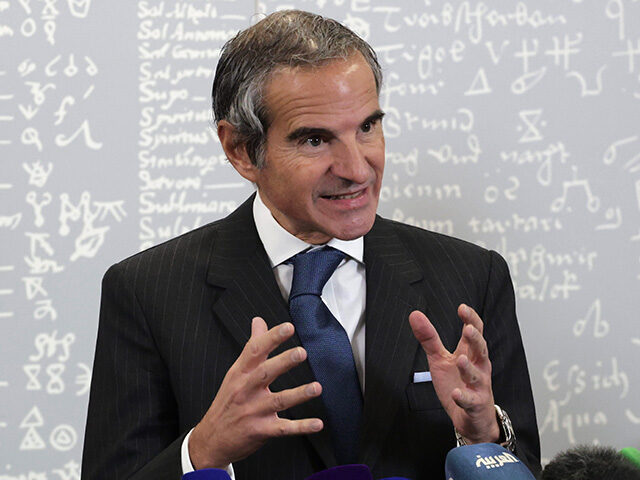

The head of the International Atomic Energy Agency (IAEA), Rafael Grossi, told reporters on Wednesday that any agreement to limit Iran’s illicit nuclear development would require the country to agree to significant international oversight.
Without “very detailed verification” that Iran was abiding by agreements not to enrich uranium beyond what is necessary for civilian use, or not to engage in any other forbidden activity, “you will not have an agreement,” Grossi warned.
The IAEA is the United Nations’ top body on nuclear development. Grossi’s comments are significant given his extensive criticism throughout the years of the last major attempt to curtail Iran’s enrichment, the Joint Comprehensive Plan of Action (JCPOA) of 2015, brokered by former President Barack Obama. Grossi has repeatedly protested that Iran has not allowed his agency to properly inspect its nuclear sites and, last year, revealed that Iranian officials appeared to have worked to “sanitize” areas to prevent the IAEA from seeing evidence of their activities. Grossi’s last report on Iran and the JCPOA resulted in the agency passing a resolution condemning Iran for the first time in 20 years.
Grossi is currently on a short list of candidates running to replace United Nations Secretary-General Antonio Guterres and is supported by his home country, Argentina – where Iran conducted the deadliest terrorist attack in Western Hemisphere history prior to September 11, 2001.
Grossi made his remarks during a visit to South Korea on Friday, dismissing the possibility of an agreement to end the current war between America and Iran that does not include robust IAEA inspection.
“Iran has a very ambitious, wide nuclear program so all of that will require the presence of IAEA inspectors,” he said, according to the Associated Press. “Otherwise, you will not have an agreement. You will have an illusion of an agreement.”
The nuclear agency chief emphasized that any such nuclear agreement “requires very detailed verification mechanism.”
President Donald Trump announced “Operation Epic Fury” on February 28, a military engagement to weaken Iran’s ability to pose a threat to its neighbors, specifically targeting its missile and drone capacity as well as its top leadership. On that day, Trump also announced that the operation had eliminated the longtime dictator of the country, Ali Khamenei. In tandem with the Israel Defense Forces (IDF), the current conflict has eliminated dozens of senior Iranian officials, particularly senior leaders within its Islamic Revolutionary Guard Corps (IRGC), a U.S.-designated terrorist organization.
Last week, American and Iranian leaders announced that they would begin a negotiation process seeking an end to hostilities, mediated by Pakistan. As part of these talks, Washington also announced a two-week ceasefire to allow for the negotiations to develop. Following meetings this weekend, however, President Trump announced that no agreement had been reached and, while the ceasefire remained in place, the United States would impose a blockade of Iranian commerce in the Strait of Hormuz. Some unconfirmed reports have since surfaced that a second round of Pakistan-mediated talks is imminent.
The negotiations center largely around convincing Iran to stop its illicit nuclear development and potentially replace the JCPOA, which Iran has consistently violated throughout its existence, with a more substantial and verifiable agreement.
As head of the IAEA, which should have had access to Iranian nuclear facilities consistently for inspections as part of the Obama nuclear deal, Grossi has for years warned that the agreement was in practice non-existent. President Donald Trump withdrew from the agreement in 2018 due to Iranian violations, but the remaining powers involved, including China and some European states, insisted that the commitment remained.
“Nobody applies it, nobody follows it. There have been attempts to revive it here in Vienna. But unfortunately, although they were relatively close to success, they failed for reasons unknown to me, because I was not involved in the process,” Grossi complained in 2024.
In May 2025, shortly before President Trump announced a wave of American airstrikes of Iranian nuclear facilities, Grossi lamented that the Iranian leadership was not abiding by its requirements to allow the IAEA access to the sites.
“It’s a very frustrating situation. We continue our activities there, but at a minimum,” he explained. “They are restricting cooperation in a very unprecedented way.”
The next month, Grossi delivered a report to the IAEA Board of Governors that he explained was incomplete because of Iranian intransigence, but nonetheless accused Iran of maintaining “undeclared nuclear sites” that it attempted to “sanitize” to hide from the United Nations body.
“Unfortunately, Iran has repeatedly either not answered, or not provided technically credible answers to, the Agency’s questions. It has also sought to sanitize the locations, which has impeded Agency verification activities,” he said.
The IAEA subsequently found Iran guilty in a resolution of “many failures to uphold its obligations since 2019 to provide the agency with full and timely cooperation regarding undeclared nuclear material and activities at multiple undeclared locations.”
Grossi warned in an interview with CBS News on March 20 that, even after the 2025 airstrikes and Operation Epic Fury, Iran could easily reconstruct its illicit enrichment sites.
“They have the capabilities, they have the knowledge, they have the industrial ability,” he emphasized, though he suggested that recovering much of the enriched uranium potentially buried by the 2025 airstrikes was difficult.
“One cannot deny that this has really rolled back the program considerably,” he explained. “But my impression is that once the military effort comes to an end, we will still inherit a number of major issues that have been at the center of all of this.”
COMMENTS
Please let us know if you're having issues with commenting.