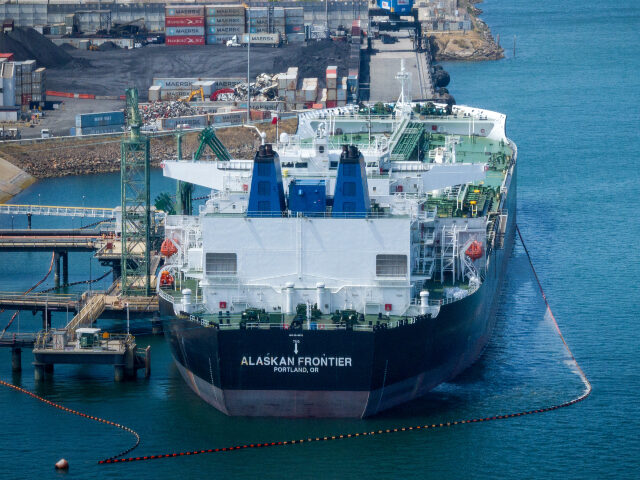

The United States overtook Saudi Arabia to become the world’s largest exporter of crude oil over the past nine weeks, as Iran’s attacks on shipping in the Strait of Hormuz choked off Middle Eastern oil shipments.
Bloomberg News reported Sunday that the United States shipped more than 250 million barrels of crude oil from its wells and storage tanks to overseas buyers over the past nine weeks, becoming a “lifeline for global consumers.”
The report cautioned that “record American exports also come with warnings that this supply cushion is rapidly being pushed to its limits.”
“Many energy experts are questioning how long shipments can be sustained at such levels. US domestic inventories are quickly depleting, with total oil and fuel stockpiles drawing down for four straight weeks to below historical averages. Meanwhile, America’s oil producers are struggling to keep up,” Bloomberg said.
The surge in exports has also raised retail gasoline prices in the United States, potentially causing political trouble for President Donald Trump, who touted U.S. export levels as “amazing” and a boost for the American economy.
“We have more oil production right now than at any time in history. And if you take a look at the ships, they’re all coming up to Texas, Louisiana, Alaska,” Trump gushed on Friday.
The Trump administration set something of a political tripwire for itself by pointing to the $5.00 per gallon prices that rocked American consumers after Russia invaded Ukraine in 2022. Current average prices are around $4.40 per gallon, so the impact of pump prices on the November midterm elections could be determined by which way gasoline goes from here, and whether the Strait of Hormuz reopens soon.
Over the long term, the geopolitical impact of traditional Middle Eastern oil customers like Japan and Southeast Asia turning to the United States could be beneficial, if American producers can meet their demands. Industry analysts who spoke to Bloomberg noted that the Asian companies might be coming close to exhausting their stockpiles, triggering a surge in demand that low U.S. inventories would be hard-pressed to meet.
American oil production is running very close to capacity at the moment, although there is some dispute about exactly where the upper limit stands. Domestic reserves have been drained by about 52 million barrels since the Strait of Hormuz crisis began, reducing the inventory available for sale if there is another stampede to American oil terminals. Some oil company analysts are warning that the infrastructure for delivering their products to ports and loading tankers could be overwhelmed before maximum well production is reached.
Bloomberg noted America’s prodigious exports in March and April would not have been possible without fracking and the shale oil revolution of the new century, which made it possible for the U.S. to lift 1970s export restrictions in 2015 and become a major force in the international marketplace. This opened avenues of foreign policy that did not exist when America had to be perpetually nervous about losing overseas oil supplies.
Trump expressed confidence on Monday that America’s muscular oil industry could meet surging foreign demand without imposing higher prices on domestic consumers.
“Everybody was wrong. They thought that energy would be at $300, right? Three hundred dollars a barrel. And it’s, like, at $100, and I think it’s going down,” he said Monday at a White House small business summit.
“I see it going down very substantially when this is over,” he continued. “I think very rapidly too at levels that you’ve never seen, because there’s there’s a lot of energy out there. Ships all over the world that are loaded up with it. They can’t do much with it because they got kidnapped by a pretty evil place, but we’re taking care of it.”
The leftist newspaper New York Times (NYT) pointed out on Friday that there are actually fewer U.S. rigs producing oil today than there were at the beginning of the war with Iran and net domestic oil production for 2026 could be lower than 2025, according to Energy Department projections. This is because decisions about expensive increases to long-term production capacity were made long before the war began.
American executives are reportedly nervous that if they expedite huge investments in production increases today, and the Strait of Hormuz crisis ends in the near future, they could lose money as Middle Eastern oil flows are restored and global oil prices plummet.
Both Exxon Mobil and Chevron have declined to invest in production increases for exactly this reason, combined with apprehension about the fate of their assets in the Middle East. Chevron CFO Eimear Bonner described their recalcitrance as the “discipline” needed to play the market over the long term.
ConocoPhillips, on the other hand, did increase its production plans for the remainder of 2026, including a new drilling rig in the Permian oil field that runs from Texas to New Mexico.
COMMENTS
Please let us know if you're having issues with commenting.