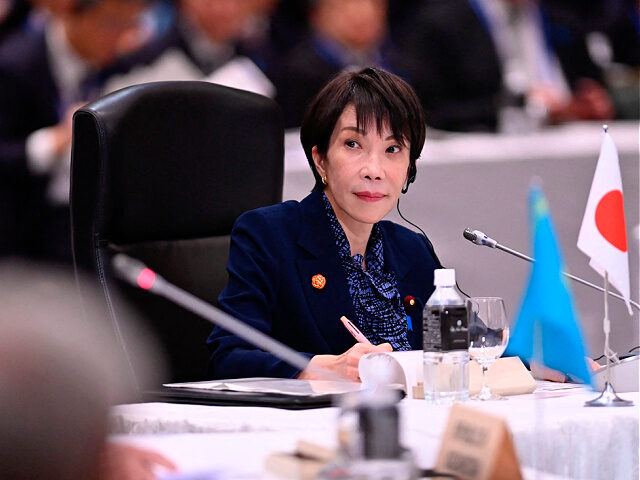
Chinese state media has been heavily promoting a rumor that the administration of Japanese Prime Minister Takaichi Sanae wants to develop nuclear weapons that could potentially be used against China.
The story was first spread by several Japanese media outlets on Thursday, including Kyodo News, Asahi Shimbun, and NHK.
According to the Kyodo News account, an unidentified source who is involved with formulating security policy for the prime minister’s office told reporters, “I think we should possess nuclear weapons.”
“In the end, we can only rely on ourselves,” the official reportedly said.
The source concluded that acquiring nuclear arms was probably an unrealistic goal, given Japan’s commitment to the Nuclear Non-Proliferation Treaty, and he said there were no serious nuclear arms discussions underway in the Takaichi administration.
“It isn’t something that can be done quickly, like just going to a convenience store to buy something,” the source concluded.
Asahi Shimbun said the source made it clear that his musings were a “personal view,” based on his assessment of growing threats from Russia, China, and North Korea.
Even though these were only the reflections of a single, unnamed source who made it clear he was not making an official policy statement, the Japanese opposition pounced, and China was not far behind.
Opposition leader Noda Yoshihiko of the Constitutional Democratic Party held a press conference on Friday to denounce the nameless source’s comments as “unbelievable,” and said it was a scandal that anyone holding such views could be an adviser to the prime minister.
“It is reasonable to have the person quickly resign,” Noda said, a sentiment echoed by Komeito Party leader Saito Tetsuo.
Nihon Hidankyo, an organization that represents survivors of the Hiroshima and Nagasaki bombings, said it was astonished and dismayed by the remarks. The group issued a statement saying that the controversial remarks “ignore the existence of atomic bomb survivors, condone nuclear war and are absolutely unforgivable.”
Nihon Hidankyo criticized Prime Minister Takaichi in November for saying that she wanted to review the Three Non-Nuclear Principles that have guided Japanese security policy since 1967. The group said it “cannot allow nuclear arms to be brought into Japan or let the country become a base for nuclear war or a target of nuclear attacks.”
The policy chief of Takaichi’s Liberal Democratic Party (LDP), Kobayashi Takayuki, said in November that the prime minister’s agenda to increase defense spending and enhance Japan’s military capabilities should include every aspect of national defense, including nuclear policy.
“It’s our responsibility as the ruling party to hold talks without any sacred cows,” Kobayashi said.
According to Takaichi administration officials, the “Third Principle” is the one most in need of review because it states that Japan will not permit other powers to bring nuclear weapons into its territory. This could interfere with the ability of Japan’s nuclear-armed ally, the United States, to protect it from a nuclear-level threat.
The sudden controversy over nuclear weapons was catnip to China, which launched a steadily escalating feud with Japan after Takaichi said her nation would view a Chinese invasion of Taiwan as a “survival-threatening situation” in early November. That particular phrase means Japan would be authorized to use military force to defend Taiwan, even under its pacifist postwar constitution.
Chinese state media played up every negative report about the nuclear weapons controversy, while downplaying the anonymous Japanese official’s disclaimer that he was speaking only for himself, not rolling out a policy change.
China’s state-run Global Times on Friday relayed a lengthy diatribe against Japan by Chinese Foreign Ministry spokesman Guo Jiakun, who accused “right-wing conservative forces in Japan” of seeking to “revive militarism, break free from the constraints of the international order, and accelerate remilitarization.”
“If the reports are true, then the situation is really severe, exposing the dangerous attempts of some people in Japan to break international law and possess nuclear weapons,” Guo said.
“This year marks the 80th anniversary of the victory of the Chinese People’s War of Resistance Against Japanese Aggression and the World Anti-Fascist War. Japan must deeply reflect on its historical crimes, abide by international law and its own constitution, stop seeking excuses for military expansion, and stop testing the bottom line of international justice on the issue of nuclear weapons,” Guo said, using the Chinese Communist Party’s terminology for World War II.
On Friday, Chief Cabinet Secretary Kihara Minoru reaffirmed the Takaichi government’s commitment to the Three Non-Nuclear Principles and said Japan would continue to “lead efforts toward a nuclear-free world so that such weapons are never used again.”
“We have consistently contributed to the peace and prosperity of the global community, and there is no change to that stance,” he said.
“As the only country that has suffered a nuclear attack, we will take realistic and practical steps to maintain and strengthen the Nuclear Non-Proliferation Treaty structure, towards a world free of nuclear weapons,” he added.
Kihara said the administration does not support even the relatively modest policy shift of “nuclear sharing,” which would allow the U.S. to position nuclear weapons in Japan that would be partly under Japanese control.
Kihara refused to comment on the identity or status of the official whose remarks stirred up the controversy. A Chinese social media user living in Japan named Song Wenzhou on Friday claimed the source of the nuclear weapon comments was Nagashima Akihisa, an LDP politician and longtime adviser. Nagashima adamantly denied the rumor and demanded Song retract his “disinformation.”
“This report is completely false. I stepped down from my position as Prime Minister’s Special Assistant for National Security in October, and I have never made such remarks to the press. Nor do I hold views of this kind in the first place,” Nagashima said on social media platform X.
COMMENTS
Please let us know if you're having issues with commenting.