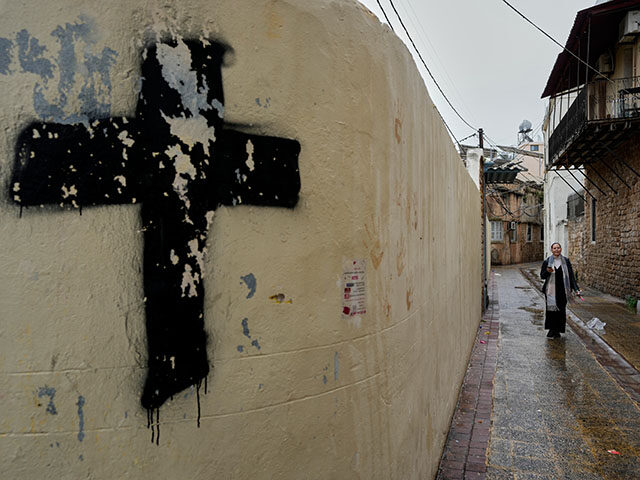

The Lebanese Army on Tuesday withdrew from four border villages, two of them Christian-majority towns whose residents have refused to follow instructions from Israel to evacuate the area while the Israel Defense Forces (IDF) battle the Iran-backed terrorists of Hezbollah.
The three villages that lost Lebanese Army coverage were Rmeish, Ain Ibl, and Braasheet in the Bint Jbeil district, plus Beit Yahoun in Nabatieh. Rmeish and Ain Ibl are Christian towns.
“The army has indeed withdrawn from Rmeish, and we would have preferred it to stay, but we, as residents of the town, will remain despite the risks. We understand the army’s reasons for leaving, but our decision is to stay,” said Hanna al-Amil, head of the Rmeish municipal council.
The army was apparently stung by criticism over its withdrawal plan, because on Wednesday it announced that some Lebanese troops would remain in the border villages.
“Following the escalation of Israeli aggression against Lebanon, particularly in areas facing enemy incursions around border localities, which result in encircling, isolating, and cutting off supply lines to deployed units, the army carried out a redeployment and repositioning operation that included a number of these units,” the Lebanese Army said.
By “enemy,” the army meant Israel, not Hezbollah. Hezbollah is the malevolent actor that dragged Lebanon into the war by launching unprovoked attacks on Israeli civilians with weapons it was not supposed to have. Having effectively admitted that it cannot control Iran’s heavily armed terrorist proxy, the Lebanese government is increasingly turning its ire against Israel for invading Southern Lebanon and attempting to create a buffer zone.
The Lebanese Army statement stated that Israeli attacks are “indiscriminately targeting both military personnel and civilians in various regions,” and lashed out at “some media outlets and social media platforms” for questioning how Lebanese officials are responding to the crisis.
Some of the media accounts disliked by the Lebanese Army are pointing out that Hezbollah fighters have been able to move unimpeded into the southern conflict zone, including foreign operatives who arrived without weapons – but found plenty of firepower waiting for them in the Hezbollah arms depots that were supposed to have been eliminated by the 2024 Gaza War ceasefire agreement.
Israel issued evacuation orders for almost the entirety of southern Lebanon before commencing its ground operation against Hezbollah. Human rights activists complained that such a huge population movement was logistically difficult under the best conditions, and the IDF had already begun airstrikes against Hezbollah missile launchers.
The U.N. Human Rights Commission (UNHCR) office in Lebanon said last week that “more than one million people – one in five residents – have been forced to flee their homes,” and even the displaced have found little comfort, as Israeli airstrikes hit central Beirut.
“Access to safety is also becoming increasingly difficult. The destruction of key bridges in the south has cut off entire districts, isolating over 150,000 people and severely limiting humanitarian access,” UNHCR said.
“The scale and intensity of this is just unprecedented,” said UNHCR spokesperson Dalal Harb.
The Associated Press (AP) reported on Wednesday that Beirut is “bursting” with refugees, as most of the people from Lebanon’s southern villages have poured into the capital city, erecting huge tent cities, sleeping in cars, and squatting in storefronts.
Some refugees said they were reluctant to leave Beirut and push even further northward, because they have no family connections in that part of the country, and they fear getting home someday would become even more difficult. Some have been making swift and stealth runs back into southern Lebanon to check on the homes and possessions they left behind.
Another uncomfortable reality is that the demographic balance of Beirut is shifting due to the evacuation, and that could have major political ramifications for the rickety Lebanese system of government, which tries to remain stable by dividing power carefully between Shiite Muslims, Sunni Muslims, and Christians. The bulk of the refugees flooding into Beirut are Shiites.
As for the Christians, many have refused to evacuate their southern villages, believing they have no part in the conflict between Shiite Hezbollah and the Israelis. One reason for the surge of anger over the Lebanese Army’s plans to withdraw was that Christians feared they would be left unprotected during Holy Week, making it dangerous to practice their faith.
Shadi Sayah, mayor of a Christian town called Alma al-Shaab, told TRT World on Tuesday that the Israeli offensive has turned his community into an “open, uninhabited zone.”
Sayah said the town initially defied Israel’s evacuation orders and “rang the church bells to demonstrate their steadfast attachment to their land.” But, as Israeli forces advanced, clashes with Hezbollah intensified. The Lebanese Army fell back and were “confronted with a harsh reality, wherein remaining behind had become tantamount to suicide.”
“Thus, despite their steadfast attachment to their land until the very last moment, the decision was ultimately made to prioritize the preservation of lives,” he said.
“I was the very last person to leave the town,” Sayah said. “There is no one in the town. We don’t know what is happening there. When will it end?”
Regional director Michel Constantin of the Catholic Near East Welfare Association (CNEWA) visited southern Lebanon in the last days of March and “encountered scenes difficult to put into words: homes reduced to rubble, towns bulldozed into silence, infrastructure shattered, and fields once full of life rendered barren.”
Constantin spoke to Maronite, Greek Melkite, Orthodox, and Evangelical Christian families who made the “courageous and deeply human choice” to stay in their homes, while over 90 percent of their neighbors evacuated. Both priests and parishioners have been killed as the war rolled over their villages.
“Despite fear, loss and uncertainty, these families remain. They are not driven by politics or ideology, but by dignity, belonging and the hope of preserving their communities,” Constatin said.
The Israeli military on Tuesday stressed that its operations in southern Lebanon were necessary because Hezbollah continues to use residential districts, including Christian towns, as cover for missile launches. The IDF said it has caught Hezbollah fighters stockpiling weapons in tunnels beneath Christian churches.
The IDF presented evidence that Hezbollah has taken control of a Christian village called Qawzah and is using it as a base for missile and rocket fire, believing that its residents will serve as human shields to “grant it protection from IDF strikes.”
Israeli Defense Minister Israel Katz said on Tuesday that the IDF will proceed with establishing a “buffer zone” in southern Lebanon and its intention to retain control of the area even after the current conflict with Iran and Hezbollah ends.
“At the end of the operation, the IDF will establish itself in a security zone inside Lebanon, on a defensive line against anti-tank missiles, and will maintain security control over the entire area up to the Litani,” Katz said in a video statement.
“In addition, the return of more than 600,000 residents of southern Lebanon who evacuated northward will be completely prohibited south of the Litani until the safety and security of northern residents are ensured,” he continued.
“All houses in villages near the border in Lebanon will be destroyed — according to the model of Rafah and Beit Hanoun in Gaza — to remove, once and for all, the threats near the border to northern residents,” he concluded.
Lebanon’s Defense Minister, Maj. Gen. Michel Menassa, responded that Katz was expressing “a clear intention to impose a new occupation of Lebanese territory, forcibly displace hundreds of thousands of citizens, and systematically destroy villages and towns in the south.”
COMMENTS
Please let us know if you're having issues with commenting.