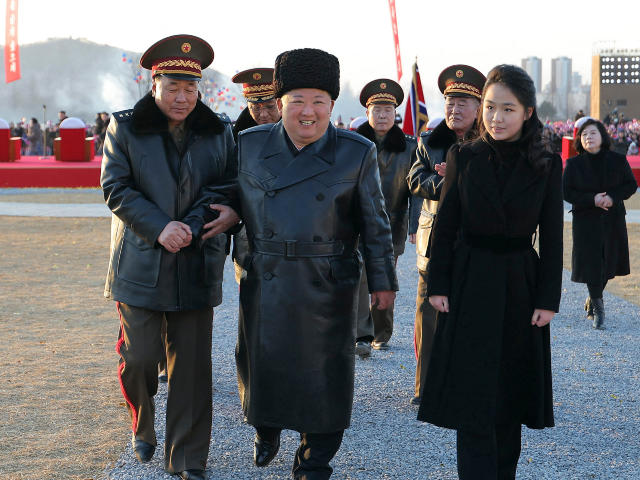

North Korean dictator Kim Jong-un, accompanied by his teenage daughter and presumptive heir Kim Ju-ae, inspected the Communist regime’s first naval destroyer this week.
Kim said he plans to order two more destroyers, as well as a new class of long-range artillery pieces that could strike the South Korean capital of Seoul.
Kim and his daughter paid a visit to the destroyer Choe Hyon on Friday where they were photographed inspecting the bridge and eating with the crew.
According to North Korean state media, Kim pronounced himself satisfied with the maneuvering capabilities of the ship after a cruise of about 120 nautical miles.
If it passes the rest of its tests, the Choe Hyon is scheduled to be formally commissioned in June, with an inaugural cruise that would take it around South Korea.
It was the dictator’s second visit to the new pride of the North Korean navy in a month. On the previous occasion, Kim oversaw cruise and anti-ship missile test launches from the yet-to-be commissioned ship.
The Choe Hyon’s cruise missiles are theoretically nuclear-capable, a point Kim stressed last month by describing the destroyer program as part of the “limitless expansion” of North Korea’s nuclear arsenal.
The 5,000-ton Choe Hyon destroyer is North Korea’s most advanced warship. The second ship in the class, named Kang Kon, embarrassingly capsized and partially sank during its launch ceremony in May 2025. The North Koreans recovered the Kang Kon and relaunched it in June 2025.
Choe Hyon’s 120-mile shakedown cruise this week was the first time the ship has been seen in ocean waters. The Kang Kon has not undergone a navigational or weapons test since it was recovered, and Kim has not inspected the ill-fated ship.
Two more destroyers are currently under construction with completion dates in late 2026. The Kim regime has an ambitious plan to crank out two destroyers per year until it has 12 of them operational in the early 2030s, which would give North Korea the fifth-largest blue-water destroyer fleet in the world, assuming they can all remain afloat. North Korean state media claims the Choe Hyon-class ships have more advanced warfare and navigational capabilities than most of the destroyers fielded by the aging Russian and European fleets.
North Korean’s state KCNA news service said on Friday that a new line of 155mm self-propelled howitzers will be deployed along the border later this year. The new guns have a nominal range of 37 miles, which means they would be able to hit Seoul, the capital city of South Korea.
“Such a rapid extension of striking range and remarkable improvement of striking capability will provide a great change and advantage in the land operations of our army,” Kim pronounced after visiting one of the main factories producing the howitzers on Wednesday.
Kim claimed North Korea will be able to field “three battalion-sized formations” of the new artillery pieces, and placed a high priority on improving the production efficiency of his munitions factories so the weapons can be produced quickly enough.
South Korean researchers say North Korea recently revised its constitution to remove references to “unification” and “ethnic unity” on the Korean peninsula, in line with Kim’s 2023 declaration that the two Koreans should be seen as “two hostile states.”
The revised constitution, written in March, defined North Korea’s land territory as everything between the borders of China, Russia, and the Republic of Korea (South Korea), but did not establish nautical boundaries — a deliberate omission that might have been intended to create room for negotiation with North Korea’s neighbors on maritime rights.
The constitutional revisions seemed to set the stage for belligerence, taken along with Kim’s manic focus on producing destroyers and long-range artillery as quickly as possible, Seoul National University political science expert Lee Jung-chul told the Korea Herald on Wednesday.
“The constitutional revision includes a newly added territorial clause and provisions emphasizing statehood, yet it does not characterize inter-Korean relations as hostile or as relations between belligerent states,” Lee noted.
“In that sense, one could make the hopeful assessment that it may provide part of the institutional groundwork for peaceful coexistence between the two Koreas,” Lee said.
University of North Korean Studies professor Yang Moo-jin said North Korea’s recent moves suggested a surly dictatorship pulling back into its den and growling at Seoul and Washington to leave it alone.
“With regard to territory, North Korea has effectively defined the northern half of the Korean Peninsula. In other words, the southern half of the peninsula belongs to the Republic of Korea, while the northern half belongs to the Democratic People’s Republic of Korea, clearly reinforcing the framework of two separate states,” Yang said.
Khang Vu, a visiting scholar at the Political Science Department at Boston College, wrote at The Diplomat on Thursday that Pyongyang was putting on a show for China and Russia as well.
“Mutual defense clauses in North Korea’s alliance treaties with both do not require Russian and Chinese assistance if North Korea attacks the South first. However, the territorial scope of the clauses is vague because before the constitutional amendments, North Korea’s territory covered the entire peninsula, and it didn’t recognize the Republic of Korea,” he explained.
Kim’s eagerness to build a world-class destroyer fleet could presage trouble on the high seas in the coming years, but Khang noted that North Korea has a long history of misbehavior at sea, and those maritime conflicts have not spilled over into land engagements.
COMMENTS
Please let us know if you're having issues with commenting.