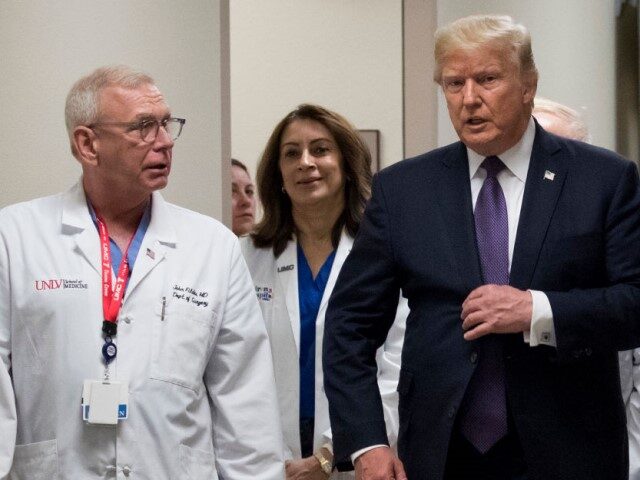
Former President Donald Trump teased during his debate against Kamala Harris that he had “concepts of a plan” for the future of American healthcare; this is what it may look like.
Although Republicans appear slated to take over the Senate majority in November, the GOP will not take over a 60-vote threshold in Congress’s upper chamber.
If Trump were to win the White House, take over the Senate, and hold the House majority, Republicans would have wide latititude to reform heatlhcare without scrapping the fundamental tenets of the Affordable Care Act, or more commonly known as Obamacare.
Republicans would likely use budgetary reconciliation to enact their healthcare reform, much like how they plan to use the relatively arcane process to extend and further Trump’s tax cuts from 2017.
Reconciliation allows lawmakers to pass legislation using a simple majority in the Senate; however, it does not allow Congress to pass or alter policy issues.
Brian Blase, a former Trump White House staffer who now heads the Paragon Health Institute, wrote that a future Trump administration should focus on six aspects:
Stop the vicious cycle of expanding Obamacare subsidies “despite underwhelming results.”
Democrats increased the amount of financial assistance Americans can receive to purchase health insruance through the Obamacare marketplaces through the coronavirus-era stimulus plan, the American Rescue Plan Act in 2021. The subsidies were then extended in 2022 with the passage of the Inflation Reduction Act, which will end in 2025.
The Paragon Institute has noted that, even with enhanced subsidies, “subsidized enrollment is also half of original expectations,” meaning that the subsidies have not drastically increased the number of Americans enrolled on the Obamacare marketplace.
Expand high-quality, affordable coverage options
The Paragon Institute says that a future Trump healthcare reform piece should expand short-term health plans and Association Health Plans (AHPs).
Trump expanded short-term, limited-duration health insurance (STLDI) coverage from three months to 364 days, and allowing the plans to be renewed for up to three years.
Short-term plans often cost less than Obamacare plans because they do not have to comply with all of Obamacare’s insurance regulations, also known as Essential Health Benefits (EHBs). Some health insurers will not cover Americans with pre-existing conditions.
Heritage Foundation health scholar Doug Badger said in a research paper that short-term health plans “offer broader choices of providers and lower premiums for people in good health than Obamacare policies.”
The Paragon Institute also found that the Obamacare plan enrollment, insurer participation, and premium trends were better in states that permitted short-term plans compared to those that did not.
Biden dramatically limited short-term plans, so a potential Trump healthcare plan could bring them back as a viable alternative to unaffordable Obamacare plans.
Trump also expanded Association Health Plans.
The Trump administration rule on AHPs allows small businesses to join together and benefit from the regulatory advantages that many large companies experience under health insurance rules. AHPs can serve employees in a city, county, state, or a particular industry across the nation.
A study from Avalere Health found that Americans would experience drastically lower health premiums through AHPs compared to Obamacare. AHPs would be roughly $2,900 lower per year compared to the small-group market and $9,700 lower per year compared to the individual market. Avalere cites that the lower average premiums in AHPs mostly result from a healthier insurance pool due to “risk selection” and less generous offerings. The Avalere research found that as many as 3.2 million Americans could leave Obamacare for AHPs.
Land O’Lakes announced in November that they created the nation’s first AHP, offering plans nearly 50 percent less expensive than Obamacare.
Give Americans More Control over Federal Healthcare Assistance
The Paragon Institute also said that Americans should have more control over federal cost-sharing assistance by receiving a deposit into a health savings account (HSA) over directly paying insurance companies to lower premiums.
Promote healthcare price transparency
In October 2020, Trump finalized a rule that that would allow more than 200 million Americans with private health insurance to have access to “real-time” price information.
Economists Steve Forbes, Arthur Laffer, and Larry Van Horn wrote in an op-ed in 2020 that Trump’s reform could help families save up to $11,000 per family each year. The economists also noted that Singapore has system-wide healthcare price transparency, and it spends 75 percent less per capita than the United States.
Sen. Mike Braun (R-IN), a longtime advocate for price transparency, has said that enshrining Trump’s transparency rules would be “bigger than Obamacare.”
He and Sen. Bernie Sanders (I-VT), a chief proponent for Medicare for All and chairman of the Senate Health Committee, introduced the Health Care Price Transparency Act.
The legislation, if it were to be included in a Trump healthcare reform package, would ensure that hospitals fully comply with the Trump transparency rules.
A February 2024 report from the Patient Rights Advocate found that only 34.5 percent of hospitals reviewed by the organization fully comply with the federal Price Transparency Rule. The Patient Rights Advocate called on the Centers for Medicare and Medicaid Services (CMS) to ramp up enforcement to ensure that hospitals comply with the Trump rule.
Sean Moran is a policy reporter for Breitbart News. Follow him on X @SeanMoran3.
COMMENTS
Please let us know if you're having issues with commenting.