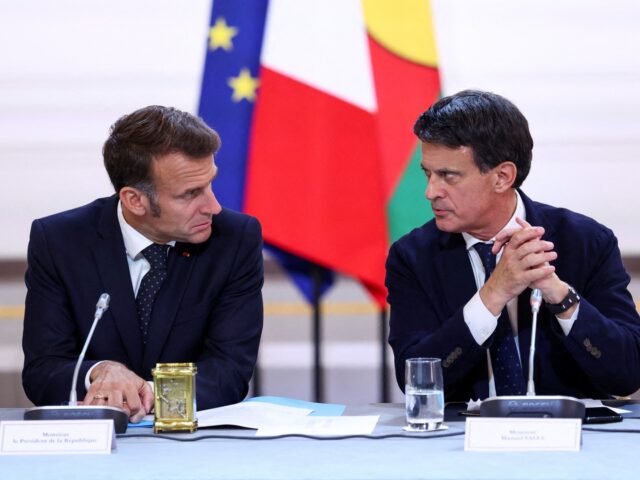

Former French Prime Minister Manuel Valls has branded the second presidential term of Emmanuel Macron as a “shipwreck” that has descended into political chaos and gridlock.
Valls, who led the Socialist government of President François Hollande from 2014 until 2016, before later joining the Macronist faction, warned that the country is facing a “democratic crisis”.
The Barcelona-born politician said in comments reported by Le Figaro that Macron’s second term in office has been “difficult, to say the least,” before adding: “It’s even a shipwreck.”
In 2022, President Macron became the first French head of state to secure a second term in office in two decades, handily defeating National Rally candidate Marine Le Pen. However, the cracks soon began to emerge in the self-styled Jupiterian leader’s armour, with his governing coalition losing its majority in the National Assembly elections just months later.
Having overseen a massive spending spree during the Chinese coronavirus crisis and the government-imposed lockdowns, the former Rothschild investment banker sought to find savings to balance the nation’s books. Macron set his sights on France’s generous pension programme as a means of doing so, advocating for the retirement age to be raised from 62 to 64 years old.
Yet, with both the leftist and Le Penists opposing such a move, arguing that Macron was attempting to shift the burden of his fiscal mistakes onto the working class, and with his coalition being relegated to governing from a minority position, the president’s key agenda item was essentially dead on arrival in the French parliament.
However, Macron’s government — then led by Prime Minister Élisabeth Borne — opted to use the so-called “nuclear option” of invoking article 49.3 of the constitution, which allows for the passing of legislation in the National Assembly without a vote.
The combination of what was perceived as an anti-democratic measure and an attack on the already struggling working class sparked months of labour union strikes and riots, resulting in hundreds of injuries and over a billion dollars in damage to businesses.
While Borne limped on for several more months in the Hôtel Matignon, the collapse in faith in her government ultimately saw her resign at the beginning of 2024. Since then, President Macron has cycled through four different prime ministers, each of whom has failed to steer the ship of state in Paris effectively.
This was in large part a result of Macron’s decision to call for snap legislative elections in June of last year after his party’s embarrassing defeat to Le Pen’s National Rally at the European Parliament elections earlier that month. After seeing the National Rally’s strong performance in the first round of voting, Macron made a “deal with the devil” electoral alliance with the New Popular Front bloc of leftist parties to prevent Le Pen from taking control of the National Assembly.
While this achieved its aim, it also resulted in a near three-way split in the parliament, making the passing of nearly any piece of legislation a monumental task. This was shortly learned by former EU Brexit negotiator Michel Barnier, who became the shortest-tenured Prime Minister in French history after the populist right and left joined forces to collapse his government just 91 days into his tenure over his attempts to pass an austerity budget.
The same fate was met by his successor, François Bayrou, who only managed ten months in office before being voted out by the National Assembly in September. Rather than allowing the public to settle the gridlock with fresh elections, Macron decided to appoint another loyalist, Sébastien Lecornu, who promptly broke Barnier’s record for the shortest premiership, resigning after 26 days before being persuaded by Macron to retake the position days later.
Although Lecornu has said that the controversial 2023 pension reforms would be suspended until after the next presidential election, it remains to be seen if such overtures will quell the divisions in the Assembly to finally pass a national budget. Should he fail to resolve the budget crisis, with debt ballooning to over 116 per cent of GDP last year and deficits running high, France may face hefty financial sanctions from the EU, which mandates countries limit deficits to three per cent of GDP.
The political chaos has taken a toll on Macron’s already low approval ratings, with a survey last month finding that 58 per cent of voters want the president to resign. Furthermore, a staggering 96 per cent said that they are unsatisfied with the state of their country.
Former Prime Minister Valls remarked: “The dissolution is a mistake that he is paying for, but that we are paying for, that the institutions, democracy are paying for, and we can clearly see that this creates conditions of instability… crisis of the regime, a democratic crisis.”
COMMENTS
Please let us know if you're having issues with commenting.