

The Trump Boom Is Here
Welcome back to Friday! This is the Breitbart Business Digest Weekly Wrap, where bring you seven days of data and insight about the economy in a single newsletter. Think of it like the top of the new food pyramid with all the good proteins and fats at the top.
We don’t know quite how to break this to you but you are probably going to have to raise your expectations for the U.S. economy. The data this week show that the economy has been outperforming the forecasts of even the most optimistic analysts. Productivity is soaring, the trade deficit is crashing, the unemployment rate is falling, and GDP appears to be on track for what we’ve come to think of as Kudlow-Compliant Growth. The Trump boom is here, and it has arrived even earlier than expected.
The Supreme Court Headfake: We Have No Tariff Opinions Today
When the Supreme Court announced earlier this week that it was going to issue at least one opinion on Friday, nearly everyone assumed we would get a ruling on the Trump administration’s tariffs. The court heard oral arguments on the case in November and is widely expected to come out with a ruling pronto.
The oral arguments did not appear to go very well for the administration. Several justices—including Chief Justice John Roberts and Justices Amy Coney Barrett and Neil Gorsuch—seemed very skeptical about the administration’s argument that the International Economic Emergency Powers Act of 1977—called Ieepa (and pronouced eye-ee-puh) by sophisticated types—creates the authority to impose sweeping taxes on imports from just about everywhere on earth. The law has been used to impose sanctions and embargoes but not tariffs. In fact, it doesn’t even mention tariffs explicitly and—as several justices noted—no president prior to Trump has claimed Ieepa gave them tariff authority.
So, the consensus expectation is that the Supreme Court will at the very least limit the president’s tariff power under Ieepa and may outright overturn the tariffs. A secondary question is what happens next. It seems unlikely that the Supreme Court would order tens of billions of dollars of tariff refunds, which would create an administrative nightmare and result in windfalls to importers who had pressured foreign suppliers to reduce prices to offset the import duties. But that’s not entirely beyond the realm of the possible. Most likely, the Supreme Court will decide that an emergency power implicitly involves something like a time limit or a more narrow scope for tariffs, allowing the government to keep the funds already collected but requiring the tariffs to expire at some point.
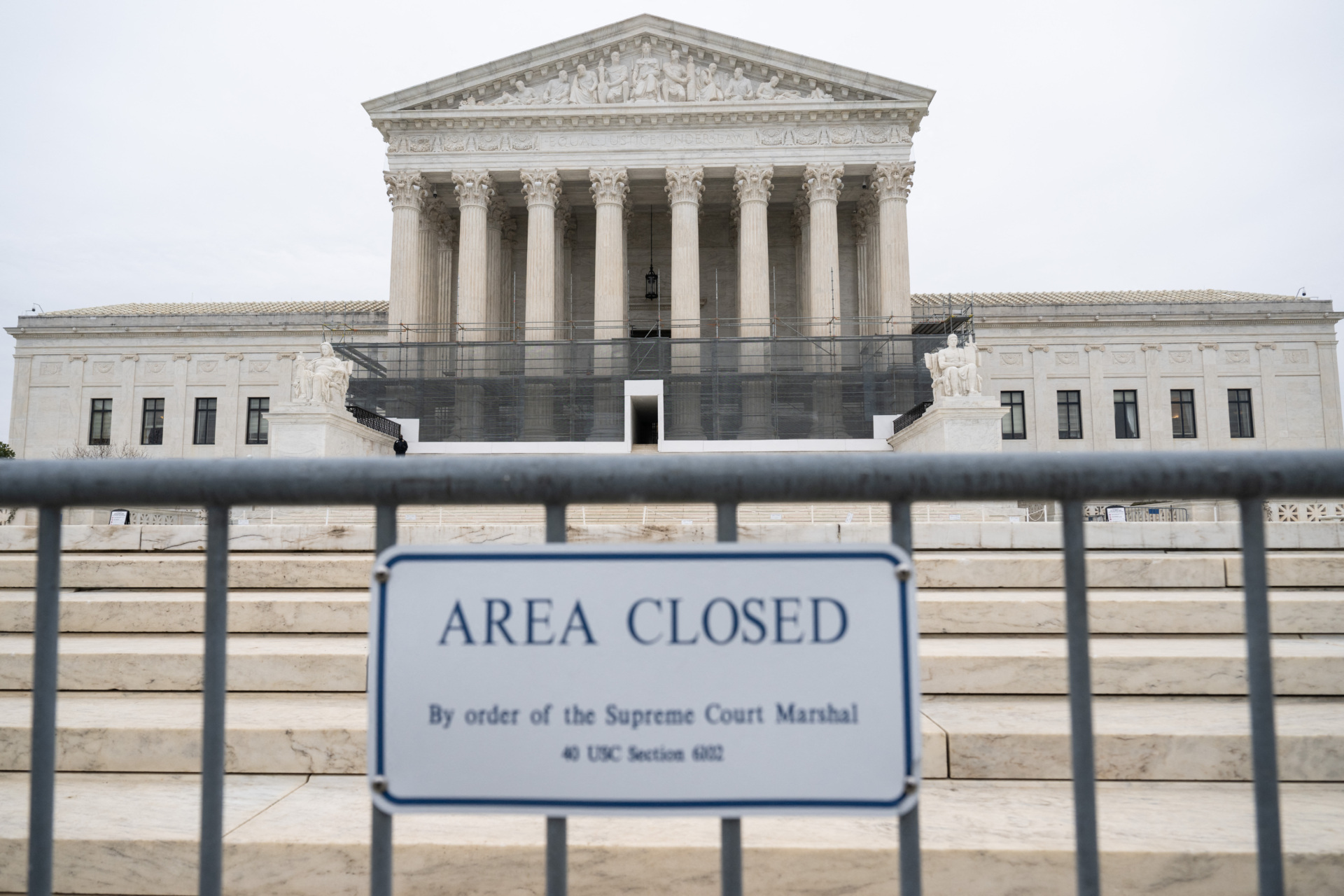
A view of the U.S. Supreme Court in Washington, DC, on January 9, 2026. (SAUL LOEB/AFP via Getty Images)
A secondary question is how the market will react to a tariff decision. Since nearly everyone expects the Supreme Court to knock down the tariffs, this should already be somewhat priced into the market, which means that most of the risk may be to the downside. If the Court turns out to be more open to tariffs under Ieepa than expected, asset prices may take a tumble. If the Court does what’s expected, the market reaction may be an immediate rally that fades as everyone realizes that stocks were already reflecting this outcome.
We’ll have to wait a little longer to find out the answers to these questions because the Supreme Court did not end up issuing its tariff decision on Friday. Instead, a divided court issued a technical ruling in a criminal case that we’re not going to waste your time explaining (or our time reading). If you are interested, you can read it here.
This Is Not Your Father’s Labor Market
We finally had a “jobs Friday” again. It has months since the last time the Bureau of Labor Statistics released a jobs report on the first Friday of the month. As you know, funding authorization for the federal government lapsed at the end of the fiscal year in September. As a result, there was no jobs report released in October. The September report was released a month-and-a half late, on November 20. And a joint report for October and November was not released until the third week in December, on a Tuesday.
But the government is back in business, and so the December jobs report came out on schedule this week. It showed that the unemployment rate unexpectedly fell to 4.4 percent, and the November rate was positively revised down from 4.6 percent to 4.5 percent. (We’ll never get an official rate for October because of the shutdown, creating a forever gap in this long-running data series.) There was a large drop in black unemployment, smaller drops in white and Hispanic unemployment, and Asian unemployment remained unchanged.
The payrolls number fell short of expectations, with the economy adding just 50,000 jobs. For the year, the economy added 584,000 jobs, an average of 49,000 per month. The private sector created 654,000 jobs last year, a monthly average of 54,500. Government payrolls, meanwhile, contracted by 181,000.
The legacy media errantly covered this as if it were a particularly bad result. “2025 was the worst year for hiring since 2020, December jobs report shows: The U.S. added 50,000 jobs last month, a mixed report capping off a difficult year for the labor market,” NBC News incorrectly declared.
Why is this wrong? Because the break-even rate for jobs—the number needed to keep up with the growth of the labor force—is lower than the number of jobs created. While the economy needed over 100,000 each month when President Biden’s policies were flooding the country with illegal immigrants, it now needs far fewer, probably as few as thirty to forty thousand. An average of 49,000 isn’t a difficult year—it’s a good year. It would be “difficult” if we were creating many more jobs because we wouldn’t have the workers to fill them.
Most economists predicted that economic growth would slow significantly if we succeeded in reducing immigration and deporting thousands of inadmissible illegal aliens. That fear was always a bit weird because what really matters for the American people is growth per citizen. You can grow the economy by importing millions without improving the economic circumstances of American citizens. You could annex Mexico, and the economy would grow by the exact size of Mexico’s economy while making American citizens no better off (and likely worse off once taxes and transfer payments are included in the calculation).
More importantly, the predicted slowdown has not happened. The economy is growing at a pace almost no one thought possible. We grew at a 3.8 percent pace in the second quarter of this year and accelerated to a 4.1 percent growth rate in the third quarter. The Atlanta Fed’s GDPNow tracker has us growing at a 5.4 percent pace in the fourth quarter. While that’s probably too optimistic, it makes it clear that the much-heralded slowdown has not happened.
As far as we can tell, no one but our friend Larry Kudlow of Fox Business has been saying the economy could grow this fast.
The Trump Productivity Boom
A big driver of the acceleration of growth appears to be improved productivity. This week the government said productivity rose at an annualized 4.9 percent pace in the third quarter and 4.1 percent in the second quarter, both much better than expected.
What we’re witnessing is a transformation of the growth engine of the economy. Instead of relying on immigration to provide cheap labor, the economy is growing through investment and innovation. As a result, businesses are focusing on capital expenditures—what Treasury Secretary Scott Bessent calls a “cap-ex boom”—to fuel growth.
And this is benefiting workers. Average hourly wages rose 3.8 percent in 2025, outpacing the rate of inflation by a full percentage point. This means that Americans have more purchasing power than they did under Joe Biden, and the Biden-era “affordability crisis” is fading into history.
Tariffs Are Closing the Trade Deficit
Another reason the economy is performing so well is that the trade deficit is narrowing. In October, the trade deficit fell to $29.35 billion, the smallest trade gap since the $27.15 billion recorded in June 2009. And September’s already low $52.83 billion number was revised down to $48.14 billion.
Alan Tonelson points out that “since the deficit ballooned during the first three months of this year in advance of the president’s ‘Liberation Day’ levies that went into effect in April, the combined goods and services deficit has totaled $397.33 billion. That’s down 24.61 percent from the number for the comparable Biden administration pre-tariff months ($527.06 billion).”
This is yet another awkward development for the economics profession. When Trump first began promising to lower the deficit, many economists insisted that it could only be done by shrinking the economy. What’s more, many economists predicted that imposing tariffs would do nothing to the trade deficit—or even raise it when other countries “inevitably” retaliated. Of course, we now know that the forecasted trade war never happened, and instead of retaliatory tariffs we got trade deals.
This was the fifth straight months of rising exports and the second straight record high month. Goods exports are now at a record high. In other words, the world is reacting to Trump’s trade policies by buying more U.S. goods.
Gone Fishing
On January 8, 1675, the New York Fishing Company was chartered by the governor and council of New York. Ownership was divided into shares with a par value of 10 pounds. This is widely regarded as the first shareholder corporation in the American colonies, not counting the British and European chartered trading companies. Happy birthday to shareholder America!
COMMENTS
Please let us know if you're having issues with commenting.