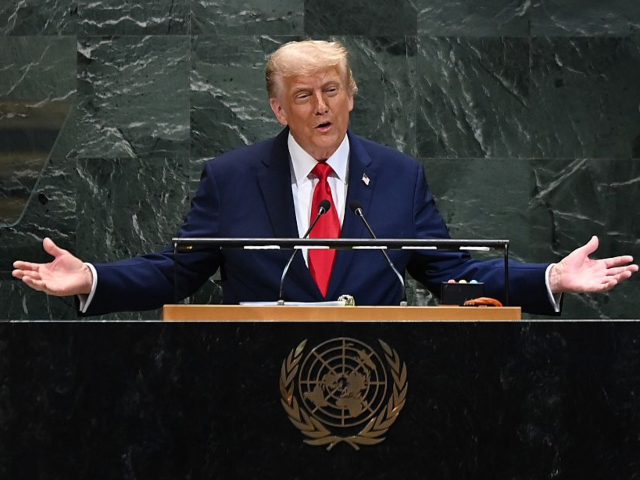

America’s withdrawal from the World Health Organization (W.H.O.) is set to formally conclude on Thursday, a year after the U.S. expressed its intent to depart the United Nations agency and a year and two days after President Donald Trump signed an executive order to begin the process.
President Trump began the withdrawal process on the first day of his second term in office, signing the executive order alongside a similar decree exiting the Paris climate agreement. Trump had initially withdrawn from the W.H.O. during his first term in office, but former President Joe Biden chose to re-enter the organization, costing America tens of millions of dollars.
The W.H.O.’s leader, Director-General Tedros Adhanom Ghebreyesus, has spent much of the past year warning that the withdrawal of the member state that previously spent the most to fund the agency would prompt a financial catastrophe that would significantly damage the W.H.O.’s ability to respond to health emergencies. Upon withdrawing both times, however, Trump argued that it was precisely the W.H.O.’s incompetence in responding to health emergencies, particularly the Wuhan coronavirus pandemic, that informed the decision. W.H.O.
“The United States noticed its withdrawal from the World Health Organization (W.H.O.) in 2020 due to the organization’s mishandling of the COVID-19 pandemic that arose out of Wuhan, China, and other global health crises,” Trump’s executive order read, “its failure to adopt urgently needed reforms, and its inability to demonstrate independence from the inappropriate political influence of W.H.O. member states.”
“In addition, the W.H.O. continues to demand unfairly onerous payments from the United States, far out of proportion with other countries’ assessed payments,” the executive order continued. “China, with a population of 1.4 billion, has 300 percent of the population of the United States, yet contributes nearly 90 percent less to the W.H.O.”
Speaking to reporters on January 20, 2025, Trump detailed, “so we paid $500 million to [the] World Health Organization when I was here, and I terminated it. China, with 1.4 billion people… let’s say we have 325, they have 1.4 billion, they were paying $39 million, we were paying $500 million. Seemed a little unfair to me, so that wasn’t the reason, but I dropped out.”
The W.H.O. lamented the decision at the time, issuing a statement urging, “We hope the United States will reconsider and we look forward to engaging in constructive dialogue to maintain the partnership between the U.S.A. and W.H.O.”
The Communist Party of China, whose relationship with the W.H.O. was among the reasons for Trump’s withdrawal, condemned the United States in its state propaganda arms on the occasion of the end of the withdrawal period, complaining that Washington has not paid alleged outstanding debts to the agency.
A regime-approved “expert,” researcher Lü Xiang, told the state-run Global Times that the United States not paying tens of millions of dollars more to an organization to which it no longer belongs “reflects a longstanding irresponsible attitude.” Lü went on to claim that the withdrawal “will have far-reaching and lasting negative consequences for the U.S. itself” and that not being a member of the agency would turn America into an “information silo” unable to communicate with any other country. Lü did not explain why the State Department or any of America’s many diplomatic vehicles were insufficient to communicate with other countries in the event of a public health emergency.
The Reuters news agency reported on Thursday that America still owes the W.H.O. $260 million. The W.H.O. told Reuters it would discuss the situation at its next executive board meeting. The State Department, meanwhile, offered, “the American people have paid more than enough to this organization and this economic hit is beyond a down payment on any financial obligations to the organization.” The W.H.O. does not have any enforcement arm to coerce countries into paying alleged debts or taking any other action.
Tedros, the W.H.O. leader, suggested in April that the U.S. withdrawal would force the agency to reduce spending by over 20 percent. While initially describing the withdrawal as a disaster, Tedros has since reframed it as an “opportunity” for the W.H.O. to become more independent.
“Just as the world was starting to recover, sudden and severe cuts in foreign aid have once again hit the poorest and most vulnerable communities the hardest,” Tedros said on Wednesday in remarks at the World Economic Forum (WEF) in Davos, Switzerland. “Many countries have had the aid rug pulled out from underneath them and are now facing an acute health financing crisis.”
“At the same time,” he continued, “many countries are seeing this crisis as an opportunity — an opportunity to transition away from aid dependency towards self-reliance, based on domestic resources.”
Tedros took credit for shifting away from relying on America too much for money, though he never mentioned the United States by name in his comments.
“When I began as Director-General in 2017, we identified W.H.O.’s over-reliance on a handful of donors as a major strategic risk,” he alleged, “with the potential to compromise our independence, and to expose us to a financial shock like the one we had last year. Over the past eight years, we have taken several steps to mitigate that risk, as part of a comprehensive set of reforms we call the W.H.O. Transformation.”
“All of us must recognize that there will be no going back to the way things were,” Tedros concluded. “Parts of the global health architecture are being demolished and rebuilt around us. But there can be no doubt that W.H.O. is — and must continue to be — at the center of that architecture.”
COMMENTS
Please let us know if you're having issues with commenting.